| Fixed star: MINTAKA | |
| Constellation: Delta (δ) Orion | |
| Longitude 1900: 21GEM00 | Longitude 2000: 22GEM24 |
| Declination 1900: +00.18′ | Declination 2000: +00.21′ |
| Right ascension: 05h 31m | Latitude: -22.53′ |
| Spectral class: O9 | Magnitude: 2.5 |
The history of the star: Mintaka
from p.314 of Star Names, Richard Hinckley Allen, 1889.
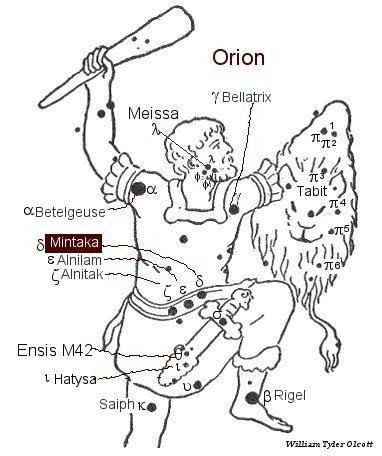 Delta (δ) Orion, Mintaka, is a double and slightly variable star, 2.4 and 6.8, brilliant white and pale violet, the west star in the Belt of the Hunter.
This star delta (δ Mintaka), along with epsilon (ε Alnilam) and zeta (ζ Alnitak) form the Belt of Orion the Hunter.
Mintaka, from Al Mintakah, the Belt, Burritt’s Atlas of 1856 has it Mintika
Mintaka at the west end is the first star of the belt stars seen to rise. Astrologers considered it of importance as portending good fortune.
It is about 23′ of arc south of the celestial equator.
Star Names, Their Lore and Meaning, Richard Hinckley Allen, 1889].
The Belt of Orion
from p.315 of Star Names, Richard Hinckley Allen, 1889.
[A scanned copy can be viewed on this webpage
“Orion’s studded belt” – Scott’s Lay of the Last Minstrel
Epsilon (ε Alnilam), zeta (ζ Alnitak), and delta (δ Mintaka), form the Belt across the middle of Orion
These three stars are one of the most obvious features people see in the sky, and are formed in a row that appear to us of almost equal size and of equal distance from each other; Mintaka, the westernmost star in the belt, comes from the Arabic word for “belt” Alnilam, the center star in the belt, means “a belt of pearls” and Alnitak, the eastern-most star, means the girdle.
These Arabian titles of delta (δ), epsilon (ε), and zeta (ζ), although now applied to them individually, were at first indiscriminately used for the three together; but they had other names also,— Al Nijad, the Belt; Al Nasak, the Line; Al Alkat, the Golden Grains, Nuts, or Spangles; and Fakar al Jauzah, the Vertebrae in the Jauzah’s (Orion‘s) back. Niebuhr cited the modern Arabic Al Mizan al H-akk, the Accurate Scale-beam, so distinguishing them from the curved line of the fainter , theta (θ), iota (ι), , and kappa (κ), Al Mizan al Batil, the False Scale-beam. The Chinese similarly knew them as a Weighing-beam, with the stars of the sword as a weight at one end.
They were the Jugula and Jugulae of Plautus, Varro, and others in Roman literature; the Balteus, or Belt, and the Vagina, or Scabbard, of Germanicus. The Zona of Ovid (43 B.C.-18?A.D.) may have been taken from the Zone of Aristotle.
The early Hindus called them Isus Trikanda, the Three-jointed Arrow; but the later transferred to it the nakshatra (Hindu Moon Mansion) title, Mrigashiras
The Sogdian Iranian Rashnawand and the Khorasmian (east of Persia) Khawiya have significations akin to our word “Rectitude,” which this straight line of stars personified. The Rabbi Isaac Israel said that it was the Mazzaroth, Mazzaloth, or Mazlatha that most of his nation applied to the zodiac.
The Italian astronomer Riccioli (1598-1671) cited Baculus Jacobi, which became in popular English speech Jacob’s Rod or Staff,—the German Jakob Stab,— from the tradition given by Eusebius that Israel was an astrologer, as, indeed, he doubtless was; and some had it Peter’s Staff. Similarly, it was the Norse Fiskikallar, or Staff; the Scandinavian Frigge Rok, Frigg’s, or Freya’s, Distaff,— in West Gothland Frigge Rakken— and Maria Rok, Mary’s Distaff; in Schleswig, Peri-pik. In Lapland it was altered to Kalevan Miekka, Kaleva’s Sword, or still more changed to Niallar, a Tavern; while the Greenlanders had a very different figure here,— Siktut, the Seal-hunters, bewildered when lost at sea, and transferred together to the sky.
The native Australians knew the stars as Young Men dancing a corroboree, the Pleiades being the Maidens playing for them; and the Poignave Indians of the Orinoco, according to Von Humboldt, as Fuebot, a word that he said resembled the Phoenician.
The University of Leipsic, in 1807, gave to the Belt and the stars in the Sword the new title Napoleon, which a retaliating Englishman offset by Nelson; but neither of these has been recognized on star-maps or globes.
{p.316} Seamen have called it the Golden Yard-arm; tradesmen, the , or Ell, the Ell and Yard, the Yard-stick, and the Yard-wand, as occupying 3° between the outer stars,— the Elwand of Gavin Douglas; Catholics, Our Lady’s Wand; and the husbandmen of France and along the Rhine, Rateau, the Rake. In Upper Germany it has been the Three Mowers; and it is often the Magi, the Three Kings, the Three Marys, or simply the Three Stars, that Tennyson had in his Princess,—
“those three stars of the airy Giants’ zone
That glitter burnished by the frosty dark.”
The celestial equator now passes through the Belt, but was 12° below it 4000 years ago.
Star Names, Their Lore and Meaning, Richard Hinckley Allen, 1889].
The astrological influences of the constellation Orion
Legend: The giant Orion was created out of an ox-hide by the Gods, Jupiter, Neptune and Mercury, at the request of Hyreus who had entertained them. He was blinded by Oenopion (the name means “wine-faced”) for having raped Merope, Oenopion’s daughter, but recovered his sight by exposing his eyes to the rising sun. In consequence of his boast that he could slay any beast bred upon the earth the scorpion (Scorpius) was brought forth and Orion died from its sting. [Robson, p.55.]
Influences: According to Ptolemy the bright stars with the exception of Betelgeuze and Bellatrix are like Jupiter and Saturn. It is said to give a strong and dignified nature, self-confidence, inconstancy, arrogance, violence, impiety, prosperity in trade and particularly by voyages or abroad, but danger of treachery and poison. It was thought by the Romans to be very harmful to cattle and productive of storms. By the Kabalists it is associated with the Hebrew letter Aleph and the 1st Tarot Trump “The Juggler.” [Robson, p.55.]
The astrological influences of the constellation Orion given by Manilius:
“Near neighbor to the Twins (Gemini), Orion may be seen stretching his arms over a vast expanse of sky and rising to the stars with no less huge a stride. A single light marks each of his shining shoulders, and three aslant trace the downward line of his sword: but three mark Orion’s head, which is imbedded in high heaven with his countenance remote. It is Orion who leads the constellations as they speed over the full circuit of heaven.” [Astronomica, Manilius, 1st century AD. p.35.]
Orion will fashion alert minds and agile bodies, souls prompt to respond to duty’s call, and hearts which press on with unflagging energy in spite of every trial. A son of Orion’s will be worth a multitude and will seem to dwell in every quarter of the city; flying from door to door with the one word of morning greeting, he will enjoy the friendship of all.” [Astronomica, Manilius, 1st century AD. p.305.]
The astrological influences of the star Mintaka
Note: Robson gives influences for Mintaka and Alnilam separately and jointly under Cingula Orionis; the Belt of Orion.
According to Ptolemy Mintaka is of the nature of Saturn and Mercury; and to Alvidas, of Mercury, Saturn and Jupiter. It gives good fortune. [Robson, p.177.]
General influence of the Cingula Orionis (Orion’s Belt): The joint influence is to give strength, energy, industry, organizing abilities, notoriety, good fortune, lasting happiness, a sharp mind and a good memory. [Robson, p.156.]
When rising, Alnilam, together with Alnitak and Mintaka, portend irreligious and treacherous individuals. These stars in medieval times were said to presage those who were “passionately devoted to hunting, but not noble hunting with falcon or bow”. Aspected by Saturn, the indications are for excellent fishermen, and in a female chart, any of these three stars rising or aspected by both Mars and a benefic portend a shrew. When setting and aspected by Mars any of these three stars indicate individuals who will incur all kinds of dangers. Mintaka alone portents good fortune as regards the growing of grain crops. [Fixed Stars and Judicial Astrology, George Noonan, 1990, p.44.]
Cingula Orionis with a malefic and the Moon at the same time with Markab (23 Pisces): death at human hands. [Robson, p.157.]
Cingula Orionis rising: Legacies, love or dissipation, gravity and austerity. [Robson, p.156.]
Mintaka with Sun: Discreet, cautious, somewhat changeable. [Robson, p.177.]
Cingula Orionis with Sun: Notoriety, good fortune, lasting happiness. [Robson, p.157.]
Mintaka with the Moon: Active, sharp, alert in business, public position, many enemies more successful in business. [Robson, p.177.]
Cingula Orionis with Moon: Blindness of at least one eye, new and influential friends, valuable gifts, love of respectable women. If a malefic be with Markab, drowning. If the moon is with Saturn also, drowning and assassination. [Robson, p.157.]
With Mercury: Studious, fond of seclusion, deliberate and fixed mind, little sympathy or disagreements with relatives. [Robson, p.177.]
With Venus: Public position, enmity of women, love disappointments. [Robson, p.177.]
With Mars: Energetic, quick mind, good speaker and debater, quarrelsome, strong passions. [Robson, p.178.]
With Jupiter: High position in law or church, studious and philosophical mind, gain through inheritance. [Robson, p.178.]
With Saturn: Far-seeing, studious, good judge of human nature, psychic, domestic disharmony, sickness to family. [Robson, p.178.]
With Uranus: Selfish, studious, eccentric, difficult to get on with, losses through lawsuits and business, successful in middle age but poverty at end of life, favorable for domestic matters, death from consumption. [Robson, p.178.]
With Neptune: Thoughtful, studious, keeps discoveries to himself, sarcastic writer, generous but not wealthy, rarely marries, death unattended in old age. [Robson, p.178.]
References:
Fixed Stars and Constellations in Astrology, Vivian E. Robson, 1923].