Constellations of Words
Explore the etymology and symbolism of the constellations
the chameleon, Well Hidden
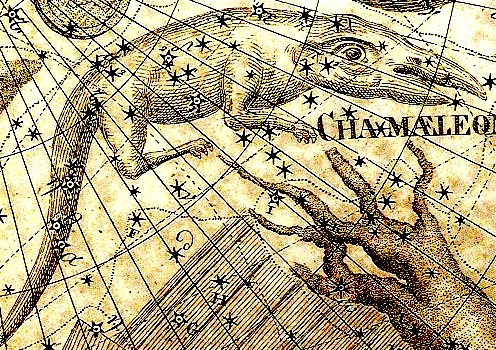
Johann Bode,Uranographia, 1801
Contents:
1. Clues to the meaning of this celestial feature
2. The fixed stars in this constellation
3. History_of_the_constellation
Clues to the meaning of this celestial feature
This constellation, Chamaeleon, is adjacent to Octans which contains the South Pole. The name ‘chameleon‘ means ‘Earth lion’, or ‘lion of the earth’, and is derived from the Greek words chamai (on the ground, on the earth) and leon (lion).
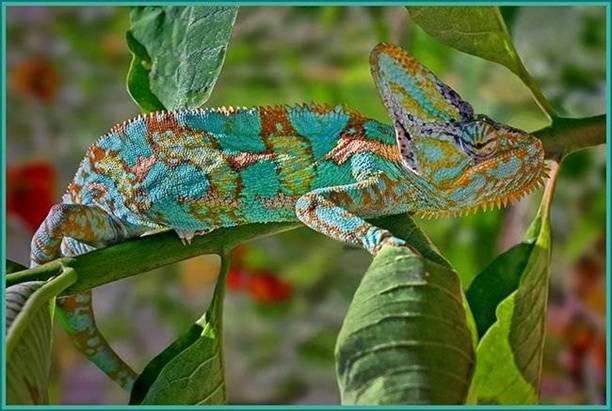 Main features of the chameleon: Skin changes color to camouflage itself. The eyes can move in different directions simultaneously, can rotate to observe two different objects simultaneously giving a full 360-degree arc of vision around their body. Long tongues, sometimes longer than their own body length, with suction cap at the tip.
Chamaeleon, chamae + lion, the prefix chamae comes from the Indo-European root *dhghem- ‘Earth’. Derivatives: bridegroom, (bride-groom, from Old English guma, man), chthonic (Greek khthon, Earth), autochthon (one of the earliest known inhabitants of a place; an aborigine. An indigenous plant or animal), chamaephyte (a low-growing perennial plant whose dormant overwintering buds are borne at or just above the surface of the ground), chameleon, chamomile, germander, (these words from Greek khamai, on the ground), humble, humiliate, humility, humus¹, omerta, exhume, inhume, transhumance, (these words from Latin humus, earth, earthling), homage, hombre¹, hominid, homo¹, homunculus, ombre, bonhomie, homicide, (these words from Latin homo, human being, man), human, humane, (from Latin humanus, human), chernozem (Russian for ‘black earth’, chërnyi, black + zemi, earth), sierozem, zemstvo, (these words from Old Russian zemi, land, earth), zamindar (from Persian zamin, earth, land). [Pokorny ghdem– 414. Watkins] The ‘homo‘ of ‘homo sapiens’ is a Latin word meaning ‘human being, man’. The ‘homo‘ of ‘homo sapiens’ has no connection with the ‘homo-‘ of homosexual.
Humans, or human beings, are bipedal primates belonging to the species Homo sapiens (Latin: ‘wise man’ or ‘knowing man’, modern humans) in the family Hominidae (the great apes) [].
The theoichthonioi, were the gods of the nether or underworld.
“The word ‘human‘ itself is from Latin humanus, an adjective cognate to homo, both derived from Proto-Indo-European language dhghem ‘earth’. Compare Hebrew adam, meaning ‘human’, cognate to adamah, meaning ‘ground’. (And compare Latin humus, meaning ‘soil’.) Both homohumanushumus and adamadamah share a conjectured Nostratic superroot, ad-ham” []. “Adam was, as his prototype Atum in Egypt, the first formation in the worlds above of the mind-in-matter combination. He was the archetypal model in ethereal mold of the earthly man to be” [].
The word chameleon can be resolved into ‘the human lion’ – ‘the humus lion’.
Life in Cold Blood Chameleon by David Attenborough is a fascinating ten minute YouTube video on chameleons.
© Anne Wright 2008.
| Fixed stars in Chamaelon | |||||||
| Star | 1900 | 2000 | R A | Decl 1950 | Lat | Mag | Sp |
| alpha | 27SCO56 | 29SCO19 | 124 57 45 | -76 45 44 | -75 24 15 | 4.08 | F5 |
| gamma | 29SCO03 | 00SAG26 | 158 43 26 | -78 20 54 | -68 04 39 | 4.10 | M0 |
| beta | 04SAG04 | 05SAG27 | 183 50 34 | -79 02 05 | -63 35 15 | 4.38 | B5 |
History of the constellation
from Star Names 1889, Richard H. Allen
Chameleon is the German Chamaleon, the French Cameleon, and the Italian Camaleonte, is a small and unimportant constellation below Carina, Octans separating it from the south pole. It was first published and figured by Bayer among his new constellations from observations by navigators of the preceding century. Pontanus, in Chilrnead’s Treatise, included it with Musca as “the Chamaeleonwiththeflie“; but Julius Schiller entirely changed its character by combining it with Apus and Musca in his biblical Eve
None of its stars seem to be named except in China, where some of the larger were SeaouTow, a small Measure or Dipper, that our alpha, theta, eta, iota, epsilon, mu, and mu well show.
Star Names: Their Lore and Meaning, Richard H. Allen, 1889.]