| Fixed star: MEKBUDA | |
| Constellation: Zeta (ζ) Gemini | |
| Longitude 1900: 13CAN36 | Longitude 2000: 14CAN59 |
| Declination 1900: +20.43′ | Declination 2000: +20.34′ |
| Right ascension: 07h 03m | Latitude: -02.02′ |
| Spectral class: G0 | Magnitude: 3.8 Variable |
The history of the star: Mekbuda
from p.235 of Star Names, Richard Hinckley Allen, 1889.
[A scanned copy can be viewed on this webpage
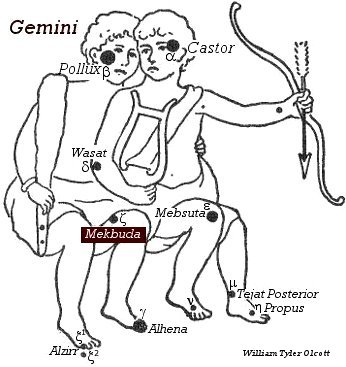
Zeta (ζ) Gemini, Mekbuda, is a variable star, 3.7 to 4.5, pale topaz, on the right leg of the Twin Pollux
Mekbuda is from Al Makbudah, Contracted, the Arabic designation for the drawn-in paw of the ancient Asad*; but some, with less probability, derive it from Al Mutakabbidah, a Culminating Star.
* Arabs had an enormous Lion, their early Asad, extending over a third of the heavens, of which the stars Arcturus and Spica were the shin-bones; Regulus, the forehead; the heads of Gemini, one of the fore paws; Canis Minor, the other; and Corvus, the hind quarters. Many Arab starnames come from this tradition. Star Names p.97.
Star Names, Their Lore and Meaning, Richard Hinckley Allen, 1889].
The astrological influences of the constellation Gemini
Legend: The constellation represents Castor and Pollux, the twin sons of Leda and Jupiter. It has also been suggested that it may represent Apollo and Hercules. [Robson, p.45.]
Influences: Ptolemy makes the following observations; the stars in the feet of Gemini have an influence similar to that of Mercury, and moderately to that of Venus; the bright stars in the thighs are like Saturn. It is said to cause trouble and disgrace, sickness, loss of fortune, affliction and danger to the knees. By the Cabalists it is associated with the Hebrew letter Qoph and the 19th Tarot Trump, The Sun”. [Robson, p.46.]
The astrological influences of the constellation Gemini given by Manilius:
“The arms to shoulders joined are accounted to the Twins” [Manilius, p.119.]
“From the Twins come less laborious callings and a more agreeable way of life, provided by varied song and voices of harmonious tone, slender pipes, the melodies inborn in strings and the words fitted thereto: those so endowed find even work a pleasure. They would banish the arms of war, the trumpet’s call, and the gloom of old age: theirs is a life of ease and unfading youth spent in the arms of love. They also discover paths to the skies, complete a survey of the heavens with numbers and measurements, and outstrip the flight of the stars: nature yields to their genius, which it serves in all things. So many are the accomplishments of which the Twins are fruitful.” [Manilius, Astronomica, 1st century AD. p.281.]
References:
Fixed Stars and Constellations in Astrology, Vivian E. Robson, 1923].