| Fixed star: JABBAH | |
| Constellation: Nu (ν) Scorpius | |
| Longitude 1900: 03SAG15 | Longitude 2000: 04SAG39 |
| Declination 1900: -19.12′ | Declination 2000: -19.27′ |
| Right ascension: 16h 11m | Latitude: +01.37′ |
| Spectral class: B2 | Magnitude: 4.3 |
The history of the star: Jabbah
from p.371 of Star Names, Richard Hinckley Allen, 1889.
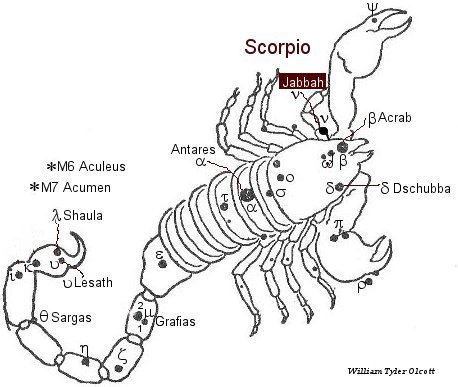 Nu (ν) Scorpius, Jabbah, is a quadruple, “double double”, star on the head of the Scorpion, lying east of beta (β Acrab).
Jabbah in the Century Cyclopedia, perhaps from its being one of the 15th manzil (Arabic Moon Mansion) Iklil al Jabhah, “the Crown of the Forehead”.
The Arabic spelling for this star is Al-Jabhah (), “The forehead” of the scorpion, Scorpius. This star, Jabbah (nu), along with the other stars on the Head of the Scorpion; Acrab (beta), and Dschubba (delta), were the Euphratean Gis-gan-gu-sur, “the Light of Hero”, or “the Tree of the Garden of Light “. In Mesopotamian these were Jia Jan Ju Sur which seems to have meant “the forbidden Tree of Life in Eden” [Star Names, under Acrab].
Star Names, Their Lore and Meaning, Richard Hinckley Allen, 1889].
The Lunar Mansions
This star in the head of the Scorpion is named Jabbah in the Century Cyclopedia, perhaps from its being one of the 15th manzil (Arabic Moon Mansion) Iklil al Jabhah, “the Crown of the Forehead”. The 15th manzil included Acrab (β Scorpius), delta (δ, Dschubba) and pi (π); some authorities occasionally adding nu (ν, Jabbah, as the name of the manzil would suggest; Jabhab) and rho (ρ). This was one of the fortunate stations, and from this manzil title comes the occasional Iclil (Arabic for a jewel).
Influences of the 15th Arabic Moon Mansion Iklil al Jabhah: Improves misfortune, makes love durable, strengthens buildings and helps seamen.
With Moon transiting here: build, sow, plant, navigate but do not marry. [Robson, p.73.]
The astrological influences of the constellation Scorpius
Ptolemy makes the following observations: “The bright stars in the front of the body of Scorpio have an effect similar to that produced by the influence of Mars, and partly to that produced by Saturn: the three in the body itself . . . are similar to Mars and moderately to Jupiter: those in the joints of the tail are like Saturn and partly like Venus: those in the sting, like Mercury and Mars.” By the Kabalists Scorpio is associated with the Hebrew letter Oin and the 16th Tarot Trump “The Lightning-Struck Tower.” [Robson, p.60-61.]
The astrological influences of the constellation Scorpio given by Manilius:
“The Scorpion presides over arms” [Manilius, Astronomica, 1st century AD, book 4, p.253]
“By virtue of his tail armed with its powerful sting, wherewith, when conducting the Sun’s chariot through his sign, he cleaves the soil and sows seed in the furrow, the Scorpion creates natures ardent for war and active service, and a spirit which rejoices in plenteous bloodshed and in carnage more than in plunder. Why, these men spend even peace under arms; they fill the glades and scour the woods; they wage fierce warfare now against man, now against beast, and now they sell their persons to provide the spectacle of death and to perish in the arena, when, warfare in abeyance, they each find themselves foes to attack. There are those, too, who enjoy mock-fights and jousts in arms (such is their love of fighting) and devote their leisure to the study of war and every pursuit which arises from the art of war.” [Manilius, Astronomica, 1st century AD, p.239-240].
References:
Fixed Stars and Constellations in Astrology, Vivian E. Robson, 1923].