| Fixed star: HATSYA | |
| Constellation: Iota (ι) Orion | |
| Longitude 1900: 21GEM36 | Longitude 2000: 23GEM00 |
| Declination 1900: -05.59′ | Declination 2000: -05.54′ |
| Right ascension: 05h 35m | Latitude: -29.11′ |
| Spectral class: O9 | Magnitude: 2.9 |
The history of the star: Hatsya
from p.317 of Star Names, Richard Hinckley Allen, 1889.
[A scanned copy can be viewed on this webpage
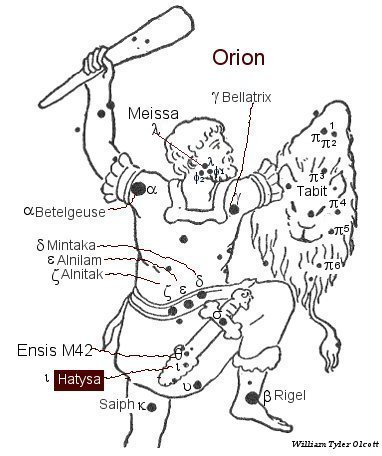 Iota (ι) Orion, Hatsya, is a triple and nebulous star, 3.5, 8.5, and 11, white, pale blue, and grape red in the sword tip of the Hunter, the brightest star in Orion’s sword.
Al Tizini (Arabian astronomer, first half of 16th century) designated this as Na’ir al Saif, the Bright One in the Sword, but it is practically unnamed with us [Wikipedia says it is a traditional name; “sometimes with the typographic error Hatysa.”], although far more deserving of the title Saiph than is the succeeding star kappa (κ Saiph).
In China it was Fa, a Middle-man, upsilon (υ) and intermediate stars being included under this name; but Edkins translates the word “Punishment,” and gives another title for it, — Tui, or Jui, the Sharp Edge, analogous to the Arabian Saif and perhaps taken from it.
Star Names, Their Lore and Meaning, Richard Hinckley Allen, 1889].
The astrological influences of the constellation Orion
Legend: The giant Orion was created out of an ox-hide by the Gods, Jupiter, Neptune and Mercury, at the request of Hyreus who had entertained them. He was blinded by Oenopion (the name means “wine-faced”) for having raped Merope, Oenopion’s daughter, but recovered his sight by exposing his eyes to the rising sun. In consequence of his boast that he could slay any beast bred upon the earth the scorpion (Scorpius) was brought forth and Orion died from its sting. [Robson, p.55.]
Influences: According to Ptolemy the bright stars with the exception of Betelgeuze and Bellatrix are like Jupiter and Saturn. It is said to give a strong and dignified nature, self-confidence, inconstancy, arrogance, violence, impiety, prosperity in trade and particularly by voyages or abroad, but danger of treachery and poison. It was thought by the Romans to be very harmful to cattle and productive of storms. By the Kabalists it is associated with the Hebrew letter Aleph and the 1st Tarot Trump “The Juggler.” [Robson, p.55.]
The astrological influences of the constellation Orion given by Manilius:
“Near neighbor to the Twins (Gemini), Orion may be seen stretching his arms over a vast expanse of sky and rising to the stars with no less huge a stride. A single light marks each of his shining shoulders, and three aslant trace the downward line of his sword: but three mark Orion’s head, which is imbedded in high heaven with his countenance remote. It is Orion who leads the constellations as they speed over the full circuit of heaven.” [Astronomica, Manilius, 1st century AD. p.35.]
Orion will fashion alert minds and agile bodies, souls prompt to respond to duty’s call, and hearts which press on with unflagging energy in spite of every trial. A son of Orion’s will be worth a multitude and will seem to dwell in every quarter of the city; flying from door to door with the one word of morning greeting, he will enjoy the friendship of all.” [Astronomica, Manilius, 1st century AD. p.305.]
References:
Fixed Stars and Constellations in Astrology, Vivian E. Robson, 1923].