| Fixed star: CAPELLA Amalthea | |
| Constellation: Alpha (α) Auriga | |
| Longitude 1900: 20GEM28 | Longitude 2000: 21GEM51 |
| Declination 1900: +45.54′ | Declination 2000: +46.00′ |
| Right ascension: 05h 16m | Latitude: +22.51′ |
| Spectral class: GG | Magnitude: 0.08 |
The history of the star: Capella
from p.86 of Star Names, Richard Hinckley Allen, 1889.
[A scanned copy can be viewed on this webpage
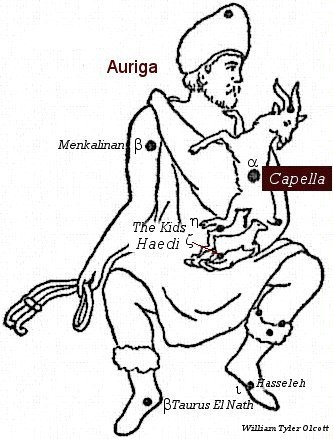 Alpha (α) Auriga, Capella, is a white star and the 6th largest star in the sky marking the goat that the Charioteer is carrying on his left shoulder.
This has been known as Capella, the Little She-goat, since at least the times of Manilius, Ovid, and Pliny, all of whom followed the (Greek) KinesaiCheimonas (kinesai kheimonas) of the Greek astronomer Aratus, circa 270 B.C., in terming it a Signum pluviale (rainy constellation) like its companions the Haedi (the two stars depicted as kid goats, offspring of Capella – Zeta, Hoedus 1 and Eta Auriga, Hoedus 11), thus confirming its stormy character throughout classical days. Pliny called it the rainy Goat-starre; Pliny and Manilius treated it as a constellation (signum) by itself, also calling it Capra, Caper, Hircus, and by other hircine titles.
Our word is the diminutive of Capra, sometimes turned into Crepa, and more definitely given as Olenia (a place in Greece), Olenie, Capra Olenie, and the Olenium Astrum of Ovid’s Heroides. In the present day the star is Cabrilla with the Spaniards, and Chevre with the French.
A previous name of this star was Amalthea which came from the name of the Cretan goat, the nurse of Jupiter and mother of the Haedi (the two stars depicted as kid goats, offspring of Capella or Amalthea – Zeta, Hoedus 1 and Eta Auriga, Hoedus 11), which she put aside to accommodate her foster-child (Jupiter/Zeus/Jove), and for which Manilius wrote:
“The Nursing Goat’s repaid with Heaven.”
From this came the occasional Jovis Nutrix (Nurse of Jove).
{p.87} But, according to an earlier version, the nurse was the nymph Amalthea, who, with her sister Melissa (who is identified with the constellation Ursa Minor), fed the infant god with goat’s milk and honey on Mount Ida, the nymph Aige being sometimes substituted for one or both of the foregoing; or Adrasta, with her sister Ida, all daughters of the Cretan king Melisseus (“bee-man”). Others said that the star represented the Goat’s horn broken off in play by the infant Jove and transferred to the heavens as Cornucopiae, the Horn of Plenty, a title recalled by the modern Lithuanian Food-bearer. In this connection, it was Amaltheias keras, also brought absurdly enough into the Septuagint as a translation of the words Kerenhappuch, the Paint-horn, or the Horn of Antimony, of the Book of Job xlii, 14,— the Comus tibii of the Vulgate, the second-century Greek astronomer Ptolemy’s Aix probably became the Arabo-Greek Aiouk of the Graeco-Persian the 14th century Greco-Persian astronomer Chrysococca’s book, and the Ayyuk, Alhajoc, Alhajoth, Alathod, Alkatod, Alatudo, Atud, etc., which it shared with the constellation; but Ideler thought Ayyuk an indigenous term of the Arabs for this star. Assemani’s Alcahela may have come from Capella. The Tyrians called it Iyutha, applied also to Aldebaran and perhaps to other stars; but the Rabbis adopted the Arabic Ayyuk as a title for their heavenly Goat, although they greatly disagreed as to its location, placing it variously in Auriga, Taurus, Aries, and Orion. The “armborne she goat,” however, of the Greek astronomer Aratus, circa 270 B.C., derived from the priests of Zeus, would seem to fix it positively where we now recognize it. The 17th century English orientalist Thomas Hyde devoted three pages of learned criticism to this important (!) subject, but insisted that the Arabic and Hebrew word Ash designated this star.
With zeta (ζ), and eta (η), the Kids (the two stars depicted as kid goats, offspring of Capella or Amalthea – Zeta, Hoedus 1 and Eta Auriga, Hoedus 11), it formed the group that the thirteenth century Persian astronomical writer Al Kazwini knew as Al Inaz, the Goats, but others as Al Anz, in the singular.
The early Arabs called it Al Rakib, the Driver; for, lying far to the north, it was prominent in the evening sky before other stars became visible, and so apparently watching over them; and the synonymous Al Hadi of the Pleiades (group of stars in Taurus), as, on the parallel of Arabia, it rose with that cluster. Wetzstein, the biblical critic often quoted by Delitzsch, explains this last term as “the singer riding before the procession, who cheers the camels by the sound of the hadwa, and thereby urges them on,” the Pleiades here being regarded as a troop of camels. An early Arab poet alluded to this Hadi as overseer of the Meisir game, sitting behind the players, the other stars.
Capella’s place on the Denderah zodiac is occupied by a mummied cat in the outstretched hand of a male figure crowned with feathers; while, always an important star in the temple worship of the great Egyptian god Ptah, the Opener, it is supposed to have borne the name of that divinity and probably was observed at its setting 1700 B.C. from his temple, the {p.88} noted edifice at Karnak near Thebes, the No Amon (No Amon, the city of Thebes, and equivalent to “the city of the god Amon”) of the books of the prophets Jeremiah and Nahum. Another recently discovered sanctuary of Ptah at Memphis also was oriented to it about 5200 B.C. Lockyer thinks that at least five temples were oriented to its setting.
It served, too, the same purpose for worship in Greece, where it may have been the orientation point of a temple at Eleusis to the goddess Diana Propyla; and of another at Athens.
In India it also was sacred as Brahma Ridaya, the Heart of Brahma; and Hewitt considers Capella, or Arcturus, the Aryaman, or Airyaman, of the Rig Veda
The Chinese had an asterism here, formed by Capella with beta (β), theta (θ), kappa (κ), and gamma (γ), which they called Woo Chay, the Five Chariots — a singular resemblance in title to our Charioteer; although Edkins says that this should be the Chariots of the Five Emperors.
The Akkadian Dil-gan I-ku, the Messenger of Light, or Dil-gan Babili, the Patron star of Babylon, is thought to have been Capella, known in Assyria as I-ku, the Leader, i.e. of the year; for, according to Sayce, in Akkadian times the commencement of the year was determined by the position of this star in relation to the moon at the vernal equinox. This was previous to 1730 B.C., when, during the preceding 2150 years, spring began when the sun entered the constellation Taurus; in this connection the star was known as the Star of Marduk, but subsequent to that date some of these titles were apparently applied to Hamal, Wega (Vega), and others whose positions as to that initial point had changed by reason of precession. One cuneiform inscription, supposed to refer to our Capella, is rendered by German Orientalist Peter Jensen (1861-1936) Askar, the Tempest God; and the Tablet of the ThirtyStars bears the synonymous Ma-a-tu; all this well accounting for its subsequent character in classical times, and one of the many evidences adduced as to the origin of Greek constellational astronomy in the Euphrates valley.
The ancient Peruvians, the Quichuas, whose language is still spoken by their descendants, appear to have devoted much attention to the stars; and Jose’ de Acosta, the Spanish Jesuit and naturalist of the 16th century, said that every bird and beast on earth had its namesake in their sky. He cited several of their stellar titles, identifying this star with Colca, singularly prominent with their shepherds, as Capella was with the same class on the Mediterranean in ancient days; indeed in later also, for the Shepherd’s Star has been applied to it by our English poets, although more commonly to the planet Venus.
In astrology Capella portended civic and military honors and wealth.
Tennyson, in some fine lines in his Maud, mentions it as “a glorious crown.”
Star Names, Their Lore and Meaning, Richard Hinckley Allen, 1889].
The astrological influences of the constellation Auriga
Legend: Auriga represents Erichthonius, son of Vulcan and King of Athens, who was the first to devise a chariot drawn by four horses which he used in order to conceal his greatly deformed feet. The goat and kids depicted in the constellation figure commemorate the goat upon whose milk Jupiter was reared, together with her offspring. [Robson, p.31.]
Influences: According to Ptolemy the bright stars are like Mars and Mercury. The constellation is said to give self-confidence, interest in social and educational problems. Happiness, but danger of great vicissitudes (changes of circumstances effecting one’s life). The native is fond of country life and may be a teacher or have the upbringing of young people. By the Kabalists Auriga is associated with the Hebrew letter Samech and the 15th Tarot Trump “The Devil”. [Robson, p.31-32.]
Auriga is one of the most fortunate constellations in the sky, but may still portend earthquakes if situated unfortunately as regard a solar eclipse. This constellation culminating in a chart presages honors, especially in the field of military and political endeavors. A modern astrologer might add sports whenever ancients mentioned military honors. [Fixed Stars and Judicial Astrology, George Noonan, 1990, p.15-16.]
The astrological influences of the constellation Auriga given by Manilius:
“The Charioteer lifts his team from ocean and wrests his wheels up from the downward slope of the horizon where icy Boreas lashes us with his bitter blasts. He will impart his own enthusiasms and the skills, still retained in heaven, which as driver of a chariot he once took pleasure in on earth (that is, the constellation is identified with Erichthonius). The Charioteer will enable his son to stand in a light chariot and hold in check the four mouths curbed with foam-flecked bits (Erichthonius, who is associated with Auriga, invented the quadriga, or four-horse chariot), guide their powerful strength, and keep close to the curve round which they wheel. Again, when the bolts have been drawn and the horses have escaped from the starting-pens, he will urge on the spirited steeds and, leaning forward, he will seem to precede them in their swift career; hardly touching the surface of the track with his light wheels, he will outstrip the winds with his coursers’ feet. Holding first place in the contest he will drive to the side in a balking course and, his obstruction delaying his rivals, deny them the whole breadth of the circus-track; or if he is placed mid-way in the press, he will now swing to a course on the outside, trusting in the open, now keep close to the pointed turning-post, and will leave the result in doubt to the very last moment. As a trick-rider too he will be able to settle himself now on one, now on a second horse, and plant his feet firmly upon them: flying from horse to horse he will perform tricks on the backs of animals in flight themselves; or mounted on a single horse he will now engage in exercise of arms, now whilst still riding pick up gifts scattered along the length of the circus. He will possess virtuosity in all that is connected with such pursuits.
“Of this constellation, I think, Salmoneus may be held to have been born imitating heaven on earth, he imagined that by setting his team of four on a bridge of bronze and driving it across he had expressed the crash of the heavens (referring to Phaeton’s disastrous attempt to drive the sun-chariot one day) and had brought to earth Jove’s very self; however, while counterfeiting thunderbolts he was struck by real ones and, falling after the fires he had flung himself, discovered in death that Jove existed. You may well believe that under this constellation was born Bellerophon, who flew amid the stars and laid a road on heaven (The Milky Way): the sky was the field over which he sped, whilst land and sea lay far beneath his feet, and his path was unmarked by footprints. By examples such as these are you to mark the rising figure of the Charioteer”. [Manilius, Astronomica, book 5, 1st century A.D., p. 305-309].
Manilius referring to this star Capella:
Capella: Alpha Auriga
“The Olenian goat (translator’s note: Capella, Olenian either as being on the left arm of the Charioteer, or as the daughter of Oleniss), keeping watch over the Kids which stray ahead, enstarred on the right in the cold north sky for her services as foster-mother of mighty Jove (Jupiter). She gave the Thunderer (Jupiter) sound nourishment, satisfying with her own milk the infant’s hungry body and giving him therewith sufficient strength to wield his bolts. Of the Goat are born anxious minds and trembling hearts, which start at every noise and are apt to flutter at the slightest cause. Inborn in them, too, is a longing to explore the unknown, even as goats seek fresh shrubs on mountain slopes and rejoice, as they browse, to move ever further afield”. [Manilius, book 5 of Astronomica 1st century A.D., p. 305-309]
The astrological influences of the star Capella
Notes: A white star situated on the body of the Goat in the arms of Auriga. The name means Little She-Goat. Sometimes called Amalthea in honor of the nurse who reared Jupiter upon the milk of the goat. [Robson, p.151.]
According to Ptolemy it is of the nature of Mars and Mercury; and, to Alvidas, of Mercury and the Moon. It gives honor, wealth, eminence, renown, a public position of trust and eminent friends, and makes its natives careful, timorous, inquisitive, very fond of knowledge and particularly of novelties. [Robson, p.151.]
Capella has a Mercury-Mars nature. The Mercury properties are more eminent and show in a love of learning, studiousness and interest in research. These properties are accentuated if Capella is connected with Moon, Mercury or the Ascendant. In plain people, these properties make themselves known by persistent, annoying and inquisitive curiosity. According to tradition, this star also makes people somewhat odd, a tendency for such natives to cut capers. This could be counted as another manifestation of a weak Neptunian influence. Connected to beneficial stellar bodies, natives will become popular, receive honors and have success in material enterprises. [Fixed Stars and Their Interpretation, Elsbeth Ebertin, 1928, p.34-35.]
When Rising its natives will be curious about all things and have an impatient eagerness to hear anything new. But care must be taken lest the native be overly anxious and take terror at even trivial bits of new information. When Setting; the curiosity of the native may lead him to reject and insult the underlying mores of the society in which he lives. The result could be ill will of the populace, leading to death or injury from actions of the people, or even (especially if aspected by malefics) death by public execution. [Fixed Stars and Judicial Astrology, George Noonan, 1990, p.15-16.]
If culminating: Military, naval or ecclesiastical connections and preferment, waste, dissipation, envy and trouble. If at the same time with Sun, Moon or Jupiter, ample fortune and great honor. [Robson, p.151.]
With Sun: Vacillating, changeable, too loquacious, quick speech, misunderstood and criticized, martial honor and wealth. [Robson, p.152.]
With Moon: Inquisitive, loquacious, indiscreet speech, sarcastic, quarrelsome, many journeys and voyages, domestic disharmony, danger to sight, liable to accidents. [Robson, p.152.]
With Mercury: Disagreeable experiences, legal action over writings and success after much difficulty. [Robson, p.152.]
With Venus: Literary and poetical ability. [Robson, p.152.]
With Mars: Intellectual, learned, talents wasted on low subjects. [Robson, p.152.]
With Jupiter: Legal or ecclesiastical connections, slander and criticism, too enthusiastic or zealous, many voyages, trouble with relatives. [Robson, p.152.]
With Saturn: Shrewd, tidy, fond of luxury, many detrimental habits, makes much money but does not keep it, trouble from opposite sex and domestic disharmony, bad health at end of life and afflicted in arms, legs or eyes necessitating restricted movement. [Robson, p.152.]
With Uranus: Eccentric, mentally unbalanced or insane, clever inventor especially in connection with electricity, dependent upon others, peculiar religions views, unfavorable for domestic affairs; children, if any, weak in intellect. [Robson, p.152.]
With Neptune: Prominent psychological writer, high ambitions and moderate success, courageous, rash, studious, connected with inventions to do with methods of transit, many journeys, peculiar hygienic ideas, disharmony with brothers, unfavorable for children, accidents in early life, health collapses in middle age necessitating confinement but mental faculties remain active. [Robson, p.152.]
References:
Fixed Stars and Constellations in Astrology, Vivian E. Robson, 1923].