| Fixed star: ALCOR | |
| Constellation: 80 Ursa Major | |
| Longitude 1900: 14VIR27 | Longitude 2000: 15VIR52 |
| Declination 1900: +55.31′ | Declination 2000: +54.59′ |
| Right ascension: 13h 25m | Latitude: +56.32′ |
| Spectral class: A1 | Magnitude: 4.0 |
The history of the star: Alcor
from p.445 of Star Names, Richard Hinckley Allen, 1889.
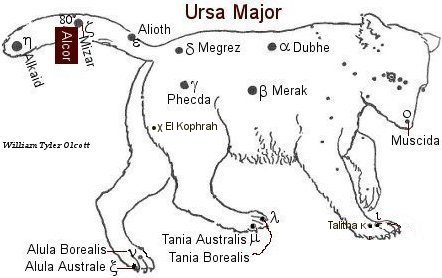 80 Ursa Major (or 80 Ursae Majoris), Alcor, is a star on the Tail of the Great Bear.
Alcor is the naked-eye companion of Mizar, and, inconspicuous though Alcor may be, has been famous in astronomical folklore.
This title, Alcor, and that of the star epsilon (ε, Alioth), may be from the same source, for the English astronomer Smyth (1788-1865) wrote of it:
“They are wrong who pronounce the name to be an Arabian word importing sharp-sightedness: it is a supposed corruption of aljaun, a courser, incorrectly written aljat, whence probably the Alioth of the Alfonsine Tables came in, and was assigned to epsilon (ε Alioth) Ursa Major, the “thill-horse” of Charles’s Wain. This little fellow was also familiarly termed Suha [the Forgotten, Lost, or Neglected One, because noticeable only by a sharp eye], and implored to guard its viewers against scorpions and snakes, and was the theme of a world of wit in the shape of saws:”
but Miss Clerke says :
“The Arabs in the desert regarded it as a test of penetrating vision; and they were accustomed to oppose “Suhel” to “Suha” (Canopus to Alcor) as occupying respectively the highest and lowest posts in the celestial hierarchy. So that Vidit Alcor, at non lunam plenam, came to be a proverbial description of one keenly alive to trifles, but dull of apprehension for broad facts.”
Al Sahja was the rhythmical form of the usual Suha; and it appears as Al “Khawwar,” the Faint One, in an interesting list of Arabic star-names, published in Popular Astronomy for January, 1895, by Professor Robert H. West, of the Syrian Protestant College at Beirut.
The 14th century Arabian lexicographer Al Firuzabadi called it Our Riddle, and Al Sadak, the Test,—correctly Saidak, True; while the 13th century Persian astronomical writer Al Kazwini said that “people tested their eyesight by this star.” Humboldt wrote of it as being seen with difficulty, and Arago similarly alluded to it; but some now consider it brighter than formerly {p.446} and no longer the difficult object that it was, even in the clear sky of the Desert; or as having increased in angular distance from Mizar
Although the statement has been made that Alcor was not known to the Greeks, there is an old story that it was the Lost Pleiad Electra, which had wandered here from her companions and became Alopex, the Fox; a Latin title was Eques Stellula, the Little Starry Horseman; Eques, the Cavalier, is from the 17th century German astronomer Bayer; while the Horse and his Rider, and, popularly, in England, Jack on the Middle Horse, are well known, Mizar being the horse. The Persian astronomer Al Biruni (973-1048 A.D.) mentioned its importance in the family life of the Arabs on the 18th day of the Syrian month Adar, the March equinox; and a modern story of that same people makes it the infant of the walidan of the three Banat.
In North Germany Alkor, as there written, has been der Hinde, the Hind, or Farm Hand; in Lower Germany, Dumke; and in Holstein, Hans Dumken, Hans the Thumbkin,— the legend being that Hans, a wagoner, having given the Savior a lift when weary, was offered the kingdom of heaven for a reward; but as he said that he would rather drive from east to west through all eternity, his wish was granted, and here he sits on the highest of the horses of his heavenly team. A variant version placed Hans here for neglect in the service of his master Christ; and the Hungarians call the star Gontzol, with a somewhat similar tale. Another Teutonic story was that their giant Orwandil (Anglo-Saxon Earendel), our Orion, having frozen one of his big toes, the god Thor broke it off and threw it at the middle horse of the Wagon, where it still remains.
In China it was Foo Sing, a Supporting Star.
Star Names, Their Lore and Meaning, Richard Hinckley Allen, 1889].
In Hindu mythology the seven stars of Ursa Major, the seven Richis or Seven Wise Men, were wedded to the seven sisters of the Pleiades. After rumors of their infidelity the Richis banished their wives. Only Arundhati (or Arundha), an exemplary wife remained with her husband, Sage Vashishta as the star Alcor; Vashishta is Mizar. In the course of Hindu marriage rituals, both the bride and groom are taken outside the marriage mandap and shown the Star Alcor, better known as Arundhati Nakshatram. This ritual symbolizes the urge of the newly weds to remain true to each other. And Alcor is pointed out as a paradigm of marital virtue to the bride. (, ).
In an Arabic story this star, Alcor, was the little infant in the arms of one of the “Mourners”. The constellation of the Great Bear (Ursa Major) was seen as a funeral procession, around a bier or coffin. The bier was marked by the Plough or Big Dipper stars on the body of the Bear – Merak (beta), Dubhe (alpha), Phecda (gamma) and Megrez (delta). The coffin was followed by “Mourners” the three big stars on the tail of the Great Bear; epsilon (Alioth), zeta (Mizar), and eta (Alkaid). These mourners, the children of Al Na’ash, who was murdered by Al Jadi, the pole-star (Polaris), are still nightly surrounding him in their thirst for vengeance, the walidan among the daughters — the star Mizar — holding in her arms her new-born infant, the little Alcor. [Star Names, p.433.]
In the Norse astronomy Rigel marked one of the great toes of Orwandil (Anglo-Saxon Earendel), the other toe having been broken off by the god Thor when frost-bitten, and thrown to the northern sky, where it became the little Alcor. [Star Names, p.313.]
The astrological influences of the constellation Ursa Major
Legend: Callisto, daughter of Lycaon, king of Arcadia, of whom Jupiter was enamored, became a follower of Diana on account of her love of hunting. Jupiter sought Callisto by assuming the form of Diana, and Juno (Jupiter’s wife) who discovered the intrigue turned Callisto into a bear. Angry that the bear was placed in heaven, Juno requested her brother Neptune never to let those stars set within his kingdom, and for this reason they are always above the horizon in Europe [never disappear below the horizon, it is always visible in the night sky, all night, every night, throughout the year]. To account for the length of the bear’s tail [because in reality bears don’t have tails], it is said that Jupiter, fearing her teeth, lifted her by the tail, which became stretched because of her weight and the distance from earth to heaven. [Robson, p.65.]
Influences: According to Ptolemy, Ursa Major is like Mars. It is said to give a quiet, prudent, suspicious, mistrustful, self-controlled, patient nature, but an uneasy spirit and great anger and revengefulness when roused. By the Kabalists it is associated with the Hebrew letter Zain and the 7th Tarot Trump “The Chariot.” [Robson, p.65.]
The astrological influences of the constellation Ursa Major given by Manilius:
“Now when, after completing a revolution round the pole, the Bear (Ursa Major) with muzzle foremost replaces her unceasing steps in her former tracks, never immersed in Ocean but ever turning in a circle, to those born at such a time wild creatures will show no hostile face, and in their dealings with animals these men will find them submissive to their rule. Such a one will be able to control huge lions with a gesture, to fondle wolves, and to play with captive panthers; so far from shunning the powerful bears that are the kin of the constellation, he will train them to human accomplishments and feats foreign to their nature; he will seat himself on the elephant’s back and with a goad will direct the movements of a beast which disgraces its massive weight by yielding to tiny jabs; he will dispel the fury of the tiger, training it to become a peaceful animal, whilst all the other beasts which molest the earth with their savageness he will join in friendship to himself; keen-scented whelps he will train…” [here the translator notes that eight pages have been lost] [Astronomica, Manilius, 1st century AD, book 5, p.357, 359]
“Now where heaven reaches its culmination in the shining Bears, which from the summit of the sky look down on all the stars and know no setting and, shifting their opposed stations about the same high point, set sky and stars in rotation, from there an insubstantial axis runs down through the wintry air and controls the universe, keeping it pivoted at opposite poles: it forms the middle about which the starry sphere revolves and wheels its heavenly flight, but is itself without motion and, drawn straight through the empty spaces of the great sky to the two Bears and through the very globe of the Earth, stands fixed, since the entire atmosphere ever revolves in a circle, and every part of the whole rotates to the place from which it once began, that which is in the middle, about which all moves, so insubstantial that it cannot turn round upon itself or even submit to motion or spin in circular fashion, this men have called the axis, since, motionless itself, it yet sees everything spinning about it. The top of the axis is occupied by constellations well known to hapless mariners, guiding them over the measureless deep in their search for gain. Helice (Ursa Major), the greater, describes the greater arc; it is marked by seven stars which vie with each other under its guidance the ships of Greece set sail to cross the seas. Cynosura [Ursa Minor] is small and wheels round in a narrow circle, less in brightness as it is in size, but in the judgment of the Tyrians it excels the larger bear. Carthaginians count it the surer-guide when at sea they make for unseen shores. They are not set face to face: each with its muzzle points at the other’s tail and follows one that follows it. Sprawling between them and embracing each the Dragon separates and surrounds them with its glowing stars lest they ever meet or leave their stations.” [Astronomica, Manilius, 1st century AD, book 1, p.27, 29].
References:
Fixed Stars and Constellations in Astrology, Vivian E. Robson, 1923].