Constellations of Words
Explore the etymology and symbolism of the constellations
the Flying Horse
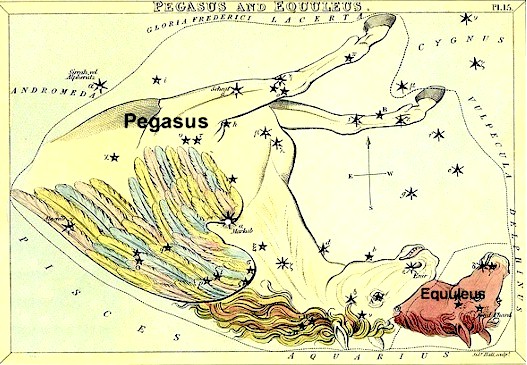
Urania’s Mirror1825
Contents:
1. Clues to the meaning of this celestial feature
2. The fixed stars in this constellation
3. History_of_the_constellation
Clues to the meaning of this celestial feature
Pegasus (Greek Pegasos) is the winged white horse, son of Poseidon in the shape of a horse. At birth Pegasus sprang forth from the bloody neck of the Gorgon Medusa (Algol) when she was beheaded by the hero Perseus. A spring was created when Pegasus’ hooves struck the earth on Mount Helicon, the fabled spring of Hippocrene, at the behest of Poseidon to prevent the mountain swelling too much. Pegasus was tamed by Bellerophon who rode him into battle against the fire-breathing Chimera. Later Bellerophon attempted to fly to Mt. Olympus, the home of the gods, on the back of Pegasus. The gods sent a gadfly to sting Pegasus causing the horse to buck, throwing Bellerophon back down to earth. Pegasus, freed of his burden, continued to wing his way to Mt. Olympus where he took a place in the stables of Zeus/Jupiter. One of his wing feathers fell to earth close to Tarsus giving the city its name. It is said that Pegasus bears for Jupiter the lightning and thunder. Pegasus was a great favorite with the nine Muses who gathered around the Mount Helicon spring to sing and dance, for its water was said to bring poetic inspiration.
Read what writers of myth have written on Pegasus on this Theoi Projectwebpage
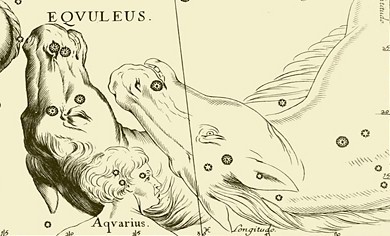 Hevelius, Firmamentum, 1690, depicts the head of Aquarius (Ganymedes) encroaching onto the heads of the two horses; Pegasus and Equuleus. This might have significance: To compensate the father of Ganymedes, King Laomedon of Troy, for abducting his son Zeus gave him two horses [].
Allen (Star Names) says that some of the mythologists said that Equuleus represented Cyllarus, given to Pollux by Juno. In myth the Gemini Twins ride two horses “the immortal steeds Cyllarus and Harpagus” []. It seems that Equuleus is Cyllarus, and Harpagus must be Pegasus
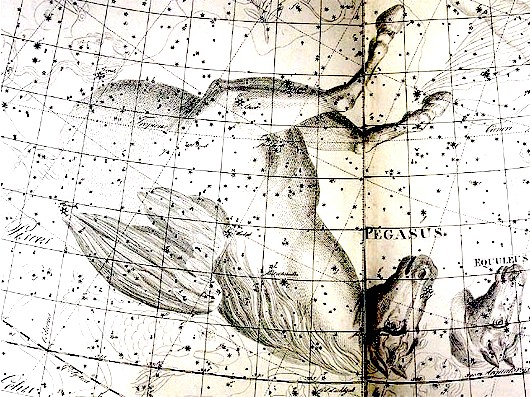
Johann Bode,Uranographia, 1801
In myth Pegasus carries the thunderbolts of Zeus. Pegasus, also called Sonipes, ‘Noisy-footed’, “becoming the Thundering Horse of Jove that carried the divine lightning” [Star Names].
There is a type of fish, called the ‘pegasus sea moth‘ of the family Pegasidae. Their horselike face, coupled with pectoral fins that spread horizontally like a pair of wings. They live in monogamous pairs, scratching the sand on the ocean floor. The specialized morphology of the pectoral fins enlarges and form ‘wings’ which they use to ‘fly’ through the water. Captive individuals have also been observed shedding their entire skin in one piece with a rapid jump every few days []. To jump out of skin is a metaphor for excitement, or shock.
“But when Perseus had cut off the head of Medousa [Medusa, see Algol] there sprang from her blood stout-hearted Khrysaor and the horse Pegasos so named from the ‘pegai‘ (springs) of Okeanos, where he was born” [Hesiod, Theogony 280
The word Pegasus is believed to be related to Greek pegai, or pege, a spring, Greek pegazo, ‘spring forth’ or ‘to gush forth’ []. Pegasus caused springs to gush forth as he pawed the earth with his hoof, on Mount Helicon, and another on Hippocrene (‘horse spring’). There is a phonetic similarity between the English word ‘peg‘, and Greek pege, spring. One of the uses for pegs is to determine the levels of underground water or springs; English peg comes from German pegel, ‘gauge rod, watermark’; hence a semantic correspondence between these words.
Another meaning of peg is a nail, horses have one toe and one large nail on each foot. A peg can also be a nail for hanging things on. Pegasus is a horse that is particularly associated with using his hooves, it was with his hoof that he scratched (ungula rupit) or scraped the surface of the ground and caused the springs to gush forth. Called Sonipes, ‘Noisy-footed’, “as his hooves could be heard thundering across the skies in a storm”.
Pegasus, so named from the Greek pegai (springs), Greek pegazo, ‘spring forth’ or ‘gush forth’ []. Pegasus is said to have sprang from the blood of Medusa after she was killed by Perseus []. Pegasus is the creator of springs through pawing the ground and causing springs to spring up. The word spring means three things; a leap or jump; the source of water, source of something; and the season in which plants spring up and grow. Spring is related to the word spurn which originally meant ‘to kick’, from Old High German spurnan to kick, Old Indian sphurati, ‘kicks with the foot’, Latin spernere ‘to spurn’. In myth Bellerophon attempts to fly to heaven on the back of Pegasus. Pegasus kicked, causing Bellerophon to fall off his back. After spurning Bellerophon, Pegasus continued on to Mount Olympus on his own. Klein gives an explanation for the root and the likely relatives of the word spurn, “from Old English spurnan, ‘to kick with the foot, drive away’, … Greek spairein ‘to move convulsively’, sphura, ‘hammer’, spuron, ‘ankle’, Latin spernere, ‘to reject, spurn’, Lithuanian spiriu, spirti, … Lithuanian sparnas, ‘wing’, Middle Irish seir (for speret-s, ‘heel’, Welsh ffer, ffern, ‘heel’, and possibly also Greek spaira ‘a sphere, ball, globe’. Compare Sphyraena, sphere. Compare also sperm, spore. Compare also spring“.
A cognate of spurn: Middle Irish seir (for speret-s), ‘heel’, Welsh ffer, ffern, ‘heel’; Tarsus, a Cilician city attributed its name to the feather which fell to the ground from Pegasus at birth, or in another version of the myths where Bellerophon fell from Pegasus. The tarsus is known as the hock in many domestic mammals. It is the anatomical homologue of the heel of the human foot [].
The Paganalia was the festival of sowing seeds, or propagating seed. The word sperm which Klein suggests is cognate with spring and spurn, is from Greek sperma, sperm seed < ‘that which is scattered’. Sperma: something sown, i.e. seed (including the male ‘sperm‘). Sperm comes from the Indo-European root *sper– ‘To strew’. Derivatives: sprawl, sprout, spruce,spritz, spritzer, sprit, bowsprit, spray², spread, Diaspora, sperm¹, spore, sporo-, exosporium, sporadic, spray¹. [Pokorny 2. (s)p(h)er– 993. Watkins] [Pegasus was created by the blood of Medusa’s severed head mixed with the foam and sand of the sea – Pegasus is adjacent to Pisces, the sea. The sperm (white liquid, white horse) mixing with the semen?]
Wikipedia gives another etymology for Pegasus “the name’s origins may come from the word in the Luwian language: pihassas, meaning ‘lightning.'”
The word spirit [related to; aspire, conspire, esprit, expire, inspire, perspire, respire, sprightly, transpire] has a number of associations with Pegasus. It was the action of his hoof pawing the ground that the Hippocrene (horse-springs), the inspiring fountain of the Muses sprang forth. “Everywhere the winged horse struck hoof to earth, an inspiringspring burst forth” []. In poetry, the phrase “My Pegasus will not go this morning” means the author’s brain will not work (lacks inspiration), and “I am mounting my Pegasus” means he’s going to write (he’s becoming inspired), and “I am on my Pegasus” means he’s engaged in writing [10]. The word peg also means ‘a drink of spirits‘. Horses, more than any other animal, are referred to as spirited. “The use of ‘spring‘ (pege) alludes to the Jacob tradition, while ‘welling up’ (hallomenou) is a verb used for the action of the Spirit of God in the Septuagint (e.g., Judges 15:14 and 1 Samuel 10:10)” [11]. “Sperm was thought to contribute the spirit to the matter of the maternal egg” [12].
Hylas soon found a spring, which the people of the neighborhood call Pegai. … a Nymphe Ephyatie (of the water), was just emerging from the limpid water as Hylas drew near. And there, with the full moon shining from a clear sky, she saw him in all his radiant beauty and alluring grace. Her heart was flooded by desire; she had a struggle to regain her scattered wits. But Hylas now leant over to one side to dip his ewer in: and as soon as the water was gurgling loudly round the ringing bronze she threw her left arm round his neck in her eagerness to kiss his gentle lips. Then with her right hand she drew his elbow down and plunged him in midstream … http://www.theoi.com/Nymphe/NymphaiMysiai.html
Ephyatie might be called a water-sprite (a doublet of spirit), who springed Hylas (springe means to trap or snare), a sprite is also the word for a large, dim, red flash that appears above active thunderstorms in conjunction with lightning. In myth Pegasus carries the thunderbolts of Zeus on Mount Olympos.
Pegasus is described as a white horse “snowy white in color” [Star Names]:
“Then I saw heaven open and there was a white horse. Its rider is called Faithful and True….His eyes were like a flame of fire, and he wore many crowns on his head….The armies of heaven followed him riding on white horses…on his robe and on his thigh was written the name: King of kings and Lord of lords” Revelations 19:11. [13
[The winning sperm might relate to adjacent Equuleus, the racehorse, ‘the first horse’ in a race. The sperm and egg together might be the two kid goats in Auriga
Ingenium. – Seneca. –Plato. –Aristotle. –Helicon. –Pegasus. –Parnassus. –Ovid. – First, we require in our poet or maker (for that title our language affords him elegantly with the Greek) a goodness of natural wit. For whereas all other arts consist of doctrine and precepts, the poet must be able by nature and instinct to pour out the treasure of his mind, and as Seneca saith, Aliquando secundum Anacreontem insanire jucundum esse; by which he understands the poetical rapture. And according to that of Plato, Frustrà poeticas fores sui compos pulsavit. And of Aristotle, Nullum magnum ingenium sine mixturâ dementiæ fuit. Nec potest grande aliquid, et supra cæteros loqui, nisi mota mens. Then it riseth higher, as by a divine instinct, when it contemns common and known conceptions. It utters somewhat above a mortal mouth. Then it gets aloft and flies away with his rider, whither before it was doubtful to ascend. This the poets understood by their Helicon, Pegasus, or Parnassus; and this made Ovid to boast, “Est deus in nobis, agitante calescimus illo, Sedibus æthereis spiritus ille venit.” [“There is a god within us, and when he is stirred we grow warm; that spirit comes from heavenly realms.”] [Discoveries Made Upon Men and Matter, and Some Poems, by Ben Johnson]
The two horses, Cyllarus and Hylonome, might relate to the two adjacent constellations Equuleus and Pegasus. Cyllarus is identified with Equuleus. Hylonome “browser of the wood”, is from the district Pagasae, similar to ‘pegasus’, and ‘pagan’ (from the above root pag-).
“Many a centauress would be his [Cyllarus’] mate, but one had gained his heart, [she-centaur] Hylonome. In the high woods there was none comelier of all the centaur-girls, and she alone by love and love’s sweet words and winning ways held Cyllarus, yes, and the care she took to look her best (so far as that may be with limbs like that). She combed her glossy hair, and twined her curls in turn with rosemary or violets or roses, and sometimes she wore a pure white lily. Twice a day she bathed her face in the clear brook that fell from Pagasae’s high forest, twice she plunged her body in its flow, nor would she wear on her left side and shoulder any skin but what became her from best-chosen beasts. Their love was equal; on the hills they roamed together, and together they would go back to their cave; and this time too they went into the Lapithae’s palace side by side and side by side were fighting in the fray. A javelin (no knowing from whose hand) came from the left and wounded Cyllarus, landing below the place where the chest joins neck – slight wound, but when the point was pulled away, cold grew his damaged heart and cold his limbs. Hylonome embraced him as he died, caressed the wound and, putting lips to lips, she tried to stay his spirit as it fled. And when she saw him lifeless, she moaned words that in that uproar failed to reach my ears; and fell upon the spear that pierced her love, and, dying, held her husband in her arms.” – Ovid, Metamorphoses 12.210 http://www.theoi.com/Georgikos/KentaurisHylonome.html
The two lovers were pegged together in death when Hylonome, in leaning over Cyllarus to embrace him, fell upon the spear that had pierced through his body, thus impaling herself.
According to Allen (below) Pegasus seems to have been regarded by the Phoenicians as the sky emblem of a ship. They used Pag, or Pega, the Bridled Horse, for the figurehead on a ship. In the old work the DestructionofTroye,, we read of “a ship built by Perseus, and named Pegasus, which was likened to a flying horse.” (Allen p.323, below). This might explain the association with ships in the astrological influences (“the constellation portends events concerning ships”).
The astrological influences of the constellation given by Manilius:
“Him the Horse in swift career strives to overtake and speeds along, his front distinguished by a resplendent star [beta Peg, Scheat]” [Manilius, Astronomica, 1st century AD, book 1, p.31.] [tries to overtake the other horse, Equuleus which is a head in front as the pictures show]
“Pegasus the winged Horse will appear and gallop aloft in the heavens. It will bring forth people endowed with swiftness of movement and limbs alert to perform every task. One man will cause his horse to wheel round in caracoles, and proudly mounted on its back he will wage war from on high; horseman and soldier in one. Another will possess the ability to rob the racecourse of its true length such is his speed that he will seem to dissemble the movement of his feet and make the ground vanish before him. Who more swiftly could fly back from the ends of the earth as messenger or with light foot to the earth’s ends make his way? He will also heal a horse’s wounds with the sap of common plants, and will know the herbs which bring aid to an animal’s limbs and those which grow for the use of man.” [Manilius, Astronomica, 1st century AD, book 5, p.350-353.]
© Anne Wright 2008
| Fixed stars in Pegasus | |||||||
| Star | 1900 | 2000 | R A | Decl 2000 | Lat | Mag | Sp |
| Kerb tau (τ) | 29PIS40 | 01ARI03 | 23h 20m 38.2s | +23° 44′ 25″ | +25 34 08 | 4.65 | A5 |
| Algenib gamma (γ) | 07ARI46 | 09ARI09 | 0h 13m 14.2s | +15° 11′ 1″ | +12 35 54 | 2.87 | B2 |
| Enif epsilon (ε) | 00PIS30 | 01PIS53 | 21h 44m 11.2s | +9° 52′ 30″ | +22 06 09 | 2.54 | K2 |
| Biham theta (θ) | 05PIS26 | 06PIS50 | 22h 10m 12s | +6° 11′ 52″ | +16 20 38 | 3.70 | A2 |
| kappa (κ) | 07PIS33 | 08PIS56 | 21h 44m 38.7s | +25° 38′ 42″ | +36 38 26 | 4.27 | F2 |
| iota (ι) | 13PIS02 | 14PIS25 | 22h 7m 0.7s | +25° 20′ 42″ | +34 15 29 | 3.96 | F3 |
| Homam zeta (ζ) | 14PIS45 | 16PIS09 | 22h 41m 27.7s | +10° 49′ 53″ | +17 40 52 | 3.61 | B8 |
| pi (π) | 17PIS59 | 19PIS22 | 22h 9m 59.2s | +33° 10′ 42″ | +41 03 11 | 5.65 | G6 |
| lambda (λ) | 21PIS41 | 23PIS04 | 22h 46m 31.9s | +23° 33′ 56″ | +28 47 49 | 4.14 | G6 |
| Markab alpha (α) | 22PIS06 | 23PIS29 | 23h 3m 46.5s | +28° 4′ 58″ | +19 24 26 | 2.57 | B9 |
| Sadalbari mu (μ) | 23PIS00 | 24PIS23 | 22h 50m 0.2s | +24° 36′ 6″ | +29 23 19 | 3.67 | G6 |
| Matar eta (η) | 24PIS20 | 25PIS43 | 22h 43m 0.1s | +30° 13′ 17″ | +35 06 30 | 3.10 | G2 |
| Scheat beta (β) | 27PIS59 | 29PIS22 | 23h 3m 46.5s | +28° 4′ 58″ | +31 08 22 | 2.61 | M2 |
History of the constellation
from Star Names 1889, Richard H. Allen
That poetic steed,
With beamy mane, whose hoof struck out from earth
The fount of Hippocrene.
— Bryant’s TheConstellations
Pegasus called thus in Germany, but Pegase in France and Pegaso in Italy, lies north of the Urn of Aquarius and the easternmost Fish (of Pisces), the stars of the Great Square inclosing the body of the Horse (the Great Square of Pegasus marked by the stars Alpheratz (alpha Andromeda), Scheat, Markab, and Algenib). Mythologically he was the son of Neptune and Medusa, sprung by his father’s command from the blood of the latter which dropped into the sea after her head had been severed by Perseus; and he was named either from Pegai, the Springs of the Ocean, the place of his birth, or from Pegos, Strong. He was snowy white in color, and the favorite of the Muses, for he had caused to flow their fountain Pirene on Helicon,— or Hippocrene on the Acrocorinthus, — whence came one of the constellation titles, FontisMusarumInventor. Longfellow prettily reproduced in modern dress this portion of the story, in his PegasusinPound, where “this wondrous winged steed with mane of gold,” straying into a quiet country village, was put in pound; but, finding his quarters uncomfortable, made his escape, and {Page 322} To those stars he soared again…
But they found upon the greensward
Where his struggling hoofs had trod,
Pure and bright a fountain flowing
From the hoofmarks in the sod.
He seems, however, to have come back to earth again, for he was subsequently caught by Bellerophon at the waters of his fountain, and ridden by him when he slew the Chimaera, helping in the latter’s destruction. By this time classical legend had given him wings, and Bellerophon sought by their aid to ascend to heaven; but Jupiter, incensed by his boldness, caused an insect to sting the steed, which threw his rider, and, as Wordsworth wrote:
Bold Bellerophon (so Jove decreed In wrath) fell headlong from the fields of air.
Pegasus then rose alone to his permanent place among the stars, becoming the Thundering Horse of Jove that carried the divine lightning.
Ptolemy mentioned the wings as well recognized in his day; and this has continued till ours, for the sky figure is now known as the WingedHorse, — a recurrence to Etruscan, Euphratean, and Hittite ideas, for the wings are clearly represented on a horse’s figure on tablets, vases, etc., of those countries, where this constellation may have been known in pre-classical times. Indeed, it is said to have been placed in the heavens by the early Aryans to represent Asva, the Sun.
Early classical mythology did not associate the Horse with Perseus, although artists and authors do not seem to have remembered this, for the celebrated picture by Rubens in the Berlin Gallery shows the winged Pegasus held by a Cupid, while Perseus in full armor is unbinding Andromeda from the rocks, Cetus raging in the waters close by; and the late Lord Leighton left unfinished his PerseusonPegasus at the cliffs of Joppa, with the Gorgoneion in his hand; while in TroilusandCressida Shakespeare mentioned “Perseus’ horse.”
The Greeks called the constellation simply Ippos (which Latins pronounced Hippos), although Aratos added ieros, “divine,” and Eratosthenes alluded to it as Pegasos, but distinctly asserted that it was without wings, and until after middle classical times it generally was so drawn, although loose plumes at the shoulders occasionally were added. The figure was considered incomplete, a possible reason for this being given under Aries. Thus it was characterized as emiteles and emitomos, “cut in two,”or as if partly hidden in the clouds; while Nonnus had Emiphanes Libus Ippos, the Half-visible Libyan Horse.
{Page 323} Thus the Equi Sectio used by Tycho and others for Equuleus would seem equally appropriate for this.
Euripides is said to have called it Melanippe, after a daughter of Chiron, also known as Euippe, changed by the goddess Artemis into a Black Mare and placed in the sky; but Bayer quoted from some later writer Menalippe. The Theiana, or Theano, of Nonnus does not seem intelligible.
Translated from Greece by the Romans, it was Equus, and later on EquusAles, qualified at times by the adjectives alter, major, Gorgoneus, and Medusaeus; but Isidorus and Lampridius degraded it to Sagmarius Caballus, a Pack-horse; La Lande cited Ephippiatus, Caparisoned; and elsewhere it was Cornipes, Horn-footed; Sonipes, Noisy-footed; and SonipesAles. Germanicus was apparently the first of Latin authors to style it Pegasus.
In the AlfonsineTables it was Alatus, Winged, Secundus sometimes being added to distinguish it from Equuleus, which preceded it on the sphere; the Almagest of 1551 had EquusPegasus, which the 17th-century astronomers extended to PegasusEquusalatus, Caesius cited Pegasides, and Bayer quoted Equusposterior, volans, aereus, and dimidiatus, Bellerophon, and Bellerophontes
Jewish legends made it the mighty Nimrod’s Horse; Caesius, one of those of Jeremiah iv, 13, that “are swifter than eagles”; other pious people, the Ass on which Christ made his triumphal entry into Jerusalem; but Julius Schiller exalted it into the ArchangelGabriel. Weigel drew it as the heraldic LuneburgHorse
Pegasus appears on coins of Corinth from 500 to 430 B.C., and from 350 to 338 B.C., and 200 years thereafter, on the decadrachma, complete and with wings; as well as on coins of Lampsacus, Scepsis, and Carthage, — on these last with the asterisk of the sun, or with the winged disc, and the hooded snakes over its back. It is also shown on a coin of Narbonne as a sectional winged figure, and as a winged horse on a Euphratean gem, with a bull’s head, a crescent moon, and three stars in the field. A coin of Panormus, the modern Palermo, has the Horse’s head with what was probably intended for a dorsal plume.
Bochart said that the word is a compound of the Phoenician Pag, or Pega, and Sus, the Bridled Horse, used for the figurehead on a ship, which would account for the constellation being shown with only the head and fore quarters; but others have considered it of Egyptian origin, from Pag, “to cease,” and Sus, “a vessel,” thus symbolizing the cessation of navigation at the change of the Nile flow. From this, Pegasus seems to have been regarded, in those countries at least, as the sky emblem of a ship. In the {Page 324} old work the DestructionofTroye, we read of “a ship built by Perseus, and named Pegasus, which was likened to a flying horse.”
Brugsch mentions as in its location an Egyptian constellation, the Servant; and some of its stars would seem to be shown on the Denderah planisphere as a Jackal.
The Arabs knew the familiar quadrangle as AlDalw, the Water-bucket, the Amphora of some Latin imitator, which generally was used for the Urn in Aquarius; and the Arabian astronomers followed Ptolemy in AlFarasalThani, the Second Horse, which Bayer turned into Alpheras; Chilmead, into AlfarasAlathem; and La Lande, into Alphares
Argelander catalogued 108 stars here, down to the 6th magnitude; and Heis, 178, to the 6½.
The starless region toward Pisces was Al Biruni’s AlBaldah, the Fox’s Kennel, a term for whose stellar connection I find no explanation.
Before leaving this constellation, it is worth while to note that an asterism, now virtually lost to us and seldom mentioned except in the lists of Al Sufi, Al Amasch, and Kazwini, is described by the last-named under the title AlFarasalTamm, the Complete Horse. Although somewhat indefinitely marked out, it is said to have occupied the space between the eastern wing of the Swan (Cygnus), the chest of Pegasus, Equuleus, and the tail of Lacerta, drawing for its components from the last three; but Beigel held that it could have existed only with the grammarians, — the Tamm in its title being easily confused, in transcription, with the Thani in the Arabians’ name for Pegasus. Ideler’s Sternnamen is the sole modern work in which I find any reference to this Complete Horse, and even that author, in one passage, seems to regard Monoceros as the modern representative of this somewhat mythical constellation; but this is impossible if Kazwini’s description be accepted. Indeed, Ideler himself, later on in his book, changed his opinion to agree with that of Beigel.
Star Names: Their Lore and Meaning, Richard H. Allen, 1889.]