| Fixed star: ZANIAH | |
| Constellation: Eta (η) Virgo | |
| Longitude 1900: 03LIB08 | Longitude 2000: 04LIB31 |
| Declination 1900: +00.40′ | Declination 2000: +00.07′ |
| Right ascension: 12h 19m | Latitude: +02.04′ |
| Spectral class: A0 | Magnitude: 4.0 |
The history of the star: Zaniah
from p.471 of Star Names, Richard Hinckley Allen, 1889.
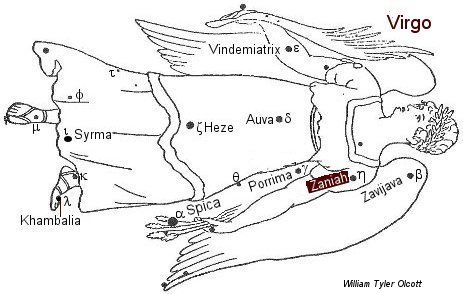 Eta (η) Virgo, Zaniah, is a star on the left arm of the Virgin.
Zaniah is from Al Zawiah, applied in German lists to this instead of to the stars beta (β Zavijava) and gamma (γ Porrima), all of these being in the Kennel.
In China it was Tso Chih Fa, the Left-hand Maintainer of Law.
It lies on the left side of the Virgin, and just to the westward is the point of the autumnal equinox which the Chinese knew as Yih Mun, Twan Mun, or Tien Mun, Heaven’s Gate.
With zeta (ζ Heze) it almost exactly marks the line of the celestial equator.
Star Names, Their Lore and Meaning, Richard Hinckley Allen, 1889].
Eric Morse in The Living Stars says about this Mercury-Venus star; “The name must bring a smile to astrologers who often associate Mercury with money and Venus with love, and Ptolemy having put the money first for Zaniyah means “Adulteress” or “Harlot”. We have seen how Virgo has had such a reputation in past times, having been Lilith and Ashtoreth as much as more honored ladies like Mary. A little amusement is permitted in reading older books in which the word is either not translated at all, or the authors digress into a learned discussion on whether or not this star belongs to a group once known as the “Kennels”, along with the title “little mosque” [for Zavijava], Victorian avoidance of the unmentionable does have its comic side!” [The Living Stars, Dr. Eric Morse, p.69-70.]
The Lunar Mansions
The stars beta (β Zavijava), eta (η Zaniah), gamma (γ Porrima), delta (δ Auva), epsilon (ε Vindemiatrix), outlining this Kennel, formed the 11th manzil (Arabic Moon Mansion), Al Awwa, the Barker, or “the Howler”, which was considered of good omen.
Influences of the 11th Arabic Moon Mansion Al Awwa: Gives benevolence, gain, voyages, harvests and freedom of captives.
With Moon transiting here: sow, plant, take medicine but do not travel or marry. [Robson, p.72.]
The astrological influences of the constellation Virgo
Legend: This constellation is said to represent Erigone, daughter of Icarius, who hanged herself through grief at the death of her father (Bootes). According to other accounts it is Astraea, daughter of one of the Titans, who sided with the Gods against her own father. [Robson, p.66.]
Influences: Ptolemy makes the following observations; “The stars in the head of Virgo, and that at the top of the southern wing, operate like Mercury and somewhat like Mars: the other bright stars in the same wing, and those about the girdle, resemble Mercury in their influence, and also Venus, moderately . . . those at the points of the feet and at the bottom of the garments are like Mercury, and also Mars, moderately.” By the Kabalists it is associated with the Hebrew letter Gimel and the 3rd Tarot Trump “The Empress.” [Robson, p.66-67.]
The astrological influences of the constellation Virgo given by Manilius:
spicifera est Virgo Cereris” — “The Virgin with her sheaf belongs to Ceres”. [Astronomica, Manilius, 1st century AD, p.117]
“Virginis in propriam descendunt ilia sortem“, — “the belly comes down to the Maid as her rightful lot” [Astronomica, Manilius, 1st century AD, p.119]
“At her rising Erigone (Virgo, who reigned with Justice over a bygone age and fled when it fell into sinful ways, bestows high eminence by bestowing supreme power; she will produce a man to direct the laws of the state and the sacred code; one who will tend with reverence the hallowed temples of the gods.” [Astronomica, Manilius, 1st century AD, p.265]
“The temperaments of those whose span of life she pronounces at their birth Erigone (Virgo) will direct to study, and she will train their minds in the learned arts. She will give not so much abundance of wealth as the impulse to investigate the causes and effects of things. On them she will confer a tongue which charms, the mastery of words, and that mental vision which can discern all things, however concealed they be by the mysterious workings of nature. From the Virgin will also come the stenographer: his letter represents a word, and by means of his symbols he can keep ahead of utterance and record in novel notation the long speech of a rapid speaker. But with the good there comes a flaw: bashfulness handicaps the early years of such persons, for the Maid, by holding back their great natural gifts, puts a bridle on their lips and restrains them by the curb of authority. And (small wonder in a virgin) her offspring is not fruitful.” [Astronomica, Manilius, 1st century AD, p.237 and 239]
The astrological influences of the star Zaniah
According to Ptolemy it is of the nature of Mercury and Venus; and, to Alvidas, of Venus and Mercury in sextile. It gives refinement, honor, congeniality, order and a lovable nature. [Robson, p.218.]
An attribute of Zaniah can be seen in the Mercury-Venus-in-Libra talent for negotiating peace. One attribute which a good commander (or salesman) must surely need is an intuition for knowing to call a halt to battle and either offer or seek terms for peace. If well aspected and on the right planet, Mercury, Venus, Sun, or Jupiter for example this is what will show up in the horoscope. With Mars or Saturn the terms for peace may be too harsh for acceptance; with the Moon or Neptune they may be either unrealistic or downright “shady”. [The Living Stars, Dr. Eric Morse, p.69-70.]
With Sun: Educational and studious interests, popular, social success, much pleasure, favorable for marriage. [Robson, p.218.]
With Moon: Worry, loss through legal and Venusian affairs, trouble through writings, led astray by sympathies. [Robson, p.218.]
With Mercury: Musical or artistic ability, gain through writing short stories, popular, social success, many friends especially among opposite sex. [Robson, p.218.]
With Venus: Quick in learning, musical and artistic ability, fond of society, many friends, favorable for gain. [Robson, p.218.]
With Mars: Active, energetic, loss through lawsuits, trouble through opposite sex. [Robson, p.218.]
With Jupiter: Religious and philosophical mind, social success, many friends. [Robson, p.218.]
With Saturn: Sober, industrious, many influential elderly friends, gain through old people, grand-parents, and marriage. [Robson, p.219.]
With Uranus: Studious, psychic, retiring, somewhat unpractical, uneventful life, many friends, social success, favorable for marriage if male but less so if female, gain through marriage and business, natural death. [Robson, p.219.]
With Neptune: Kind, sympathetic, somewhat impatient, good at detail work, peculiar love affairs, gain through marriage and partnership, help from influential friends, uneventful life, danger of death at about 10 years of age or natural death in middle life. [Robson, p.219.]
References:
Fixed Stars and Constellations in Astrology, Vivian E. Robson, 1923].