| Fixed star: MIMOSA Becrux | |
| Constellation: Beta (β) Crux | |
| Longitude 1900: 10SCO16 | Longitude 2000: 11SCO39 |
| Declination 1900: -59.09′ | Declination 2000: -59.40′ |
| Right ascension: 12h 47m | Latitude: -48.38′ |
| Spectral class: B1 | Magnitude: 1.25 Variable |
The history of the star: Mimosa
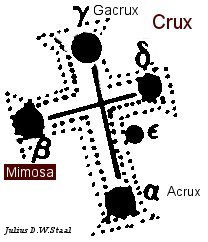 Beta (β) Crux, Mimosa, is a star on the transverse beam of the constellation of the Cross.
There is a plant named Mimosa, from Latin mimus ‘mimic’, because its leaves seem to flinch when touched, mimicking a recoiling animal.
There is little astrological interpretation and no mythology or legends associated with these large stars in Crux because the Cross was unknown to the ancients by its present title, its four chief stars being noted by Ptolemy (in Egypt where it was visible) as a part of the Centaur Centaurus, which now surrounds it on three sides. Bayer, who invented Crux in 1679, outlined it over the hind feet of the Centaur, these now are alpha (Acrux), beta (Mimosa), gamma (Gacrux), and delta Crucis (unnamed), —alpha at the foot, gamma at the top, with beta, and delta (unnamed), as the transverse.
The astrological influences of the constellation Crux
Crux is said to give perseverance, but many burdens, trials and responsibilities, together with much suffering and many hardships. In connection with rulerships of countries it may be noted that Brazil was named the Land of the Holy Cross by the discoverer Cabral on May 1st 1500, and that the constellation Crux has been represented on the postage stamps of that country”. [Robson, p.41.]
The astrological influences of the star Mimosa
[Interpretations for alpha and beta Crux – Acrux and Mimosa] Inventive mind, intuition and wisdom, a grasp for the inner nature of one’s fellow man. The gift of successful investigation of the hidden side of things. A deeply religious nature connected with mystical and theosophical interests. [Fixed Stars and Their Interpretation, Elsbeth Ebertin, 1928, p.63.]
References:
Fixed Stars and Constellations in Astrology, Vivian E. Robson, 1923].