| Fixed star: MESARTHIM Arietis | |
| Constellation: Gamma (γ) Aries | |
| Longitude 1900: 01TAU47 | Longitude 2000: 03TAU11 |
| Declination 1900: +18.48′ | Declination 2000: +19.17′ |
| Right ascension: 01h 53m | Latitude: +07.09′ |
| Spectral class: A0 | Magnitude: 4.8 |
The history of the star: Mesarthim
from p.82 of Star Names, Richard Hinckley Allen, 1889.
[A scanned copy can be viewed on this webpage
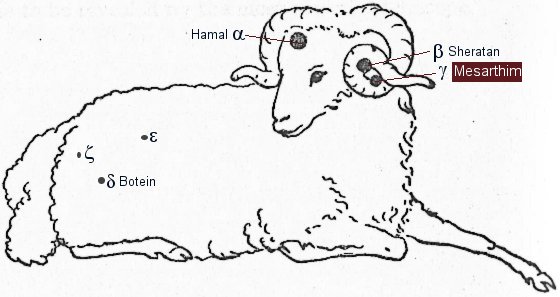 Gamma (γ) Aries, Mesarthim, is a double, 4.5 and 5, bright white and gray, in the left horn of the Ram. It has been called the First Star in Aries, as at one time nearest to the equinoctial point (392 B.C.).
Its present title, Mesarthim, or Mesartim, has been connected with the Hebrew Mesharetim, Ministers, but the connection is not apparent; and Ideler considered the word an erroneous deduction by the 17th century German astronomer Bayer from the name of the lunar station of which this and beta (β Sheratan) were members. In the English astronomer Smyth (1788-1865)’s index it is Mesartun; and the 17th century Dutch astronomer Caesius had Scartai from Sharatain
Alpha (α Hamal), beta (β Sheratan), and gamma (γ this star Mesarthim) may have been the Jewish Shalisha,— more correctly Shalish,— some musical instrument of triangular shape, a title also of Triangulum. And they formed one of the several Athaflyy, Trivets or Tripods; this Arabic word indicating the rude arrangement of three stones on which the nomad placed his kettle, or pot, in his open-air kitchen; others being in our Draco, Orion, Musca, and Lyra
Star Names, Their Lore and Meaning, Richard Hinckley Allen, 1889].
The Lunar Mansions
Al Sharatain, The Two Signs. Beta (β Sheratan) with this star gamma (γ Mesarthim) Aries were the 1stmanzil (Arabic Moon Mansion) in the Persian astronomer Al Biruni ‘s (973-1048 A.D.) list, the earlier 27th. This mansion is now considered to begin the series of lunar mansions.
Influences of the 1st Arabic Moon Mansion Al Sharatain: Causes discords and journeys. [Robson p.75.]
With Moon transiting here: buy cattle, plant and take voyages. [Robson p.75.]
Beta (β Sheratan) and gamma (γ this star Mesarthim) constituted the 27th nakshatra (Hindu Moon Mansion) A çvini (or Ashvini), the Ashwins, or Horsemen, the earlier dual A çvinau (or Ashvinau) and A çvayujau, the Two Horsemen, corresponding to the Gemini of Rome, but figured as a Horse’s Head. Robson says the Regents were the Asvini Devas. Ruled by the Dragon’s Tail. This mansion superseded Krittika (the Pleiades in Taurus) as leader at about 400 B.C.
Influences of the 27th Hindu Moon Mansion Asvini: It is a light asterism belonging to the Vaisya caste (farmers and merchants) and favorable for sales, art, sculpture, learning, marital love, wearing of ornament, medicine and purchase of carriages when containing the Moon. Those born on the lunar day will be physicians, military commanders and dealers in horses. With Moon here at birth native will be polite, fond of ornaments, handsome, popular and intelligent. Rules towns and the upper part of the feet. [Robson p.86.]
The astrological influences of the constellation Aries
Legend: Aries represents the ram with the golden fleece, a gift from Mercury, upon which Phrixus and his sister Helle escaped through the air from their step-mother Ino. On arriving in Colchis, Phrixus sacrificed the ram to Jupiter and its fleece was hung in the Grove of Mars, whence it was subsequently carried away by Jason (see Argo). According to another account it was the ram that guided Bacchus to a spring of water in the Libyan desert. [Robson, p.31.]
Influences: Ptolemy’s observations are as follows: “The stars in the head of Aries possess an influence similar in its effects to that of Mars and Saturn: those in the mouth act similarly to Mercury, and in some degree to Saturn; those in the hinder foot, to Mars; those in the tail, to Venus.” By the Kabalists Aries is associated with the Hebrew letter He and the 5th Tarot Trump “The Pope.” [Robson, p.31.]
“All the Aries stars have been in the sign Taurus for 200-300 years now. Hamal just over 600 (Botein actually entered Taurus in year 505AD), and in this same period we have seen large-scale aggression change its nature from barbaric raiding and migration of earlier centuries to the building of large empires which had to be administered and kept in peace and good order, as well as exploited by their conquerors. This is typical both of the sign Taurus and of the planet Saturn”. [The Living Stars, Dr. Eric Morse].
The astrological influences of the constellation Aries given by Manilius:
“The Ram, who is rich with an abundance of fleecy wool and, when shorn of this, with a fresh supply, will ever cherish hopes; he will rise from the sudden shipwreck of his affairs to abundant wealth only to meet with a fall, and his desires will lead him to disaster; he will yield his produce for the common benefit, the fleece which by a thousand crafts gives birth to different forms of gain, now workers pile into heaps the undressed wool, now card it, now draw it into a tenuous thread, now weave the threads to form webs, and now they buy and sell for gain garments of every kind; no nation could dispense with these, even without indulgence in luxury. So important is this work that Pallas herself has claimed it for her own hands, of which she has judged it worthy, and deems her victory over Arachne a token of her greatness. These are the callings and allied crafts that the Ram will decree for those born under his sign: in an anxious breast he will fashion a diffident heart that ever yearns to commend itself by its own praise.
“When the Ram emerges above the surface of the waves (rising) and the curve of his neck appears before his horns, he will give birth to hearts that are never content with what is theirs; he will engender minds bent on plunder and will banish all sense of shame: such is their desire for venture. Even thus does the ram himself rush forth with lowered horns, resolved to win or die. Not for them the gentle ease of a fixed abode with none but peaceful cares; it is ever their delight to travel through unknown cities, to explore uncharted seas, and enjoy the whole world’s hospitality. The Ram himself gives you evidence of this: once furrowing a trail through the glassy sea, he tinged it with the gold of his fleece, when on his back he carried Phrixus, bereft of his sister (Helle) by fate’s decree, and brought him to the banks of the Phasis and to Colchis”. [Astronomica, Manilius, 1st century AD, book 4, p.233].
The astrological influences of the star Mesarthim
Arietis is a word meaning Ministers in old Hebrew and it is noteworthy that Ptolemy gave this near neighbor of Hamal and Sheratan the same planetary simile in opposite order: Saturn-Mars. The implication is that Mesartim shows up more of the protective-administrative quality, less of the impulsive aggressive of Hamal and Sheratan which are Mars-Saturn natures. [The Living Stars, Dr. Eric Morse, p.33.]
References:
Fixed Stars and Constellations in Astrology, Vivian E. Robson, 1923].