| Fixed star: MERAK | |
| Constellation: Beta (β) Ursa Major | |
| Longitude 1900: 18LEO02 | Longitude 2000: 19LEO26 |
| Declination 1900: +56.55′ | Declination 2000: +56.23′ |
| Right ascension: 11h 01m | Latitude: +45.07′ |
| Spectral class: A1 | Magnitude: 2.4 |
The history of the star: Merak
from p.438 of Star Names, Richard Hinckley Allen, 1889.
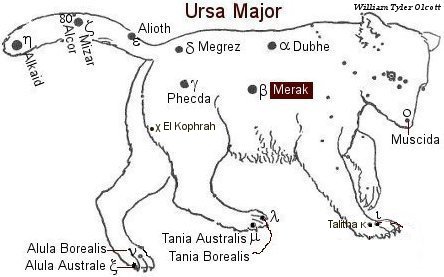 Beta (β) Ursa Major, Merak, is a greenish white star in the loin or flank of the Great Bear.
Merak, or Mirak, is from Al Marakk, the Loin (of the Bear); but English writer on globes John Chilmead (circa 1639) said Mirae, and the 16th century French scholar Scaliger, Mizar. It may have been known by the Greeks as Helike, one of their names for the whole constellation of Ursa Major
The Chinese called it Tien Seuen, an Armillary Sphere, and the Hindus, Pulaha (born from Brahma’s navel), one of the seven Rishis or Sages [identifying Kratu with the star α Dubhe; Pulaha with β Merak; Pulastya with γ Phecda; Atri with δ Megrez; Angiras ε Alioth; Vasishtha with ζ Mizar; Bhrigu with η Alkaid. [] []]
Close to it, on the west, lies the Owl Nebula, N.G.C. (New Galaxy Catalog) 3587, 97 M., discovered by Mechain in 1781.
Star Names, Their Lore and Meaning, Richard Hinckley Allen, 1889].
Alpha (Dubhe) and beta (this star Merak) were the Keepers, or the Pointers, at the front of the “Dipper Bowl” in Ursa Major; a line extending through these two will direct the observer to Polaris, the North Star.
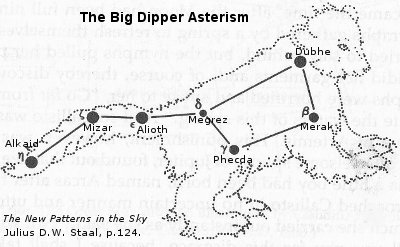 It is one of the “The Plough”, also called “the Big Dipper” stars, an asterism in the back of the Bear, outlined by the stars; Merak (this star beta), Dubhe (alpha), Phecda (gamma) and Megrez (delta) on the body of the Bear, along with the three star of the tail; epsilon (Alioth), zeta (Mizar), and eta (Alkaid). The asterism was also seen as a Dipper or Ladle with the three stars in the tail forming the handle. In early Arabic astronomy the four plough stars on the body of the bear constituted the coffin or bier surrounded by mourners (the three stars in the tail) of Al Na’ash, who was murdered by Al Jadi, the pole-star (Polaris), and this constellation was seen as a funeral procession, attributing this title to the slow and solemn motion of the figure around the pole. The Big Dipper has been seen by various cultures as a plough, an ox cart, a wagon, it was known as Charlie’s Wain in northern Europe. To the Hindus the four stars of the plough and the three stars in the tail was Sapta Rishi “The seven Wise Men.” These seven stars (septentriones, from the phrase septem triones, meaning “seven plough oxen”) are the origin of the Latin word septentriones meaning “north”.
The astrological influences of the constellation Ursa Major
Legend: Callisto, daughter of Lycaon, king of Arcadia, of whom Jupiter was enamored, became a follower of Diana on account of her love of hunting. Jupiter sought Callisto by assuming the form of Diana, and Juno (Jupiter’s wife) who discovered the intrigue turned Callisto into a bear. Angry that the bear was placed in heaven, Juno requested her brother Neptune never to let those stars set within his kingdom, and for this reason they are always above the horizon in Europe [never disappear below the horizon, it is always visible in the night sky, all night, every night, throughout the year]. To account for the length of the bear’s tail [because in reality bears don’t have tails], it is said that Jupiter, fearing her teeth, lifted her by the tail, which became stretched because of her weight and the distance from earth to heaven. [Robson, p.65.]
Influences: According to Ptolemy, Ursa Major is like Mars. It is said to give a quiet, prudent, suspicious, mistrustful, self-controlled, patient nature, but an uneasy spirit and great anger and revengefulness when roused. By the Kabalists it is associated with the Hebrew letter Zain and the 7th Tarot Trump “The Chariot.” [Robson, p.65.]
The astrological influences of the constellation Ursa Major given by Manilius:
“Now when, after completing a revolution round the pole, the Bear (Ursa Major) with muzzle foremost replaces her unceasing steps in her former tracks, never immersed in Ocean but ever turning in a circle, to those born at such a time wild creatures will show no hostile face, and in their dealings with animals these men will find them submissive to their rule. Such a one will be able to control huge lions with a gesture, to fondle wolves, and to play with captive panthers; so far from shunning the powerful bears that are the kin of the constellation, he will train them to human accomplishments and feats foreign to their nature; he will seat himself on the elephant’s back and with a goad will direct the movements of a beast which disgraces its massive weight by yielding to tiny jabs; he will dispel the fury of the tiger, training it to become a peaceful animal, whilst all the other beasts which molest the earth with their savageness he will join in friendship to himself; keen-scented whelps he will train…” [here the translator notes that eight pages have been lost] [Astronomica, Manilius, 1st century AD, book 5, p.357, 359]
“Now where heaven reaches its culmination in the shining Bears, which from the summit of the sky look down on all the stars and know no setting and, shifting their opposed stations about the same high point, set sky and stars in rotation, from there an insubstantial axis runs down through the wintry air and controls the universe, keeping it pivoted at opposite poles: it forms the middle about which the starry sphere revolves and wheels its heavenly flight, but is itself without motion and, drawn straight through the empty spaces of the great sky to the two Bears and through the very globe of the Earth, stands fixed, since the entire atmosphere ever revolves in a circle, and every part of the whole rotates to the place from which it once began, that which is in the middle, about which all moves, so insubstantial that it cannot turn round upon itself or even submit to motion or spin in circular fashion, this men have called the axis, since, motionless itself, it yet sees everything spinning about it. The top of the axis is occupied by constellations well known to hapless mariners, guiding them over the measureless deep in their search for gain. Helice (Ursa Major), the greater, describes the greater arc; it is marked by seven stars which vie with each other under its guidance the ships of Greece set sail to cross the seas. Cynosura [Ursa Minor] is small and wheels round in a narrow circle, less in brightness as it is in size, but in the judgment of the Tyrians it excels the larger bear. Carthaginians count it the surer-guide when at sea they make for unseen shores. They are not set face to face: each with its muzzle points at the other’s tail and follows one that follows it. Sprawling between them and embracing each the Dragon separates and surrounds them with its glowing stars lest they ever meet or leave their stations.” [Astronomica, Manilius, 1st century AD, book 1, p.27, 29].
The astrological influences of the star Merak
Merak has a Mars nature and is of importance in a natal chart, if the sign Leo is tenanted and other configurations give a clue to love of command and domination. This star is credited with increasing the power to get on in life and this is especially so if in conjunction with the Sun, Mars or Pluto. [Fixed Stars and Their Interpretation, Elsbeth Ebertin, 1928, p.49.]
References:
Fixed Stars and Constellations in Astrology, Vivian E. Robson, 1923].