| Fixed star: DENEB OKAB | |
| Constellation: Delta (δ) Aquila | |
| Longitude 1900: 22CAP14 | Longitude 2000: 23CAP38 |
| Declination 1900: +02.55′ | Declination 2000: +03.06′ |
| Right ascension: 19h 25m | Latitude: +24.49′ |
| Spectral class: A5 | Magnitude: 3.4 |
The history of the star: Deneb Okab
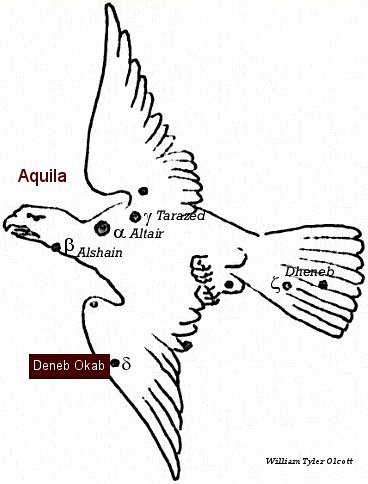 Delta (δ) Aquila, is a star positioned in the right wing of the Eagle. Deneb Okab “Tail of the Eagle” is probably a misnomer by the astrology programs from where I got the star’s details. Astronomers have a title Deneb Al Okab translated “the south star in the tail of the Eagle” for the star zeta (ζ) Dheneb, and the northern star in the tail is epsilon (ε) Deneb al Okab Borealis, “the north star in the tail of the Eagle”.
Although this star was always part of Aquila, for a time it was also once part of the constellation of Antinous along with eta and sigma, theta, iota, kappa, lambda, upsilon, all now in Aquila. The constellation Antonius is said to have been introduced into the sky, in the year 132, by the Emperor Hadrian, in honor of his young Bithynian favorite, whose soul his courtiers had shown him shining in its lucida after the youth’s self-sacrifice by drowning in the Nile from his belief that his master’s life might thus be prolonged. This was because the oracle at Beza had asserted that only by the death of the object which the emperor most loved could great danger to the latter be averted. The new asterism, however, was little known among early astronomers; and although Ptolemy alluded to it, he did so but slightingly [likely because of catamite connotations]. [from p.40 of Star Names, a scanned copy can be viewed on this webpage
This star delta, along with eta and theta, of 3rd to 4th magnitudes, in Antinous, were Al Mizan, the “Scale-beam”, of early Arabia, from their similar direction and nearly equal distances apart.
Star Names, Their Lore and Meaning, Richard Hinckley Allen, 1889].
The astrological influences of the constellation Aquila
Legend: Originally called Vultur Volans or the Flying Grype, Aquila represents the Eagle, thought to be Jupiter himself, that carried Ganymedes to heaven (see Aquarius). [Robson, p.29.]
Influences: According to Ptolemy the influence of Aquila is similar to that of Mars and Jupiter. It is said to give great imagination, strong passions, indomitable will, a dominating character, influence over others, clairvoyance, a keen penetrating mind and ability for chemical research. It has always been associated with the sign Scorpio, and by the Kabalists with the Hebrew letter Vau and the 6th Tarot Trump “The Lovers.” [Robson, p.29.]
The astrological influences of the constellation Aquila given by Manilius:
“The Eagle, soars to the heights, the bird of mighty Jupiter carrying thunderbolts, it is a bird worthy of Jupiter and the sky, which it furnishes with awful armaments. This bird brings back the thunderbolts which Jupiter has flung and fights in the service of heaven. He that is born on earth in the hour of its rising, will grow up bent on spoil and plunder, won even with bloodshed; he will draw no line between peace and war, between citizen and foe, and when he is short of men to kill he will engage in butchery of beast. He is a law unto himself, and rushes violently wherever his fancy takes him; in his eyes to show contempt for everything merits praise. Yet, should perchance his aggressiveness be enlisted in a righteous cause, depravity will turn into virtue, and he will succeed in bringing wars to a conclusion and enriching his country with glorious triumphs. And, since the Eagle does not wield, but supplies weapons, seeing that it brings back and restores to Jupiter the fires and bolts he has hurled, in time of war such a man will be the aide of a king or of some mighty general, and his strength will render them important service”. [Astronomica, Manilius, 1st century AD, book 5, p.341.]
The astrological influences of the star Deneb Okab
Ability to command. Success in martial arts. [Fixed Stars and Judicial Astrology, George Noonan, 1990, p.20.]
References:
Fixed Stars and Constellations in Astrology, Vivian E. Robson, 1923].