| Fixed star: ARKAB POSTERIOR | |
| Constellation: Beta (β) Sagittarius | |
| Longitude 1900: 14CAP26 | Longitude 2000: 15CAP50 |
| Declination 1900: -44.59′ | Declination 2000: -44.48′ |
| Right ascension: 19h 23m | Latitude: -22.29′ |
| Spectral class: A9 | Magnitude: 4.5 |
The history of the star: Arkab Posterior
from p.357 of Star Names, Richard Hinckley Allen, 1889.
[A scanned copy can be viewed on this webpage
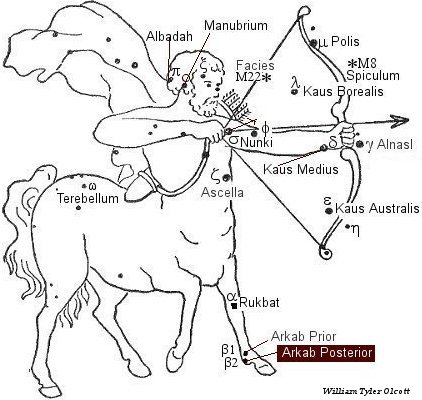 Beta (β) Sagittarius, Arkab Posterior, is a star in the constellation of the Archer. There are two beta stars in Sagittarius; β is Arkab Prior; and this star β, Arkab Posterior; the two stars are separated by 0.36°.
Arkab and Urkab are from Arabic Al ‘Urkub, translated by Ideler as the “Tendon uniting the calf of the leg to the heel”, or it is the tendon on the leg just above the ankle (in either man or horse) of Sagittarius, and this coincides with their location in the figure on modern maps, as well as with their Euphratean title Ur-ner-gub, the “Sole of the Left Foot” but Al Sufi and the engraver of the Borgian globe assigned these stars to the rear of the horse’s body.
Alpha (α Rukbat) and the two betas (β, Arkab Prior, and β, Arkab Posterior) were the Arabic Al Suradain, the two Surad, desert birds differently described, — by some as “larger than sparrows” and variegated black and white (magpies?); by others as yellow and larger than doves.
Star Names, Their Lore and Meaning, Richard Hinckley Allen, 1889].
The astrological influences of the constellation Sagittarius
The following are Ptolemy’s remarks: “The stars at the point of the arrow in Sagittarius have influence similar to that of Mars and the Moon: those on the bow, and at the grasp of the hand, act like Jupiter and Mars . . . those in the waist and in the back resemble Jupiter, and also Mercury moderately: those in the feet, Jupiter and Saturn.” … By the Kabalists Sagittarius is associated with the Hebrew letter Vau and the 6th Tarot Trump “The Lovers.” [Robson, p.60.]
The astrological influences of the constellation Sagittarius given by Manilius:
“As for the Archer, when the foremost portion of his cloak rises, he will give birth to hearts renowned in war and will conduct the conqueror, celebrating great triumphs in the sight of all, to his country’s citadels. Such a one will build high walls (moenia from Latin murus) one moment and pull them down the next. But if Fortune favours them too generously with success, the mark of her envy is to be seen on their faces, for she works cruel havoc upon their features. So was it that a dread warrior paid for his victories at the Trebia, Cannae, and the Lake, even before the hour of his retreat, with such disfigurement.” [Translator’s note: *Hanibal who lost an eye (Livy 22.2.11: Sagittarius is one-eyed; see p.103] [Manilius, Astronomica, 1st century AD, book 4, p.267]
“But they whose lot it is to be born under the Centaur of double form delight in yoking a team, in bringing a fiery horse to obey the pliant reins, in following herds which graze all over the grasslands, and in imposing a master on every kind of quadruped and taming them: they soften tigers, rid the lion of his fierceness, speak to the elephant and through speech adapt its huge bulk to human skills in a variety of displays. Indeed, in the stars of this constellation the human form is blended with a beast’s and placed above it; wherefore it has lordship over beasts. And because it carries a shaft poised on drawn bow, it imparts strength to limb and keenness to the intellect, swiftness of movement, and an indefatigable spirit.” [Manilius, Astronomica, 1st century AD, book 4, p.241.]
References:
Fixed Stars and Constellations in Astrology, Vivian E. Robson, 1923].