| Fixed star: ALPHIRK | |
| Constellation: Beta (β) Cepheus | |
| Longitude 1900: 04TAU11 | Longitude 2000: 05TAU33 |
| Declination 1900: +70.07′ | Declination 2000: +70.34′ |
| Right ascension: 21h 28m | Latitude: +71.09′ |
| Spectral class: B2 | Magnitude: 3.3 |
The history of the star: Alphirk
from p.158 of Star Names, Richard Hinckley Allen, 1889.
[A scanned copy can be viewed on this webpage
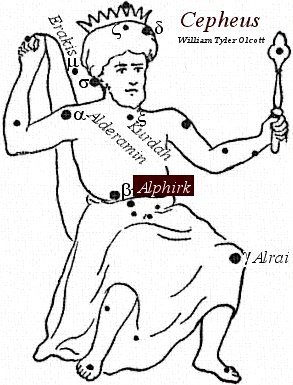
Beta (β) Cepheus, Alphirk, is a star under the belt on the right side of the Ethiopian King.
Alfirk (Arabic for “the Flock” according to Allen p.157) is now current for this star, although originally given to alpha (α Alderamin); and Ficares is occasionally seen, from one of the degenerated names for the whole constellation that also may have been applied by the Arabs to others of its brighter stars.
Star Names, Their Lore and Meaning, Richard Hinckley Allen, 1889].
The astrological influences of the constellation Cepheus
Legend: Cepheus, King of Æthiopia, was taken into heaven with his wife Cassiopeia and daughter Andromeda in commemoration of the deeds of Perseus. [Robson, p.37.]
Influences: According to Ptolemy, Cepheus is like Saturn and Jupiter. It gives authority and a sober mind, sometimes making its natives judges or arbitrators, but exposes to cruel and severe trials. If Mars afflicts the luminaries from Cepheus, especially if in an angle, it causes death by hanging, decapitation, crucifixion or impalement. By the Kabalists this constellation is associated with the Hebrew letter Shin and the 22nd Tarot Trump “The Fool.” [Robson, p.37.]
The astrological influences of the constellation Cepheus given by Manilius:
“Cepheus will not engender dispositions inclined to sport. He fashions faces marked by a stern demeanor, and moulds a countenance whereon is depicted gravity of mind. Such men will live on worry and will incessantly recall the traditions of a bygone age and commend old Cato’s maxims [Cato the censor].
“Cepheus will also create a man to bring up boys of tender age he will lord it over his lord [dominum dominus] by virtue of the law which governs a minor and, bemused by this semblance of power, will mistake for reality the role of arrogant guardian or stern uncle which he plays.
“Offspring of Cepheus (those influenced astrologically by Cepheus) will also furnish words for the buskin of tragedy [translator’s note; on the 2nd-century Farnese globe Cepheus is depicted in the garb of a tragic actor] whose pen, if only on paper, is drenched in blood; and the paper [the audience at a performance], no less will revel in the spectacle of crime and catastrophe in human affairs. They will delight to tell of scarce one burial accorded three [translator’s note; Thyestes unwittingly ate his three sons, whom, their extremities cut off, his brother Atreus served up to him as a meal: the burial incomplete because the sons were not completely eaten, took place in the father’s stomach – Cicero, who perhaps quotes the Atreus of Accius]. The father belching forth the flesh of his sons, the sun fled in horror, and the darkness of a cloudless day; they will delight to narrate the Theban war between a mother’s issue [between Eteocles and Polynices] and one [Oedipus] who was both father and brother to his children; the story of Medea’s sons, her brother and her father, the gift which was first robe and then consuming flame, the escape by air, and youth reborn from fire. A thousand other scenes from the past will they include in their plays and perhaps Cepheus himself will also be brought upon the stage.
“If anyone is born with the urge to write in lighter vein, he will compose for presentation at the merry games scenes of comedy about the loves of headstrong youths and abducted maidens, hood-winked old men, and slaves of infinite resource. In such plays Menander made his own day live for all generations: a man whose eloquence surpassed that of his native Athens [translator’s note; and that when its language attained its richest bloom], he held up a mirror to life and enshrined the image in his works.
“Should his powers not rise to such masterpieces, the child of Cepheus will yet be fitted to perform those of others he will interpret the poet’s words, now by his voice, now by silent gesture and expression, and the lines he declaims he will make his own.
“On stage he will take the part of Romans or the mighty heroes of myth; he will assume every role himself, one after another, and in his single person represent a crowd; he will draw over his limbs the aspect of fortune’s every vicissitude and his gestures will match the songs of the chorus; he will convince you that you see Troy’s actual fall and Priam expiring before your very eyes.” [Manilius, Astronomica, 1st century AD, book 5, p.336-341]
References:
Fixed Stars and Constellations in Astrology, Vivian E. Robson, 1923].