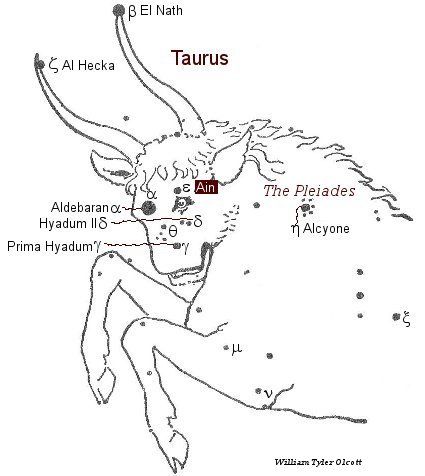
| AIN See also Prima Hyadum | |
| Epsilon Taurus | |
| 07GEM04 | 08GEM28 |
| +18.58'. | +19.11'. |
| 04h28m. | -02.34'. |
| G8. | 3.6. |
History of the star: One of the Hyades, one of six stars situated on the forehead marking the northern eye of the Bull Taurus. Other stars identified with the Hyades group are; Alpha Aldebaran (there is dispute whether this star is actually one of the Hyades); Theta 1 and Theta 2, Prima Hyadum (gamma); Hyadum 11 (delta).
Ain is from the Arabic 'Ain (1), the "Eye" (of the Bull), near which it lies. Flamsteed calling it Oculus boreus, the Northern Eye.
The Latin colloquial title for the Hyades was Suculae, "the Little Pigs", from Sus, "Sow". It was thought that there was a resemblance in shape of the outline of this star group to a pig's jaws; or because Aldebaran and its companion stars were like a sow with her litter. Pliny accounting for it by the fact that the continual rains of the season of their setting made the roads so miry that these stars seemed to delight in dirt, like swine!
[Star
Names, Their Lore and Meaning, Richard Hinchley Allen, 1889].
History of the Hyades: The Hyades were the seven daughter of Atlas and Aethra, half sisters of the Pleiades, with whom they were entrusted by Jupiter with the care of the infant Bacchus. They were placed among the stars as a reward for their sisterly love, which was evinced by their sorrow at the death of their brother Hyas (or Hylas) who was drowned in a well (in another version he was killed by a wild beast in Libya). The Roman poet Ovid (43bce-17ce) records that the sisters were grief-stricken when their mortal brother Hyas drowned in a well, and their tears fall on us as rain. "Hyades" means "rainy ones". The stars were of ill omen to farmers and sailors because the season of storms and heavy rains coincided with the time of their heliacal rising and setting (their first appearance after a time of invisibility, and their last appearance before becoming invisible again). During the classical times those periods were at the end of May and November.
Etymology: AIN the eye of the bull. AYiN means source of water or well, but it more clearly develops from the body’s source of water, the eye. AYiN or GHaYiN is eye in Hebrew, the entry on p. 70 (see below) shows how OGLE, OCULAR or Middle English eyne (eye) came from this source. Mention is made of the kabbalist Alef as ox (Taurus). The Alef letter glyph depicts an ox, a root heard in that most ALOOF of oxen, the ELEPH(ant) [Note that in Indian astronomy the constellation of Taurus was represented by an elephant]. The Taurus-Venus eye for aesthetics is a gift, but one must be careful of haughty or lustful eye. [Isaac Mozeson, author of The Word, Dictionary].
The Hyades are a stormy star group and was regarded as a separate constellation. Always stirring up furious quarrels; enemies of quiet and peace, inflames the minds of individuals who are restless and riotous, always stirring up popular dissent and revolution, madly desiring civil and domestic wars". Those born at this time take no pleasure in tranquillity and set no store by a life of inaction; rather they yearn for crowds and mobs and civil disorders. Sedition and uproar delight them; they long for the Gracchi to harangue from the platform, for a secession to the Sacred Mount, leaving but a handful of citizens the at Rome; they welcome fights which break the peace and provide sustenance for fears. Such are the qualities engendered by the Hyades at the rising of their stars.
[Manilius, book 5 of Astronomica, 1st century AD].
The astrological influences of the constellation: By the Kabalists Taurus is associated with the Hebrew letter Aleph and the 1st Tarot Trump "The Juggler". (Robson*).
The astrological influences given by Manilius for the constellation Taurus:
The Bull will dower the
countryside with honest farmers and will come as a source of toil
into their peaceful lives; it will bestow, not gifts of glory, but
the fruits of the earth. It bows its neck amid the stars and of
itself demands a yoke for its shoulders. When it carries the sun's
orb on its horns, it bids battle with the soil begin and rouses the
fallow land to its former cultivation, itself leading the work, for
it neither pauses in the furrows nor relaxes its breast in the dust.
The sign of the Bull has produced a Serranus and a Curius, has
carried the rods of office through the fields, and has left its
plough to become a dictator. [eque suo dictator venit aratro] Its
sons have the love of unsung excellence ; their hearts and bodies
derive strength from a massiveness that is slow to move, whilst in
their faces dwells the boy-god Love. [Astronomica,
Manilius, 1st century AD, book 4, p.233].
The astrological influences given by Manilius for the Hyades:
"The Hyades are a stormy star group and
was regarded as a separate constellation. Those born at this
time take no pleasure in tranquillity and set no store by a life
of inaction; rather they yearn for crowds and mobs and civil
disorders. Sedition and uproar delight them; they long for the
Gracchi to harangue from the platform, for a secession to
the Sacred Mount, leaving but a handful of citizens at Rome;
they welcome fights which break the peace and provide sustenance
for fears. They herd their foul droves over untilled
countryside, for this constellation also begot Ulysses' trusty
swineherd (Eumaeus,
or Eumaios, was Odysseus' swineherd
). Such are
the qualities engendered by the Hyades at the rising of their
stars". [Astronomica,
Manilius, 1st century AD, book 5, p.308-311].
General influence of the Hyades: According to Ptolemy they are of the nature of Saturn and Mercury; and, to Alvidas, of Mercury and Mars. Simmonite likens them to Mars but this is probably a misinterpretation of Ptolemy's meaning. They give tears, sudden events, violence, fierceness, poisoning, blindness, wounds or injuries to the head by instruments, weapons or fevers, and contradictions of fortune. (Robson*).
Striving for prestige leading to power
politics leads to tremendous success in life if bridled, if not, failure and a
fall from power. May exploit other human beings in quest of power. Staggering
increase in sexual urge, a dissolute life, excessive and licentious ways. (Fixed Stars and Their Interpretation, Elsbeth Ebertin, 1923)
Saturn-Mercury star in Ptolemy's
coding, which we might well describe as unhappy thoughts and so it shows up when
the star is on a difficult spot or planet in a horoscope. But if it be
harmonious in aspect, instead, the same star denotes a good clear thinker,
writer or speaker. (The Living Stars, Dr. Eric Morse).
Rising: Rising or culminating with luminaries, makes their natives military captains, commanders, colonels of horse and emperors. Injuries to the face, wounds, stabs (may be operations nowadays). Blindness, bad eyes. Imprisonment. (Robson*).
If culminating: Disgrace, ruin, violent death. (Robson*).
With Sun: Evil disposition, disturbed mind, failure in study, muddled thinking, misfortune, murderer or murdered, death by blows, stabs, shooting, beheading or shipwreck. (Robson*).
With Moon: Tactful, fair ability, difficulties connected with writings, may forge the name of employer or friend but finally escape punishment and retain position, liable to sickness and disgrace, danger of blindness or eye injuries. (Robson*).
With Mercury: Quick mind, resentful, hasty temper, broods over small troubles, favorable for gain. (Robson*).
With Venus: Many accomplishments, artistic, ability to write or paint, strong passions, which influence work. (Robson*).
With Mars: Abrupt, brave, aggressive, courageous, lacks concentration. (Robson*).
With Jupiter: Ambitious, dishonest, legal difficulties, quarrels with relatives, judicial sentence. (Robson*).
With Saturn: Caution, forethought, omnivorous reader, scientific, success but little prominence, worry and annoyance from relatives. (Robson*).
With Uranus: Scientific, literary, artistic and mystical interests, unconsciously psychic, greatly influenced by environment, favorable for marriage after 35 and for gain and children, ill-health, seldom long life. (Robson*).
With Neptune: Keen intellect, learned, kind-hearted, sympathetic, scientific and philosophical interests, some inventive genius often connected with etheric waves, which will bring fame but not wealth, broad and unorthodox religious views, benefits from companies, favorable for domestic matters, not good for children, brothers or sisters, knowledge gained psychically, sudden death while engaged in important work. (Robson*).
"The Hyades with Neptune in the 8th
causes confused ideas, making 'world saviors' and leading to delusions of
grandeur", Vehlow wrote this before 1934. It is therefore hardly possible that
he meant this to refer to Hitler in whose nativity Pluto is found in conjunction
with the Hyades and nearby positioned is Neptune in the 8th house."
(Fixed Stars and Their Interpretation, Elsbeth Ebertin, 1923)
References
*(Fixed Stars and Constellations in Astrology , Vivian E. Robson, 1923)