| Fixed star: ACAMAR | |
| Constellation: Theta (θ) Eridanus | |
| Longitude 1900: 21ARI52 | Longitude 2000: 23ARI16 |
| Declination 1900: – 40.42 | Declination 2000: – 40.19 |
| Right ascension: 02h 58m | Latitude: -53.45 |
| Spectral class: A2 | Magnitude: 3.4 |
The history of the star: Acamar
from p.219 of Star Names, Richard Hinckley Allen, 1889.
[A scanned copy can be viewed on this webpage
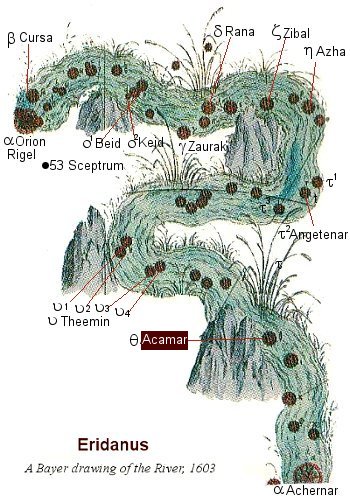 Theta (θ) Eridanus, Acamar, is a star in the River.
In Classical times, this star, Acamar, was the most southerly bright star in the River Eridanus that could be seen from the latitude of Greece. It marked the south end of the River, until travellers reaching more southerly locations in the 16th century described the River as extending to alpha (α), Achernar
Achernar, from Arabic Al Ahir Al Nahr, “the end of the river”, was the early name for this star at the then recognized end of the Stream (the south end of Eridanus is now marked by the star Achernar, alpha α Eridanus). Various forms of its title are given under alpha (α, Achernar), but the name Acamar, from the AlfonsineTables, is peculiar to this star theta (θ) Eridanus.
The fifteenth century Tartar astronomer Ulug Beg called it Al Thalim, the Ostrich, but the seventeenth century English orientalist Thomas Hyde rendered this the Dam, as if blocking the flow of the stream to the south.
The Greco-Persian astronomer Chrysococca had it as GreekAulax, “the Furrow”, equivalent to the sulcus (“furrow”) of the Latins used by Vergil to denote the track of a vessel, appropriate enough to a star situated in the Stream of Ocean (Eridanus, the River).
It has been said that its brilliancy has probably lessened since the second-century Greek astronomer Ptolemy’s time, for the latter designated it by alpha (α) — i. e. of the 1st magnitude.
Star Names, Their Lore and Meaning, Richard Hinckley Allen, 1889].
The astrological influences of the constellation Eridanus
Legend: Eridanus represents the river Padus or Po into which Phaeton fell when slain by Jupiter for having set the world on fire by misguiding the chariot of his father Phoebus. [Robson, p.44.]
Influences: According to Ptolemy all the stars with the exception of Achernar are like Saturn. Eridanus gives a love of knowledge and science, much travel and many changes, a position of authority, but danger of accidents especially at sea and of drowning. [Robson, p.44.]
The astrological influences of the star Acamar
Success in public office, ecclesiastical success. [Fixed Stars and Judicial Astrology, George Noonan, 1990, p.47.]
References:
Fixed Stars and Constellations in Astrology, Vivian E. Robson, 1923].