Webster’s Online Dictionary
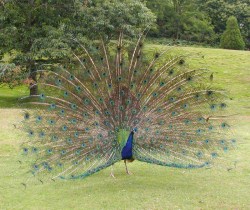
Pavo represents the male peacock (pavo cristatus; crested pavo), a male peafowl of the pheasant family. The feathers of its spectacular long tail, or train, are marked with iridescent eyelike spots and that can be spread in a fanlike form. The tail consists of some 250 long feathers, about 150 of which are decorated with a purplish black-centred coppery eye-spot []. The peacock was endowed with the power to kill snakes, and apparently they are known to eat small poisonous snakes []. Because of its ability to swallow snakes and assimilate their venom, it was seen as a symbol of transmutation, and the venom gave its flesh an immunity to decay. It also accounted for its colorful plumage: “The shimmering colors of his tail feathers were explained by his supposed ability to transform snake venom into solar iridescence” [].
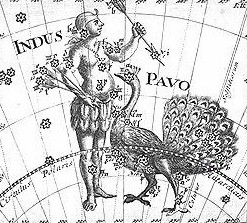
IndusandPavoin Corbinianus Thomas,Firmamentum firmianum, 1730
Indus and Pavo, the Indian and the Peacock, are usually depicted together. The Peacock appears to be watching the figure of the Indian. Indus, might also represent Io, the heifer. In his Metamorphoses the Roman poet Ovid tells how Io was seduced by Zeus (Jupiter), Hera’s husband. In a vain attempt to hide his crime, Zeus changed himself into a cloud (the Small Magellanic Cloud is close to Indus in the adjacent constellation Tucana) and transformed Io into a heifer to escape Hera’s detection. Hera was not fooled. She demanded the heifer as a present, and Zeus could not refuse her without arousing suspicion. Hera tethered Io to an olive-tree and appointed Argus to be the guardian of the heifer. Argus, or Argos, surnamed Panoptes (pan-, ‘all’, + optes, ‘eyes’), was a giant covered in eyes, depending on the version of the myth he had a hundred, a thousand, or ten thousand eyes. Hermes was sent to distract the guardian and slay him. Hermes, disguised as a shepherd, first put all of Argus’s eyes asleep with boring stories then cut off his head. Hera (Juno) placed the eyes of Argus Panoptes ‘who sees all’, or ‘all eyes’, on the peacock’s tail. These ‘eyes’ are said to represent the stars in the night sky, or the whole starry sky. Argus never slept, he always had half his eyes open and half closed in sleep at any one time. This might relate to the fact that the Sun is shining on half the earth at any one time while the other half is in darkness under the night stars. Mercury/Hermes, messenger of the gods, (a planet travelling close to the Sun, sometimes appearing before, and with the Sun’s rising, at other times with the Sun’s setting), cut off Argus’ head and thus quenching the lights of the eyes; the lights of the stars.
The argus pheasant is a relative of the peacock, Pavo cristatus. Argus’ name is said to be cognate with the Argo of Argo Navis (Jason entrusted the building of the ship to Argus, after whom it was named), and also with Latin argentum, silver, and it was said that Indus, a neighboring constellation, king of Scythia, first discovered silver, Latin argentum, the word is cognate with the word Argus (according to Klein).
The word peacock is related to Pavo, pavan or pavane (peacock dance, a processional dance common in Europe during the 16th century). Taos is the Greek name for the peacock, the French word is paonPavonated means peacock blue. Latin paupulo is ‘the natural sound of the peacock’.
Ponceau is the ‘corn poppy‘ from Old French poncel, a derivative of paon, ‘peacock‘, from Latin pavanem, accusative of pavo, ‘peacock‘. French paon was used in some North French dialects in the sense of ‘poppy‘ (Klein, p.576.) “The word poppy, is from Vulgar Latin papavum (whence also Old French pavo)” [Klein, p.577]. The word poppy comes from Latin papaver, ‘poppy’. Opium is the solidified juice of the opium poppy, from Greek opos (<*hopos), juice. The peacock was put in the heavens by Juno and the eyes of Argus Panoptes ‘who sees all’ was ‘all eyes’ (ocelli, eye-spots) were put on its tail. [There is a resemblance between Greek ops, genitive opos, ‘eye’, opsis, ‘sight’ (the first is omega), and Greek opos, opium (the first is omicron)?]
“The peacock is called pavo, therefore, from pavor, fear, since its cry produces fear in those who hear it” [Aberdeen Bestiary
Latin pavor is related to Latin pavere, to fear, and the word pavid, ‘exhibiting or experiencing fear’, from the Indo-European root *pau-² ‘To cut, strike, stamp’. Derivatives include: putamen (an outer layer), putative (supposed), account, amputate, compute, computer, count¹ (in numbers), depute, dispute, impute, repute, (these words from Latin putare, to prune, clean, settle an account, think over, reflect), computer (from Latin computare which means ‘to reckon together’, from com- ‘together’ and putare ‘to think, to reckon’), deputy, recount, reputation. b. Possibly Latin puteus, well: pit¹ (a hole or cavity in the ground.), pave or pavé (pavement, from Latin pavire, to beat), pavid (timid, from Latin pavire, to fear < ‘to be struck’), raconteur ( re– + aconter. One who tells stories and anecdotes with skill and wit). [Pokorny 3. peu– 827. Watkins
Klein sees the word paean, ‘a hymn, a song, joy and triumph’, from Greek paian, as a likely cognate, a paean is hymn of thanksgiving, often addressed to Apollo, literally ‘one who touches’, whence used in the sense ‘one who heals by a touch’, from Greek paio, paiein
Isidore gives his view on how many of these words are related to each other:
“Pavements (pavimentum) that are worked out with the skill of a picture have a Greek origin; mosaics (lithostratum) are made from little pieces of shell and tiles colored in various hues. They are called pavements because they are ‘rammed down’ (pavire), that is, beaten. From this also comes the word ‘dread’ (pavor), which strikes the heart” [p.312.]. “Alarmed (pavidus) is one whom agitation of mind disturbs; such a one has a strong beating of the heart, a moving of the heart – for to quake (pavere) is to beat, whence also the term pavimentum (beaten floor; cf. pavire, ‘ram down’)” [p.227.]. [The Etymologies of Isidore of Seville, 7th century AD]
Pavements are often made with pebbles and counting was done with pebbles. The word pave can also have the meaning ‘pave the way’, to prepare a smooth easy path. Hermes amputated the head of Argus, and his eyes were put on the tail of the Peacock by Hera. The peacock represents the starry heavens, the counting of stars is mentioned in the bible:
“Now look toward the heavens, and count the stars, if you are able to count them.” And He said to him, “So shall your descendants be.” (Genesis 15:5). “I will multiply your descendants as the stars of the heavens” (Exodus 32:13
“The number five is cognate with Old Indian panca, Tocharian A pan, Greek pente, etc. Plutarch says “five is analogous partly to the father and partly to the mother, being made up of a triad and dyad. Panta (all) is cognate with pente (five), and they [the ancient Egyptians] say ‘to reckon by fives’ for ‘to count‘.” [Plutarch. De Iside et Osiride. Ed. with intro J. Gwyn Griffiths. Cambridge: U of Wales P, 1970]. A star has five points.
The outer dark layer of the lenticular nucleus in the brain is called the putamen. It appears to play a role in reinforcement learning. Putamen is also a botanical term for the stone in a fruit, such as a peach [].
One of the attributes given to the peacock is compassion [], from the Indian story of a peacock taking pity on Indra and to hide him from his enemies, raised its tail to form a blind or screen behind which Indra could hide himself. As a reward for this act of compassion, the bird was honored with the jewel-like blue-green plumage that it bears to this day [].
Patient (patiens) is so called from ‘striking’ – for pavere (i.e. pavire) is ‘strike’ – for such a one is beaten and endures it.” [p.225.] [The Etymologies of Isidore of Seville, 7th century AD]
The words patience and compassion come from the Indo-European root *péi Also pe-, pi-. ‘To hurt’. Derivatives: fiend (a diabolically evil or wicked person, from Old English feond, enemy, devil, hating, hostile), passible, passion, passive, patient (Latin patiens), compassion, (these words from Latin pati, to suffer). [Pokorny pe(i)– 792. Watkins
The Medieval Bestiary said the peacock had the voice of a fiend
“… he hath the voice of a fiend, head of a serpent, pace of a thief. For he hath an horrible voice. ” Bartholomaeus Anglicus [13th century CE] (De proprietatibus rerum, book 12)
Julius Schiller united Pavo with Indus in his biblical figure ‘. Job.’ Job is a character in the Book of Job in the Bible. The devil inflicted great suffering on him. “You have heard of the patience of Job, and you have seen the end of the Lord, that the Lord is merciful and compassionate” [James 5:11
_______
“Then Hermes told this story [of Pan and his pursuit of the Nymph Syrinx] … The tale remained untold; for Cyllenius [Hermes] saw all Argus’ eyelids closed and every eye vanquished in sleep. He stopped and with his wand, his magic wand, soothed the tired resting eyes and sealed their slumber; quick then with his sword he struck off the nodding head and from the rock threw it all bloody, spattering the cliff with gore. Argus lay dead; so many eyes, so bright quenched, and all hundred shrouded in one night. Saturnia [Hera] retrieved those eyes to set in place among the feathers of her bird [the peacock, Pavo] and filled his tail with starry jewels.” – Ovid, Metamorphoses 1.624 [
Pavo, might relate to the god Pan. Charles de Kay in Bird Gods says; “[the peacock’s] name is a variant on that of Pan and generally keeps the initial P, even when, as in Latin pavo, Esthonian pabu, it drops the n. Catalonian has an odd 132 form pago; Burgundian French had paivo; but the Berry dialect retains the n in pante, peahen. [Bird Gods1898, Charles de Kay, p.132] The French for peacock is paon, Welsh, Serbo-, and Romanian, have paun, for peacock.
According to Ovid (above) Mercury told (recounted) a story to Argus [Argos Panoptes, Argos ‘all eyes’] as he was trying to lull him to sleep (just before he cut off his head); about how the amorous god, Pan, chased the chaste nymph, Syrinx, and before he could catch up with her she was transformed into reeds of which Pan made his pan-pipes []. This happened before Mercury cut off Argus’ head and before Argus’ eyes were scattered on the tail of the peacock by Hera/Juno; suggesting that this story had something to do with what was about to happen, perhaps that Argus was about to become Pan. [Aigipan, the goat-fish of Capricorn, is distinct from Pan [10]].
“Originally an attribute of Pan, he yielded it [the peacock] to Hera/Juno as symbolizing the starry firmament; the Argus eyes are scattered over the tail by Hera” [J.C. Cooper, p.127].
Both Pan and the peacock’s tail are representatives of the starry heavens:
“They made Pan the symbol of the universe, and gave him his horns as symbols of sun and moon, and the fawn skin as emblem of the stars in heaven, or of the variety of the universe.” [Porphyry (c. 232 AD – c. 304) Fragment 8]
Pan, Greek god of the shepherds, is also the prefix in the word pa-on, which means ‘shepherd’ and shares its prefix with the modern English word ‘pasture’ [11]. In Mesopotamia and the ancient middle-eastern regions the terms sheep or flocks was a metaphor for stars. “Tammuz, the moon god, was given the title of shepherd, the stars being his flock” (Penguin, p.874). Various groups of stars were referred to as sheepfolds. The ‘straying sheep’ was a metaphor for the ‘wandering planets’. This Jupiter Projectwebsite explains that the meaning of the biblical passage Luke 2:8, “shepherds watching their flock by night” says it meant star-gazing.
“The peacock, as Isidore says, gets its name from the sound of its cry. For when it starts, unexpectedly, to give its cry, it produces sudden fear in its hearers. The peacock is called pavo, therefore, from pavor, fear, since its cry produces fear in those who hear it” [from Aberdeen Bestiary webpage].
Latin pavor (which Isidore thinks is related to Pavo) is often translated into English as panic [12], although these two words are not recognized cognates. Pan inspired sudden fear in lonely places; “For causeless terrors are said to come from the god Pan” [Pausanias], which gave us the words panic and pandemonium (the screeching of a harem of peacocks might sound like a pandemonium). Pan sometimes appeared to travellers startling them with a sudden awe or terror. Hunters owed their success to him, and if they were unsuccessful they used to scourge (pavire, to beat?) his statue [13]. The word pan means ‘all’ and some believe that the whole starry sky influences all things. He is often referred with the title ‘god’, ‘the god Pan’, more so than other Greek gods.
In Australia “the Saucepan” is sometimes used as an unofficial name for part of the constellation of Pavo, when finding the south by the stars [14].
“The peacocks erect and fan out their trains, drooping their half-open wings to the sides and strut and prance from one foot to the other, shivering from time to time to produce a spectacular shimmering, psychedelic display” [Raghavendra Gadagkar].
© Anne Wright 2008.
| Fixed stars in Pavo | |||||||
| Star | 1900 | 2000 | R A | Decl 1950 | Lat | Mag | Sp |
| eta | 26SAG35 | 27SAG58 | 265 12 18 | -64 42 10 | -41 18 08 | 3.58 | K1 |
| pi | 29SAG52 | 01CAP15 | 270 56 29 | -63 40 24 | -40 13 46 | 4.44 | A5 |
| xi | 02CAP08 | 03CAP31 | 274 39 18 | -61 31 10 | -38 07 09 | 4.25 | M1 |
| zeta | 03CAP44 | 05CAP07 | 279 18 03 | -71 28 28 | -48 10 16 | 4.10 | K0 |
| kappa | 06CAP15 | 07CAP38 | 282 57 05 | -67 17 57 | -44 09 52 | var | G0 |
| lambda | 06CAP25 | 07CAP48 | 281 53 51 | -62 14 52 | -39 05 43 | 4.42 | B2 |
| epsilon | 12CAP09 | 13CAP32 | 298 42 41 | -73 02 44 | -50 52 40 | 4.10 | A0 |
| delta | 16CAP13 | 17CAP36 | 300 57 36 | -66 18 44 | -44 40 25 | 3.64 | G4 |
| beta | 21CAP07 | 22CAP30 | 310 07 09 | -66 23 05 | -45 56 57 | 3.60 | A5 |
| Peacock alpha | 22CAP25 | 23CAP49 | 305 25 33 | -56 53 50 | -36 15 38 | 2.12 | B3 |
| gamma | 27CAP13 | 28CAP36 | 320 35 02 | -65 35 39 | -46 58 34 | 4.30 | F8 |