The constellation Gemini depicts the two Dioscuri or heavenly twins, Castor and Pollux, the names of the two brightest stars in the constellation. The twins were the sons of Leda, wife of Tyndareus, the king of Sparta. Castor was the mortal son of Tyndareus, and Pollux the divine son of Zeus who seduced Leda in the guise of a swan. They were born or hatched from an egg and were pictured with half of the severed egg on each of their heads as a cap or helmet.
In mythology the Twins were involved in cattle theft, it was during a dispute over the division of spoils of a cattle raid with their cousins that Castor met his death. Pollux was granted immortality by Zeus, but he persuaded Zeus to allow him to share the gift with Castor. As a result, the two spend alternate days on Olympus (as gods) and in Hades (as deceased mortals) []. The stars Castor and Pollux are never above the horizon at the same time.
The Gemini twins, Castor and Polydeukes (Pollux), are the Greek Dioscuri (Dioskouroi, from dios, god, + kouroi, boys, the sons of Dios, God, or the ‘sons of Zeus’, from Greek -kouros, a growing boy). For the mythology of the Dioskouroi see http://www.theoi.com/Ouranios/Dioskouroi.html
The word ‘Gemini‘ has few known relatives and comes from the Indo-European root *yem– ‘To pair’. Derivatives: geminate (in pairs), Gemini, gimmal (gimmal or gimbal, double ring, French gemeau, jumeau), bigeminal. [Pokorny iem– 505. Watkins] In Greek didumos, means twin, or double.
Klein sees the word Gemini as a likely relative of Indic Yama and his sister Yami who are opposite-sex twins:
“Gemini, Latin, ‘twins’, specifically ‘the constellation Castor and Pollux’; probably cognate with Old Indian yamah, Avestic yemo, ‘twin’, Middle Irish emon (masculine), emuin (feminine), ‘pair of twins’. These words possibly derive from Indo-European base gem [*yem-], ‘to press’, whence also Greek gemein, ‘to be pregnant, to be full of, Middle Irish gemel, Welsh gefyn, ‘fetter'” [Klein, Comprehensive Etymological Dictionary].
“Yama and his twin sister Yami, later his wife, were the first couple to inhabit the earth (a sort of Hindu parallel of Adam and Eve)” []?
Yama, in Hindu mythology, was the first of men that died, the judge of the dead from Old Indian Yamah, of uncertain origin. It means perhaps literally ‘the restrainer’, from Old Indian yamah, ‘rein, bridle’ [the twins, Castor and Pollux were horsemen], and is related to yamati, yacchati, ‘holds together, reins in, curbs’ and possibly cognate with Latin red-imio, + -ire, ‘to wreathe round’, redimiculum, ‘band, fillet, frontlet'” [Klein]. Yima, is the Avestic equivalent of Yama (Persian mythology) — Avestic Yima-, related to Old Indian Yamah. “In Vedic tradition Yama was considered to have been the first mortal who died and espied the way to the celestial abodes, and in virtue of precedence he became the ruler of the departed. Yama’s name can be interpreted to mean ‘twin’, and in some myths he is paired with a twin sister Yami” []. “In Hindu myth, there are many hells, and Yama, Lord of Justice, sends human beings after death for appropriate punishment. In Vedic beliefs, Yami is the first woman, along with her twin brother, Yama. In Tibetan beliefs, Yami is a goddess of death and rules the female spirits of the underworld (Naraka). She is the consort of Yama, lord of the underworld” [].
The vegetable yam, of the genus Dioscorea, is the sweet potato, from Senegal nyami, ‘to eat’. From Susaraqy a contributor to the Discussion List
“Dioscorea species contain diosgenin, which is estrogenic and is used as a commercial precursor for various steroids. In Panama (and I believe elsewhere) some preparations are used to treat arthritis http://www.ars-grin.gov/duke/dictionary/tico/d.html A quick google shows there is a rich ethnobotany for these plants, which may be relevant to your etymology exploration for Gemini.”
Gemini are the twin sons of Leda, born from an egg after Jupiter made love to her disguised as a swan (Cygnus). The creation of twins happens at a very early stage after conception. The zygote stage is a one celled entity (see the adjoining constellation Orion whose appellation is ‘Jugula’, a cognate of ‘zygote’). The ovum or egg first divides into two identical twin cells. At this stage the two cells can break apart to form two embryos. This phase relates to gemination (doubling) of the cells, the division and multiplying of cells; whether or not the cells break apart or form twins or remain together to form one embryo.
The cells of the body are likened to bricks as indicated in such instructive commentary as; “the human body is built out of billions of bricks; the cells”, or “the cells are the building bricks of life” etc. A symbol for Gemini was ‘a Pile of Bricks‘, referring to the building of the first city and the fratricidal brothers, and the Sumerian name for the month May-June, when the sun was in Gemini, signified ‘Bricks’ [Allen, Star Names]. Masonry is the craft of piling one stone or brick upon another. Mason is related to the word make, mate, and match, from Old English gemaca, related to gemæcca, ‘one of a pair, mate, consort’, gemaecc, ‘well-matched, suitable’. [These words correspond phonetically and semantically to gemini, although they are not recognized cognates].
The Gemini twins were said to be born of the same mother but different fathers. In English we use the same terms, brothers or sisters, for offspring of either the maternal or paternal parent. It seems there was a distinction in Latin between maternal and paternal siblings. One title the twins were known of in Roman times (see Allen below on they page) was DiiGermani, the Brother Gods. Technically they are not ‘brothers’ (‘brother’, Latin frater) because ‘brother’ was understood to be from the father’s seed, they were ‘maternal brothers’ (Latin germanus). So it would seem more likely that germanus might be a better fit for this constellation than frater, or English brother: Also used in Latin ‘frater germanus‘ ‘true brother’ ‘sor germana‘ ‘true sister’. The Latin word geminus ‘twofold; twin’, appears fairly similar to the Latin word germanus ‘brother’.
“Brothers (Latin frater) are so called because they are of the same fruit (fructus), that is, born of the same seed. However, ‘maternal brothers’ (germanus) are those issuing from the same mother (genetrix) and not, as many say, from the same seed (germen); only the latter are called fratres. Therefore fratres issue from the same fruit, and germani from the same mother”. [Isidore, The Etymologies 7th century AD, p.208.]
Castor (alpha Gemini) is also the Greek name for the beaver, and beavers are of the genus Castor
Pollux: According to WikipediaCastor means ‘beaver’ in both Greek and Latin, and polydeukes (Polydeuces, Poludeukes, Polydeukous, Latinized as Pollux) means “much sweet wine”. Greek polus, ‘much, many’, + deukes, ‘sweet’; “very sweet”.
Polydeuces might also relate to “many twos”, –deuces, from Greek duo (duce, deuce etc);
“Polydeukes chose for both this twofold life” [- Pindar, Odes Nemean 10 ep3-ep5
to share half their days in Heaven and half in Hades.
Another explanation comes from The Lost Language of Symbolism; “In Greece the Twins were known as olydeuces, a word which as it stands means many dukes or many leaders. The word deuce used to-day [early 20th century] as an ejaculation, may be equated with the first syllable of disheal !–an exclamation which is made in the Highlands on any sudden peril or emergency.”
Jana Thompson of the American Philological Association examines the name Poludeukes and gives some interesting suggestions.
According to traditional astrology where all things have their own specific rulerships in the zodiac, the sign Gemini rules birds. In myth the twins Castor and Pollux emerged from eggs and have made appearances to armies and sailors in egg-shell caps. Many birds employ the same masonry techniques in their nest-building as humans use to make bricks and build, they too use mud mixed with fibrous material like chaff and straw.
 ] Gemini had a title ‘the pile of bricks’, and also the Sumerian name for the month when the sun was in Gemini, signified ‘Bricks’: Gemini is ruled by Hermes/Mercury. The name Hermes comes from herma the Greek word for a cairn or heap of stones.
Bricks and the building of cities are an aspect of Gemini symbolism. It may be that the word Castor is related to Anglo-Saxon –ceaster, meaning city or town as in the suffix of names of English cities Winchester, Dorchester, Chichester, Manchester, etc. These -ceasters were originally towns built around fortified Roman army camps.
The name Pollux looks similar to the Greek word for city, polis, and citizen, polites, from Indo-European *pele-3
The Dioskouroi, Castor and Pollox, appeared to sailors in distress during storms in the form of two lights, St. Elmo’s fire, the electrical discharge which creates a glow about the mast-head (Pyxis) and rigging of ships. In astrology Gemini rules the lungs, and human lungs used to be called “the lights”. The English word “light” (‘not heavy’) is completely unrelated to light (‘not dark’), but it comes from the same source as the word “lung” (from IE *legwh-). In mythology on the Argo voyage Castor & Pollux demonstrated they had power over the winds and waves. Wind and breath are metaphorically linked; breath comes from the lungs.
“The apparatus of the circus comprises the ‘eggs,’ the turning posts, the obelisk, and the starting-gate. Some people say the ‘eggs’ (i.e. objects used to mark the number of circuits of the chariots) are in honor of Pollux and Castor; these same people do not blush to believe that these two were begotten from an egg sired by Jupiter as a swan.” [Isidore, The Etymologies 7th century AD, p.367.]
The astrological influences of the constellation given by Manilius:
“The arms to shoulders joined are accounted to the Twins” – Manilius p.119
“From the Twins come less laborious callings and a more agreeable way of life, provided by varied song and voices of harmonious tone, slender pipes, the melodies inborn in strings and the words fitted thereto: those so endowed find even work a pleasure. They would banish the arms of war, the trumpet’s call, and the gloom of old age: theirs is a life of ease and unfading youth spent in the arms of love. They also discover paths to the skies, complete a survey of the heavens with numbers and measurements, and outstrip the flight of the stars nature yields to their genius, which it serves in all things. So many are the accomplishments of which the Twins are fruitful.” [Manilius, Astronomica, 1st century AD. p.235.]
© Anne Wright 2008.
| Fixed stars in Gemini | |||||||
| Star | 1900 | 2000 | R A | Decl 1950 | Lat | Mag | Sp |
| Propus eta | 02CAN02 | 03CAN26 | 092 57 53 | +22 31 23 | -00 53 40 | 3.30 var | M3 |
| Tejat Posterior mu | 03CAN54 | 05CAN18 | 094 59 02 | +22 32 28 | -00 49 30 | 3.19 | M3 |
| nu | 05CAN25 | 06CAN48 | 096 29 56 | +20 14 44 | -03 03 45 | 4.06 | B5 |
| Alhena gamma | 07CAN42 | 09CAN06 | 098 42 21 | +16 26 37 | -06 44 54 | 1.93 | A1 |
| Mebsuta epsilon | 08CAN33 | 09CAN56 | 100 12 51 | +25 10 57 | +02 03 50 | 3.18 | G8 |
| theta | 09CAN44 | 11CAN07 | 102 22 26 | +34 01 25 | +11 01 29 | 3.64 | A2 |
| Alzirr xi | 09CAN50 | 11CAN13 | 100 37 15 | +12 57 04 | -10 06 28 | 3.40 | F5 |
| Mekbuda zeta | 13CAN36 | 14CAN59 | 105 17 11 | +20 38 43 | -02 02 42 | 3.08 var | G0 |
| Wasat delta | 17CAN07 | 18CAN31 | 109 17 04 | +22 04 34 | -00 11 03 | 3.51 | A8 |
| lambda | 17CAN24 | 18CAN47 | 108 48 18 | +16 37 56 | -05 38 26 | 3.65 | A2 |
| iota | 17CAN37 | 19CAN01 | 110 39 29 | +27 53 57 | +05 45 14 | 3.89 | G7 |
| rho | 17CAN42 | 19CAN05 | 111 28 28 | +31 53 08 | +09 48 03 | 4.18 | A8 |
| Castor alpha | 18CAN51 | 20CAN14 | 112 51 11 | +31 59 58 | +10 05 30 | 1.58 | A2 |
| upsilon | 19CAN58 | 21CAN21 | 113 12 39 | +27 00 31 | +05 12 42 | 4.22 | MO |
| sigma | 21CAN15 | 22CAN38 | 115 02 51 | +29 00 22 | +07 26 51 | 4.26 | K1 |
| Pollux beta | 21CAN50 | 23CAN13 | 115 33 54 | +28 08 55 | +06 40 50 | 1.21 | K0 |
| kappa | 22CAN17 | 23CAN40 | 115 21 29 | +24 31 11 | +03 04 26 | 3.68 | G7 |
from Star Names, 1889, Richard H. Allen
Then both were cleansed from blood and dust
To make a heavenly sign;
The lads were, like their armour, scoured,
And then hung up to shine;
Such were the heavenly double-Dicks,
The sons of Jove and Tyndar.
— John Grubb, in Percy’s Reliques of Ancient English Poetry
The conception of a sky couple for these stars has been universal from remote antiquity, but our Latin title dates only from classical times, varied by Gemelli, which still is the Italian name. The Anglo-Saxons knew them as ge Twisan, and the Anglo-Normans as Frere; the modern French as Gemeaux, and the Germans as Zwillinge, Bayer’s Zwilling
While on earth these Twins were sons of Leda, becoming, after their transfer to the sky, Geminum Astrum, Ledaei Fratres, Ledaei Juvenes, and Ledaeum Sidus; Dante calling their location Nido di Leda, the Nest of Leda. Cowley, the contemporary of Milton, wrote of them as the Ledaean Stars, and Owen Meredith of our day as
The lone Ledaean lights from yon enchanted air.
They also were Gemini Lacones, — Milton’s Spartan Twins and William Morris’ Twin Laconian Stars; Spartana Suboles from their mother’s home, and Cycno generati from her story; Pueri Tyndarii, Tyndarides, Tyndaridae, and Horace’s clarum Tyndaridae Sidus, from Tyndarus, their supposed father; while the Oebalii and Oebalidae of Ovid, Statius, and Valerius Flaccus are from their grandfather, Oebalus, king of Sparta. Manilius called them Phoebi Sidus as being under Apollo’s protection.
{Page 223} Individually they were CastorandPollux, — Dante’s and the Italians’ Castore e Polluce; Apollo and Hercules, Triptolemus and lasion, Theseus and Pirithous. Horace wrote Castor fraterque magni Castoris; Pliny, Castores; and Statius had alter Castor from their alternate life and death that the modern James Thomson repeated in the Summer of his Seasons
Th’ alternate Twins are fix’d.
But Welcke gave an astronomical turn to these titles by seeing in the first Astor, the Starry One, and in Pollux Polyleukes, the Lightful.
With the Greeks they were Didumoi, the Twins, — Riccioli’s Didymi, — originally representing two of the Pelasgian Kabeiroi (Cabeiri), but subsequently the Boeotian Ephestioi (Greek ephestioi is translated ‘hearth’), —Dioscuri in Rome, — the Sons of Zeus; as also AmphionandZethus, Antiope’s sons, who, as Homer wrote, were
Founders of Thebes, and men of mighty name,
strikingly shown on the walls of the Spada Palace in Rome, and with the Farnese Bull now in the Naples Museum. Plutarch called them Anakes, Lords, — Cicero’s Anaces, — and Sio, the Two Gods of Sparta; Theodoretus, Ephestioi, the Familiar Gods; others, DiiSamothraces, from the ancient seat of worship of the Cabeiri; and DiiGermani, the Brother Gods.
In India they always were prominent as Acvini, the Ashwins, or Horsemen, a name also found in other parts of the sky for other Hindu twin deities; but, popularly, they were Mithuna, the Boy and Girl, the Tamil Midhunam, afterwards changed to Jituma, or Tituma, from the Greek title.
A Buddhist zodiac had in their place a Woman holding a golden cord.
Some of the Jews ascribed them to the tribe of Benjamin, although others more fitly claimed them for Simeon and Levi jointly, the Brethren. They called them Teomim; the Tyrians, Tome; and the Arabian astronomers, AlTau’aman, the Twins; but in early Desert astronomy their two bright stars formed one of the fore paws of the great ancient Lion; although they also were AlBurjalJauza’, the Constellation of the Twins. From this came Bayer’s Algeuze, which, however, he said was unrecht, thus making Riccioli’s Elgeuzi and Gieuz equally wrong. Hyde adopted another form of the word, — Jauzah, the Centre, — as designating these stars’ position in mediocoeli, or in a region long viewed as the centre of the heavens; either because they were a zenith constellation, or from the brilliancy of this portion of the sky. Julius Pollux, the Egypto-Greek writer of our second century, derived the title from Jauz, a Walnut, as mentioned in his Onomasticon. But there is much uncertainty as to the {Page 224} stellar signification and history of this name, as will be further noticed under Orion
The 1515 Almagest has the inexplicable Alioure, said to be from some early edition of the AlfonsineTables
The Persians called the Twins DuPaikar, or DoPatkar, the Two Figures; the Khorasmians, Adhupakarik, of similar meaning; and Riccioli wrote that they were the “Chaldaean” Tammech
Kircher said that they were the Klusus, or ClaustrumHori, of the Egyptians; and others, that they represented the two intimately associated gods, HorustheElder, and HorustheYounger, or Harpechruti, — the Harpocrates of Greece.
The Twins were placed in the sky by Jove, in reward for their brotherly love so strongly manifested while on earth, as in the verses of Manilius:
Tender Gemini in strict embrace
Stand clos’d and smiling in each other’s Face;
and were figured as Two Boys, or Young Men, drawn exactly alike:
So like they were, no mortal
Might one from other know;
or as Two Infants, DuoCorpuscula. But Paulus Venetus and other illustrators of Hyginus showed TwoAngels, and the Venetian edition of Albumasar of 1489 has two nude seated figures, a Boy and a Girl, with arms outstretched upon each other’s shoulders.
The LeydenManuscript shows two unclad boys with Phrygian caps, each surmounted by a star and Maltese cross; one with club and spear, the other with a stringed instrument. Bayer had something similar, Pollux, however, bearing a peaceful sickle.
Caesius saw here the TwinSonsofRebecca, or DavidandJonathan; while other Christians said that the stars together represented Saint James the Greater; or, to go back to the beginning of things, Adam and Eve, who probably were intended by the nude male and female figures walking hand in hand in the original illustration in the AlfonsineTables. A similar showing appears, however, on the Denderah planisphere of 1300 years previous.
The Arabians drew them as Peacocks, from which came a mediaeval title, DuoPavones; some of the Chaldaeans and Phoenicians, as a PairofKids following Auriga and the Goat, or as TwoGazelles; the Egyptians, as TwoSproutingPlants; and Brown reproduces a Euphratean representation of a couple of {Page 225} small, naked, male child-figures, one standing upon its head and the other standing upon the former, feet to feet; the original Twins being the sun and moon, when the one is up the other is generally down; a variant representation showing the positions reversed and the figures clothed.
Another symbol was a PileofBricks, referring to the building of the first city and the fratricidal brothers — the Romulus and Remus of Roman legend; although thus with a very different character from that generally assigned to our Heavenly Twins. Similarly Sayce says that the Sumerian name for the month May-June, when the sun was in Gemini, signified “Bricks”(?).
In classical days the constellation was often symbolized by two stars over a ship; and having been appointed by Jove as guardians of Rome, they naturally appeared on all the early silver coinage of the republic from about 269 B.C., generally figured as two young men on horseback, with oval caps, surmounted by stars, showing the halves of the egg-shell from which they issued at birth. On the denarii, the “pence” of the good Samaritan, they are in full speed as if charging in the battle of Lake Regillus, and the sestertii and quinarii have the same; but even before this, about 300 B.C., coins were struck by the Bruttii of Magna Graecia, in Lower Italy, that bore the heads of the Twins on one side with their mounted figures on the other. The coins of Rhegium had similar designs, as had those of Bactria.
For their efficient aid in protecting their fellow Argonauts in the storm that had nearly overwhelmed the Argo, the Gemini were considered by the Greeks, and even more by the Romans, as propitious to mariners, Ovid writing in the Fasti
Utile sollicitare sidus utrumque rati
which moral John Gower, the friend of Chaucer, rendered:
A welcome couple to a vexed barge;
and Horace, in his Odes, as translated by Mr. Gladstone:
So Leda’s twins, bright-shining, at their beck
Oft have delivered stricken barks from wreck.
In TheActsoftheApostles, xxviii, 11, we read that the Twin Brothers were the “sign,” or figurehead, of the ship in which Saint Paul and his companions embarked after the eventful voyage that had ended in shipwreck on Malta; or, as Tindale rendered it in 1526:
a ship of Alexandry, which had wyntred in the Vie, whose badge was Castor and Pollux, —
{Page 226} the Greek Alexandria, and Ostia, the harbor of Rome, specially being under the tutelage of the Twins, who were often represented on either side of the bows of vessels owned in those ports.
The incident of the storm in the history of the Twins seems to have associated them with the electrical phenomenon common in heavy weather at sea, and well known in ancient times, as it is now. Pliny described it at length in the HistoriaNaturalis, and allusions to it are frequent in all literature; the idea being that a double light, called Castor and Pollux, was favorable to the mariner. Horace designated this as FratresHelenae, lucidasidera, rendered by Mr. Gladstone “Helen’s Brethren, Starry Lights”; Rabelais wrote:
He had seen Castor at the main yard arm;
and our Bryant:
resplendent cressets which the Twins
Uplifted in their ever-youthful hands.
A single light was “that dreadful, cursed, and threatening meteor called Helena,” — the sister of the Twins that brought such ill luck to Troy.
In modern times these lights are known as Composant, Corposant, and Corpusant, from the Italian Corpo Santo; Pigafetta ending one of his descriptions of a dangerous storm at sea with “God and the Corpi Santi came to our aid”; and as the Fire of Saint Helen, Saint Helmes, or Telmes — San Telmo of Spain; or of San Anseimo, Ermo, Hermo, and Eremo, from Anselmus, or Erasmus, bishop of Naples, martyred in Diocletian’s reign. Ariosto wrote of it, ladisiatalucediSantoErmo; and in Longfellow’s GoldenLegend the Padrone exclaims:
Last night I saw Saint Elmo’s stars,
With their glittering lanterns all at play
On the tops of the masts and the tips of the spars,
And I knew we should have foul weather to-day.
The phenomenon also has been called Saint Anne’s Light; and some one has dubbed it Saint Electricity. In recent centuries, with seamen of the Latin races, it has been Saint Peter and Saint Nicholas; the former from his walking on the water, and the latter from the miracles attributed to him of stilling the storm on his voyage to the Holy Land when he restored to life the drowned sailor, and again on the Aegean Sea. These miracles have made Nicholas the patron saint of all Christian maritime nations of the south of Europe, and famous everywhere. In England alone 376 churches are dedicated to him, — more than to that country’s Saint George.
{Page 227} In Eden’s translation from Pigafetta’s account of his voyage with Magellan, 1519-1522, we read that when off the coast of Patagonia the navigators
were in great danger by tempest. But as soon as the three fires called saint Helen, saint Nicholas, and saint Clare, appeared upon the cables of the ships, suddenly the tempest and fury of the winds ceased … the which was of such comfort to us that we wept for joy.
This Saint Clare is from Clara d’Assisi, the foundress of the order of Poor Clares in the 13th century, by whose rebuke the infidel Saracens were put to flight when ravaging the shores of the Adriatic. Von Humboldt mentioned in Cosmos another title, San Pedro Gonzalez, probably Saint Peter of Alcantara, another patron saint of sailors, “walking on the water through trust in God.”
A few words as to Pigafetta may be not uninteresting. His work is described in Eden’s Decades as
A brief declaration of the voyage or navigation made about the world. Gathered out of a large book written hereof by Master Antonie Pygafetta Vincentine [. . from Vincenza], Knight of the Rhodes and one of the company of that voyage in the which, Ferdinando Magalianes a Portugale (whom sum call Magellanus) was general Captain of the navy.
Pigafetta was knighted after his return to Seville in the ship Victoria that Transilvanus wrote was “more worthy to bee placed among the stars then that old Argo.” And it was from Eden’s translation of this “large book” that Shakespeare is supposed to have taken his Caliban of the Tempest, whose “dam’s god, Setebos,” was worshiped by the Patagonians. Indeed Caliban himself seems to have been somewhat of an astronomer, for he alludes to Prospero as having taught him how
To name the bigger light, and how the less,
That burn by day and night.’
The Gemini were invoked by the Greeks and Romans in war as well as in storm. Lord Macauley’s well-known lines on the battle of Lake Regillus, 498 B.C., one of his LaysofAncientRome, have stirred many a schoolboy’s heart, as Homer’s HymntoCastorandPollux did those of the seamen of earliest classical days. Shelley has translated this last:
Ye wild-eyed muses! sing the Twins of Jove,
….mild Pollux, void of blame,
And steed-subduing Castor, heirs of fame.
These are the Powers who earth-born mortals save{Page 228)
And ships, whose flight is swift along the wave.
When wintry tempests o’er the savage sea Are raging, and the sailors tremblingly
Call on the Twins of Jove with prayer and vow,
Gathered in fear upon the lofty prow,
And sacrifice with snow-white lambs, the wind
And the huge billow bursting close behind,
Even then beneath the weltering waters bear
The staggering ship — they suddenly appear,
On yellow wings rushing athwart the sky,
And lull the blasts in mute tranquillity,
And strew the waves on the white ocean’s bed,
Fair omen of the voyage; from toil and dread,
The sailors rest rejoicing in the sight,
And plough the quiet sea in safe delight.
They seem to have been a common object of adjuration among the Romans, and, indeed, as such have descended to the present time in the boys’ “ByJiminy!” while the caricature of 1665, HomerlaMode, had, as a common expression of that day, “Gemony !” And theatre-goers will recall the “Gemini!” of Lucy in Sheridan’s Rivals
Astrologers assigned to this constellation guardianship over human hands, arms, and shoulders; while Albumasar held that it portended intense devotion, genius, largeness of mind, goodness, and liberality. With Virgo it was considered the House of Mercury, and thus the Cyleniustour of Chaucer; and a fortunate sign, ruling over America, Flanders, Lombardy, Sardinia, Armenia, Lower Egypt, Brabant, and Marseilles; and, in ancient days, over the Euxine Sea and the river Ganges. High regard, too, was paid to it in the 17th century as being peculiarly connected with the fortunes of the south of England and the city of London; for the Great Plague and Fire of 1665 and 1666 occurred when this sign was in the ascendant, while the building of London Bridge and other events of importance to the city were begun when special planets were here. But two centuries previously it was thought that whoever happened to be born under the Twins would be “ryght pore and wayke and lyfin mykul tribulacion.” Chinese astrologers asserted that if this constellation were invaded by Mars, war and a poor harvest would ensue.
Ampelius assigned to it the care of Aquilo, the North Wind, the Greek Boreas that came from the north one third east.
Its colors were white and red like those of Aries, and it was the natal sign of Dante, who was born on the 14th of May, 1265, when the sun entered it for the first time in that year. He made grateful acknowledgment of this in the Paradiso
{Page 229} O glorious stars,
O light impregnated
With mighty virtue, from which I acknowledge
All of my genius, whatsoever it be;
and called them gliEterniGemelli. How like this is to Hesiod’s reference to the Muses!
To them I owe, to them alone I owe,
What of the seas, or of the stars, I know.
The sign’s symbol,  , has generally been considered the Etrusco-Roman numeral, but Seyffert thinks it a copy of the Spartans’ emblem of their Twin Gods carried with them into battle. Brown derives it from the cuneiform …, the ideograph of the Akkad month Kas, the Twins, the Assyrian Simanu, corresponding to parts of our May and June when the sun passed through it. The constellation was certainly prominent on the Euphrates, for five of its stars marked as many of the ecliptic divisions of that astronomy.
The Gemini were the Ape of the early Chinese solar zodiac, and were known as ShihChin; Edkins, calling it ShiCh’en, says that this title was transferred to it from Orion. Later on the constellation was known as YinYang, the Two Principles; and as Jidim, an important object of worship.
The Reverend Mr. William Ellis wrote, in his PolynesianResearches, that the natives of those islands knew the two stars as Twins, Castor being Pipiri and Pollux Rehua; and the whole figure NaAinanu, the Two Ainanus, one Above, the other Below, with a lengthy legend attached; but the Reverend Mr. W. W. Gill tells the same story, in his Myths and Songs of the South Pacific, as belonging to stars in Scorpio. The Australian aborigines gave them a name signifying Young Men, while the Pleiades were Young Girls; the former also being Turree and Wanjil, pursuing Purra, whom they annually kill at the beginning of the intense heat, roasting him by the fire the smoke of which is marked by Coonar Turung, the Great Mirage. The Bushmen of South Africa know them as YoungWomen, the wives of the eland, their great antelope.
Aristotle has left an interesting record of the occultation, at two different times, of some one of the stars of Gemini by the planet Jupiter, the earliest observation of this nature of which we have knowledge, and made probably about the middle of the 4th century B.C.
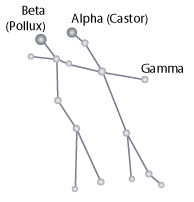
The southern half of the constellation lies within the Milky Way, alpha (Castor) and beta (Pollux), on the north, marking the heads of the Twins between Cancer and Auriga, and noticeably conspicuous over setting Orion in the April sky.
Argelander enumerates 53 naked-eye stars, and Heis 106.
{Page 230} Starry Gemini hang like glorious crowns
Over Orion’s grave low down in the west.
— Tennyson’s Maud
Star Names: Their Lore and Meaning, Richard H. Allen, 1889.]