When Arion of Lesbos, the most famous lyre player, was doomed by the sailors and forced to cast himself into the sea, a Dolphin, charmed with the music of his funeral dirge carried him on its back, and bore him safely. It was for this characteristic of friendliness to man and philanthropy that earned the Dolphin, Delphinus, a place among the stars.
The nine stars in the constellation were also considered to be the nineMuses
Delphinus and Dolphin comes from Greek delphis, genitive delphinos, ‘dolphin’, whence Greek delphus, ‘womb’, (referring to its shape), Sanskrit garbha, ‘womb’. Greeks called siblings born of the same mother adelphoi (singular), adelphos (brother), and adelphas (sister), literally “from the same womb”.
Greek delphus, ‘womb’, Sanskrit garbha, ‘womb’, is cognate with Gallic-Latin galba and Gothic kil-thei `womb’. The word child, from Old English cild, is cognate with Gothic kilthei , ‘womb’. [] Plural children. Related to the word kilt. [
“The name Delphi from Greek Delphoi, is connected with delph, ‘hollow’ or delphus, ‘womb'” []. Greek delph ‘hollow’, is cognate with our word delve, from Old English delfan, meaning to search deeply and laboriously, or to dig the ground, as with a spade, and comes from the Indo-European root *dhelbh– ‘To dig, excavate’. The city Delft or Delf in Holland is related to this root from where we get delft, glazed earthenware.
The word ‘dolphin’ is related to dauphin (the French word for the eldest son of the king of France from 1349 to 1830), Philadelphus, Philadelphia, calf (young of a cow, and various species of mammals including dolphins), chilver (a ewe lamb, a ‘chilver lamb’, Old High German kilbur, chilburra `mother lamb’), the surname Chilvers, the second element in dagoba which is the short form of dhatu-garbha, a Buddhist shrine or stupa, a beehive shaped building.
The common dolphin is Delphinus delphi. Delphi was the site of the sanctuary to Phoebus Apollo because Apollo appeared there in the guise of a dolphin. It was the site of the Pythian Games and the legendary Oracle ‘Pythia‘ (“the Python”; constellations can have a number of related symbols). Delphi was also known as the center of the world. To find out exactly where the center of the world was located, Zeus released two eagles (Aquila, eagle, is an adjoining constellation) from opposite ends of the earth, one from the east and one from the west, and the precise spot where they met, was in Delphi. The Delphic Oracle was known as the ‘Pythia’.
“This earliest oracle [at Delphi] was protected by a horrible dragon named Delphyne or Python, who was devastating the countryside. When Apollo was still very young, he slew the dragon, claimed the oracle for himself and established funerary games (the Pythian Games) in order to appease the dead monster’s spirit. He dedicated one of his symbols—a three-legged stool called a tripod—to the shrine and installed his own priestess, the Pythia, upon it. According to tradition, the Pythia was seated in the midst of vapors billowing from the earth beneath her tripod, seated in a trancelike state induced by the mists and by chewing laurel leaves, babbling her incoherent prophecies that were then translated into Homeric hexameter by a priest []. From her sometimes garbled muttering, the priest would translate into hexameter verse. The Pythia never gave a straight answer…” [Delphi by Ron Leadbetter].
Persuasor Amphitrites’ was a title for Delphinus, from the story of the Dolphin who persuaded Amphitrite to marry Poseidon. The story goes that Poseidon (Neptune) wanted Amphitrite’s hand in marriage. Amphitrite would have nothing to do with him, and to elude him she tried to hide, sometimes in deep water, sometimes on land (her name implies amphibian). Poseidon asked the Dolphin, Delphin, to trace her which he was able to do, and he persuaded her to marry Poseidon. Hyginus said that Delphin himself took charge of the wedding [Hyginus, Astronomica 2.17 ()]. The grateful god rewarded his service by placing him among the stars []. The Pythia (also called Delphyne, although this is uncertain…) was the priestess presiding over the Oracle of Apollo at Delphi. Greek peitho (from peithein) means persuasion and this word resembles Pythia and Python. Greek peitho is personified as a goddess called Peitho, a daughter of Aphrodite. She is identified with the Roman Suada, Suadela, the personification of persuasion []. Persuade comes from the Indo-European root *swád ‘Sweet, pleasant’. Derivatives: sweet, suasion, assuasive, dissuade, persuade, (these words from suasus, Latin suadere, to advise, urge < ‘recommend as good’), suave, assuage, (these words from Latin suavis, delightful), aedes (a mosquito of the genus Aëdes, transmits diseases such as yellow fever and dengue, from Greek edos, pleasure). Suffixed form *swad-ona; hedonic (pleasure), hedonism, from Greek hedon, pleasure. [Pokorny swad– 1039. Watkins
A womb wraps a baby in ‘swaddling‘ [not a recognized cognate of *swád-, but it looks likely] clothes, with numerous layers of ‘skins’ or membranes.
Note how close the Greek word hedon, ‘pleasure’, is to the word Eden, as in the ‘Garden of Eden’? It is often suggested that the Garden of Eden is probably the womb.
Greek delphus or delphos, means a womb, and so it seems does the meaning of Pandora’s pithos, or Pandora’s Box, mistranslated by sixteenth century monk Erasmus who changed the original Greek word pithos to Latin pyxis, box.
Pythia, the Python, the Delphian oracle; Greek pithos, a jar; and Greek peitho, persuasion; have a similar resonance.
“A pithos is a jar that is womb-like in shape and is a symbol for the earth, the mother of all. The implications of the pithos to the story of Pandora are obvious. Pandora’s gifts are released from her own womb. Her fault lies not in her curiosity, but in her being. She is constitutionally deceptive and lethal because she draws men into her pithos, and brings new men forth for a life of misery. The image of Woman as a pithos is extremely ancient. In many ancient Helladic burials, the pithos was used as a coffin. The deceased was placed inside in a fetal position, covered with honey, and buried in the hope of new life and regeneration” [Robert E. Meagher, Helen, Myth, Legend, and the Culture of Misogyny].
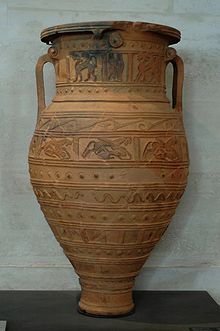 Popularly in England Delphinus is now Job’s Coffin [Allen, Star Names]. A pithos is a jar that is womb-like in shape. Anything could be placed in a pithos; however, they were used primarily for grains, seeds, wine and oil. In many ancient Helladic burials, the pithos was used as a coffin. The deceased was placed inside in a fetal position, covered with honey, and buried in the hope of new life and regeneration [Meagher]. A coffin is a tomb, and a womb is often likened symbolically to a tomb. Varro called Delphi the tomb of the Python. A number of Etruscan tombs show dolphins leaping from the waves, often below funerary banqueters [11]. Greek pithos is cognate with Latin fidelia, ‘clay vessel’, fiscus, ‘storage jar; treasury’. The Greek word pithos is known in its Latin form as the fiscus where the funds are stored [12]. From this root, pithos, we derive fisc [state treasury], fiscal, and confiscate [com- + fiscus, treasury].
A womb as an entity would have an interest in promoting marriage so that it can fulfill its purpose. The Dolphin played the part of a procurer, matchmaker, or proxy, for Neptune.
Another explanation for the name:
Python actually means serpent but there is a possibility that Pythia is derived from pythao [to rot], since Apollo left the body of the serpent to rot in the sun.”
When dolphins beach themselves and die, they rot in the sun.
The motif of a boy riding a dolphin could relate to a womb carrying a baby.
“In continuation of the Greek story of Arion (probably Cygnus, who was rescued by a dolphin) the dolphins, lovers of music, were attracted to Arion‘s singing and playing on the lyre] and his Lyre (Lyra) appears Greek Mousikon zodion, the Musicum signum of the Latins (as titles for Delphinus); or this may come from the fact mentioned in Ovid’s Fasti that the constellation was supposed to contain nine stars, the number of the Muses …” [Allen, Star Names
“Ovid’s Fasti that the constellation was supposed to contain nine stars, the number of the Muses …”. A baby spends nine months in the womb.
Herodotus has told the story of Arion, the boy musician who rides on a dolphin’s back. Arion became a swan (Cygnus) at his death. The words swan, and consonant are related, from Latin sonare, ‘to sound’. Aristotle says the dolphin has a voice that can utter vowel [10], vocal (from Indo-European *wekw-) sounds, which might explain the significance of Arion riding a dolphin; consonants and vowels; and the utterances of the Pythia or Delphine which no one could understand; the voice from the womb:
“The dolphin, when taken out of the water, gives a squeak and moans in the air, … For this creature has a voice (and can therefore utter vocal or vowel sounds), for it is furnished with a lung and a windpipe; but its tongue is not loose, nor has it lips, so as to give utterance to an articulate sound (or a sound of vowel and consonant in combination.)” [The History of Animals, Aristotle]
‘Diviner than the Dolphin is nothing yet created, for indeed they were aforetime men and lived in cities along with mortals, but…they exchanged the land for the sea, and put on the form of fishes; but even now, the righteous spirit of men in them preserves human thoughts and human deeds’. [Oppian, Halieutica (12)]
The astrological influences of the constellation given by Manilius:
“Then the Dolphin too rises starward from the deep, the pride of sea and sky, in each revered.” [Manilius, Astronomica, 1st century AD, book 5, p.31]
“The sea-dark Dolphin ascends from the Ocean to the heavens and emerges with its scales figured by stars, birth is given to children who will be equally at home on land and in the sea. For just as the dolphin is propelled by its swift fins through the waters, now cleaving the surface, now the depths below, and derives momentum from its undulating course, wherein it reproduces the curl of waves, so whoever is born of it will speed through the sea. Now lifting one arm after the other to make slow sweeps he will catch the eye as he drives a furrow of foam through the sea and will sound afar as he thrashes the waters; now like a hidden two-oared vessel he will draw apart his arms beneath the water; now he will enter the waves upright and swim by walking and, pretending to touch the shallows with his feet, will seem to make a field of the surface of the sea; else, keeping his limbs motionless and lying on his back or side, he will be no burden to the waters but will recline upon them and float, the whole of him forming a sail-boat not needing oarage.
“Other men take pleasure in looking for the sea in the sea itself: they dive beneath the waves and try to visit Nereus and the sea nymphs in their caves; they bring forth the spoils of the sea and the booty that wrecks have lost to it, and eagerly search the sandy bottom.
From their different sides swimmers and divers share an equal enthusiasm for both pursuits, for their enthusiasm, though displayed in different ways, springs from a single source.
“With them you may also reckon men of cognate skill who leap in the air, thrown up from the powerful spring-board, and execute a see-saw movement, the first’s descent throwing up the second and the plunge of the second lifting the first on high; or hurl their limbs through the fire of flaming hoops, imitating the dolphin’s movement in their flight through space, and land as gently on the ground as they would in the watery waves: they fly though they have no wings and sport amid the air.
Even if the Dolphin’s sons lack these skills, they will yet possess a physique suited to them; nature will endow them with strength of body, briskness of movement, and limbs which fly over the plain” [Manilius, Astronomica, 1st century AD, book 5, p.335].
© Anne Wright 2008.
| Fixed stars in Delphinus | |||||||
| Star | 1900 | 2000 | R A | Decl 1950 | Lat | Mag | Sp |
| Rotanev beta | 14AQU57 | 16AQU20 | 308 48 03 | +14 25 12 | +31 55 23 | 3.72 | F3 |
| Sualocin alpha | 15AQU59 | 17AQU23 | 309 19 44 | +15 44 04 | +33 01 35 | 3.86 | B8 |
| delta | 16AQU44 | 18AQU07 | 310 16 51 | +14 53 38 | +31 56 53 | 4.53 | A5 |
| gamma | 17AQU59 | 19AQU22 | 311 04 53 | +15 56 35 | +32 42 34 | 5.47 | F6 |
from Star Names 1889, Richard H. Allen
. . . the Delphienus heit
Up in the aire.
— King James I, in AneschortPoemeofTyme
Delphinus, the Dolphin is Dauphin in France, Delfino in Italy, and Delphin in Germany: all from the Greek Delphis and Delphin, transcribed by the Latins as Delphis and Delphin. This last continued current through the 17th century, and in our day was resumed by Proctor for his reformed list. Chaucer, in the Hous of Fame, had Delphyn, and later than he it was Dolphyne
It now is one of the smallest constellations, but originally may have included the stars that Hipparchos set off to form the new Equuleus; and in all astronomical literature has borne its present title and shape, with many and varied stories attached, for its namesake was always regarded as the most remarkable of marine creatures.
{Page 199} In Greece it also was Ieros Ikhthus, the Sacred Fish, the creature being of as much religious significance there as a fish afterwards became among the early Christians; and it was the sky emblem of philanthropy, not only from the classical stories connected with its prototype, but also from the latter’s devotion to its young. It should be remembered that our stellar Dolphin is figured as the common cetacean, Delphinus delphis, of Atlantic and Mediterranean waters, not the tropical Coryphaena that Dorado represents.
Ovid, designating it as clarum sidus, personified it as Amphitrite, the goddess of the sea, because the dolphin induced her to become the wife of Neptune, and for this service, Manilius said, was “rais’d from Seas” to be
The Glory of the Floud and of the Stars.
From this story the constellation was known as PersuasorAmphitrites, as well as Neptunus and Triton
With Cicero it appeared as Curvus, an adjective that appropriately has been applied to the creature’s apparent form in all ages [Allen notes: Huet, in his notes on Manilius, quoted many examples of the use of this term by the Latins, and said Perpetuam hoc Delphinum Epitheton] down to the “bended dolphins” in Milton’s picture of the Creation. Bayer’s Currus merely is Cicero’s word with a typographical error, for he explained it, Ciceroni ob gibbum in dorso; but he also had Smonnautis, and Riccioli Smonbarbaris, which seems to be the Simon, Flat-nosed, of old-time mariners, quoted by Pliny for the animal.
Another favorite title was VectorArionis, from the Greek fable that attributed to the dolphin the rescue of Arion on his voyage from Tarentum to Corinth — a variation of the very much earlier myth of the sun-god Baal Hamon. Hence comes Henry Kirke White’s
lock’d in silence o’er Arion’s star,
The slumbering night rolls on her velvet car.
In continuation of the Greek story of Arion and his Lyre (Lyra) appears Mousikon zodion, the Musicumsignum of the Latins; or this may come from the fact mentioned in Ovid’s Fasti that the constellation was supposed to contain nine stars, the number of the Muses, although Ptolemy prosaically catalogued 10; Argelander, 20; and Heis, 31.
Riccioli and La Lande cited Hermippus for Delphinus, and Acetes after the pirate-pilot who protected Bacchus on his voyage to Naxos and Ariadne; while to others it represented Apollo returning to Crissa or piloting Castalius from Crete.
{Page 200} The Hindus, from whom the Greeks are said to have borrowed it, — although the reverse of this may have been the case, — knew it as Shi-shu-mara, or Sim-shu-mara, changed in later days to Zizumara, a Porpoise, also ascribed to Draco. And they located here the 22d nakshatra, Cravishtha, Most Favorable, also called Dhanishtha, Richest; the Vasus, Bright or Good Ones, being the regents of this asterism, which was figured as a Drum or Tabor: beta marking the junction with Catabishaj.
Brown thinks that it may have been the Euphratean Makhar, although Capricorn also claimed this.
Al Biruni, giving the Arabic title AlKa’ud, the Riding Camel, said that the early Christians — the Melkite and Nestorian sects — considered it the Cross of Jesus transferred to the skies after his crucifixion; but in Kazwini’s day the learned of Arabia called alpha, beta, gamma, and delta Al ‘Ukud, the Pearls or Precious Stones adorning AlSalib, by which title the common people knew this Cross; the star epsilon, towards the tail, being Al ‘AmudalSalib, the Pillar of the Cross. But the Arabian astronomers adopted the Greek figure as their Dulfim, which one of their chroniclers described as “a marine animal friendly to man, attendant upon ships to save the drowning sailors.”
Above: “described as ‘a marine animal friendly to man, attendant upon ships to save the drowning sailors.'” friendly to man = philantrophy.
The Alfonsinetables of 1545 said of Delphinus, Quaehabetstellasquaesapiuntnaturam, a generally puzzling expression, but common in the 1551 translation of the Tetrabiblos, where it signifies stars supposed to be cognizant of human births and influential over human character, — naturam. Ptolemy, as is shown in these FourBooks, was a believer in the genethliacal influence of certain stars and constellations, of which this seems to have been one specially noted in that respect.
Delphinus lies east of Aquila, on the edge of the Milky Way, occupying, with the adjoining aqueous figures, the portion of the sky that Aratos called the Water. It culminates about the 15th of September.
Caesius placed here the Leviathan of the 104th Psalm; Novidius, the GreatFish that swallowed Jonah; but Julius Schiller knew some of its stars as the WaterpotsofCana. Popularly it now is Job’Coffin, although the date and name of the inventor of this title I have not been able to learn.
The Chinese called the four chief stars and zeta KwaChaou, a Gourd.
Star Names: Their Lore and Meaning, Richard H. Allen, 1889.]