| Fixed star: MIRZAM | |
| Constellation: Beta (β) Canis Major | |
| Longitude 1900: 05CAN48 | Longitude 2000: 07CAN11 |
| Declination 1900: -17.54′ | Declination 2000: -17.57′ |
| Right ascension: 06h 22m | Latitude: -41.15′ |
| Spectral class: B1 | Magnitude: 2.0 |
The history of the star: Mirzam
from p.129 of Star Names, Richard Hinckley Allen, 1889.
[A scanned copy can be viewed on this webpage
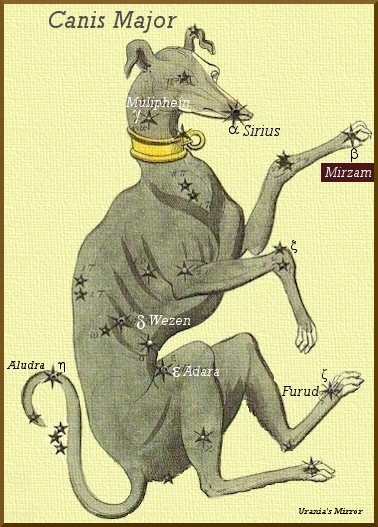 Beta (β), Mirzam, is a white 2nd magnitude star in Canis Major on the front left paw of the Greater Dog.
Murzim, generally but less correctly Mirzam, and occasionally Mirza, is from Al Murzim, the Announcer. This star Mirzam or beta (β) Canis Major, was often combined by the Arabs with the star beta (β) Canis Minor (Gomeisa), and these two beta stars together were titled “The Anouncers”, heralding the coming of Sirius, the biggest star in the sky, because they rose before Sirius in the night sky. In the plural they were Al Mirzamani, or as Al Mirzama al Shi’rayain, the two Sirian Announcers; Ideler’s idea of the applicability of this title being that this star announced the immediate rising of the still brighter Sirius
The German philologist Buttmann asserted that Mirzam also was Al Kalb, the Dog, running in front {p.130} of Sirius, but this must have been from early times in the Desert. In our maps it marks the right fore foot (actually the left) of the Dog, Canis Major
The Chinese called it Kuen She, the Soldiers’ Market.
Star Names, Their Lore and Meaning, Richard Hinckley Allen, 1889].
The astrological influences of the constellation Canis Major
Legend: This constellation is said to represent the dog set by Jupiter to guard Europa whom he had stolen and conveyed to Crete. According to other accounts, however, it was either Laelaps, the hound of Actaeon; that of Diana’s nymph Procris; that given by Aurora to Cephalus; or finally one of the dogs of Orion. [Robson, p.34.]
Influences: Ptolemy states that the stars of this constellation, with the exception of Sirius, are like Venus. It is said to give good qualities, charity and a faithful heart, but violent and dangerous passions. There is some danger from, or fear of, darkness and the night, and liability to dog bites, though the latter characteristic is probably associated more particularly with Sirius. Canis Major is connected by the Kabalists with the Hebrew letter Tzaddi and the 18th Tarot Trump, “The Moon”. [Robson, p.34.]
The astrological influences of the constellation Canis Major given by Manilius:
The names of the constellation Canis Major and its alpha star, Sirius, were often confused or meant the same thing.
“It is Orion who leads the constellations as they speed over the full circuit of the heavens. At his heels follows the Dog outstretched in full career: no star comes on mankind more violently or causes more trouble when it departs. Now it rises shivering with cold, now it leaves a radiant world open to the heat of the Sun [translator’s note: In ancient times the Dogstar’s evening rising occurred in early January, its evening setting in early May]: thus it moves the world to either extreme and brings opposite effects. Those who from Mount Taurus‘ lofty peak observe it ascending when it returns at its first rising learn of the various outcomes of harvests and seasons, what state of health lies in store, and what measure of harmony. It stirs up war and restores peace, and returning in different guise affects the world with the glance it gives it and governs with its mien. Sure proof that the star has this power are its color and the quivering of the fire that sparkles in its face. Hardly is it inferior to the Sun, save that its abode is far away and the beams it launches from its sea-blue face are cold. In splendor it surpasses all other constellations, and no brighter star is bathed in ocean or returns to heaven from the waves. [Manilius, Astronomica, 1st century AD, book 1, p.34-37]
“The brilliant constellation of the Dog: it barks forth flame, raves with its fire, and doubles the burning heat of the Sun. When it put its torch to the earth and discharges its rays, the earth foresees its conflagration and tastes its ultimate fate [translator’s note: the ecpyrosis of the Stoics, who held that the Universe would ultimately be engulfed in conflagration and all things would return to the condition of primeval fire]. Neptune lies motionless in the midst of his waters and the green blood is drained from leaves and grass. All living things seek alien climes and the world looks for another world to repair to; beset by temperatures too great to bear, nature is afflicted with a sickness of its own making, alive, but on a funeral-pyre: such is the heat diffused among the constellations, and everything is brought to a halt by a single star. When the Dogstar rises over the rim of the sea, which at its birth not even the flood of Ocean can quench, it will fashion unbridled spirits and impetuous hearts; it will bestow on its sons billows of anger, and draw upon them the hatred and fear of the whole populace.
“Words run ahead of the speakers: the mind is too fast for the mouth [translator’s note: the impetuosity of the speaker causes him to utter words before he has time to adapt them to grammar or logic]. Their hearts start throbbing at the slightest cause, and when speech comes their tongues rave and bark, and constant gnashing imparts the sound of teeth to their utterance. Their failings are intensified by wine, for Bacchus [meaning alcohol] gives them strength and fans their savage wrath to flame.
“No fear have they of woods or mountains, or monstrous lions, the tusks of the foaming boar, or the weapons which nature has given wild beasts; they vent their burning fury upon all legitimate prey.
“Lest you wonder at these tendencies under such a constellation, you see how even the constellation itself hunts among the stars, for in its course it seeks to catch the Hare (Lepus) in front.” [Manilius, Astronomica, 1st century AD, book 5, p.316-319].
This star Mirzam or beta (β) Canis Major, was often combined by the Arabs with the star beta (β) Canis Minor (Gomeisa), and these two beta stars together were titled “The Anouncers”, heralding the coming of Sirius, the biggest star in the sky, because they rose before Sirius in the night sky. In Arabia they were imagined as two dogs. One can imagine barking dogs announcing the arrival of visitors, or barking dogs bringing something to people’s attention: Many radio and TV announcers are influenced by either of these two stars (birth-charts from the AstroDataBank program).
References:
Fixed Stars and Constellations in Astrology, Vivian E. Robson, 1923].