| Fixed star: MIRFAK | |
| Constellation: Alpha (α) Perseus | |
| Longitude 1900: 00GEM41 | Longitude 2000: 02GEM05 |
| Declination 1900: +49.30′ | Declination 2000: +49.52′ |
| Right ascension: 03h 24m | Latitude: +30.07′ |
| Spectral class: F5 | Magnitude: 1.9 |
The history of the star: Mirfak
from p.331 of Star Names, Richard Hinckley Allen, 1889.
[A scanned copy can be viewed on this webpage
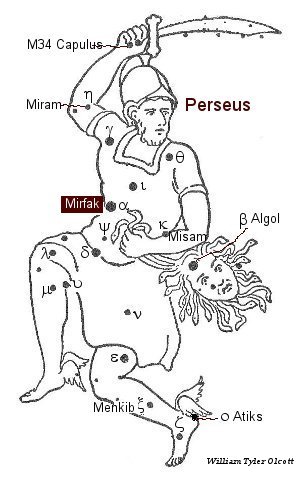 Alpha (α) Perseus, Mirfak, is a star on the right side of the Champion.
Algenib, with the early variations of Algeneb, Elgenab, Genib, Chenib, and Alchemb, is from Al Janb, the Side, its present position on the maps; the 14th century Greco-Persian astronomer Chrysococca, similarly called it (Greek) Pleura Persaous (Perseus’ side or rib).
Another name, Marfak or Mirfak, the Elbow, sometimes written Mirzac, comes from the Arabians’ Marfik al Thurayya, thus qualified as being next to the Pleiades (a group of stars in Taurus) to distinguish it from the other elbow. But this may indicate a different representation of Perseus in their day,— a suspicion stengthened by the nomenclature of others of his stars, especially of xi (ξ Menkib) and omicron (ο Atiks).
Assemani alluded to a title on the Borgian globe,—Mughammid, or Mu-hammir, al Thurayya, the Concealer of the Pleiades,—which, from its location, may be for this star.
With gamma (γ), delta (δ), and others it was the Chinese Tien Yuen, the Heavenly Enclosure.
Star Names, Their Lore and Meaning, Richard Hinckley Allen, 1889].
The astrological influences of the constellation Perseus
Legend: Zeus visited Danae in the form of a shower of gold and got her pregnant with Perseus. As a young man Perseus undertook a mission to kill the Medusa. He was furnished with the sword, cap and wings of Mercury and the shield of Minerva. He killed the Medusa by cutting off her head and afterwards killed the sea monster Cetus and then rescued and married Andromeda. Perseus founded a city, having dropped his cap or found a mushroom (both named myces) at Mycenae. [Robson, p.56.]
Influences: According to Ptolemy, Perseus is like Jupiter and Saturn. It is said to give an intelligent, strong, bold and adventurous nature, but a tendency to lying. By the Kabalists it is associated with the Hebrew letter Lamed and the 12th Tarot Trump "The Hanged Man." [Robson, p.56.]
The constellation is indicative of events effecting large numbers of people, especially those events caused by major meteorological phenomena. When prominent in a natal chart it is said to denote adventurous individuals, but also those who are less than honest in their dealings with others. [Fixed Stars and Judicial Astrology, George Noonan, 1990, p.14.]
References:
Fixed Stars and Constellations in Astrology, Vivian E. Robson, 1923].