| Fixed star: KELB ALRAI Cebalrai | |
| Constellation: Beta (β) Ophiuchus | |
| Longitude 1900: 23SAG56 | Longitude 2000: 25SAG20 |
| Declination 1900: +04.37′ | Declination 2000: +04.34′ |
| Right ascension: 17h 43m | Latitude: +27.56′ |
| Spectral class: K1 | Magnitude: 2.9 |
The history of the star: Kelb Alrai
from p.301 of Star Names, Richard Hinckley Allen, 1889.
[A scanned copy can be viewed on this webpage
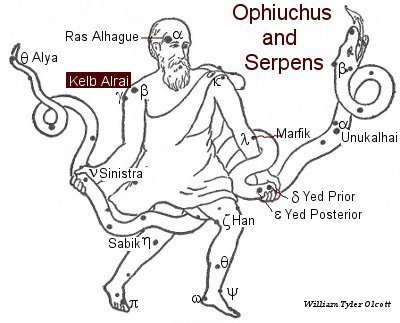
Beta (β) Ophiuchus, Kelb Alrai, is a yellow star in the right shoulder of the Snake charmer.
Cebalrai, Celbalrai, and Cheleb are from Kalb al Ra’i. "The Heart of the Shepherd," which Brown gives as the meaning of his Celabrai, is erroneous, doubtless from confusion of the Arabic Kalb, Heart, and Kalb, Dog.
The star is 9° southeast of alpha (α), and 5° west of Taurus Poniatovii, the Polish Bull, now included in Ophiuchus.
Star Names, Their Lore and Meaning, Richard Hinckley Allen, 1889].
The astrological influences of the constellation Ophiuchus
It is said to give a passionate, blindly good-hearted, wasteful and easily seduced nature, unseen dangers, enmity and slander. Pliny said that it occasioned much mortality by poisoning. This constellation has also been called Aesculapius and held to rule medicines. By the Kabalists it is associated with the Hebrew letter Oin and the 16th Tarot Trump "The Lightning Struck Tower". [Robson, p.54.]
The astrological influences of the constellation Ophiuchus given by Manilius:
"When Ophiuchus, encircled by the serpent’s great coils, rises he renders the forms of snakes innocuous to those born under him. They will receive snakes into the folds of their flowing robes, and will exchange kisses with these poisonous monsters and suffer no harm." [Manilius, Astronomica, 1st century AD, book 5, p.333].
"One called Ophiuchus holds apart the serpent which with its mighty spirals [gyris] and twisted body encircles his own, that so he may untie its knots and back that winds in loops. But, bending its supple neck, the serpent looks back and returns; and the other’s hands slide over the loosened coils. The struggle will last for ever, since they wage it on level terms with equal powers." [Manilius, Astronomica, 1st century AD, book 1, p.31].
References:
Fixed Stars and Constellations in Astrology, Vivian E. Robson, 1923].