| Fixed star: ARCTURUS | |
| Constellation: Alpha (α) Bootes | |
| Longitude 1900: 22LIB50 | Longitude 2000: 24LIB14 |
| Declination 1900: +19.42′ | Declination 2000: +19.11′ |
| Right ascension: 14h 15m | Latitude: +30.44′ |
| Spectral class: K2 | Magnitude: -0.04 |
The history of the star: Arcturus
from p.98 of Star Names, Richard Hinckley Allen, 1889.
[A scanned copy can be viewed on this webpage
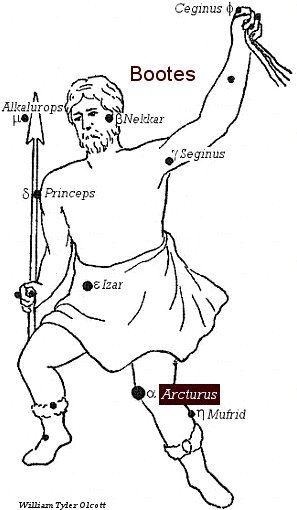 Alpha (α) Bootes, Arcturus, is a golden red star situated on the left knee of the Herdsman, the 4th brightest in the sky.
Arcturus has been an object of the highest interest and admiration to all observant mankind from the earliest times, and doubtless was one of the first stars to be named; for from Hesiod’s day to the present it thus appears throughout all literature, although often confounded with the Greater Bear (Ursa Major). Indeed Hesiod’s use of the word probably was for that constellation (Bootes), except in two cases, already quoted, where he unquestionably referred to this star, mentioning its rising fifty days after the winter solstice, the first allusion that we have to that celestial point. And it is popularly supposed that {p.99} our Arcturus is that of the Book of Job, xxxviii, 32; but there it merely is one of the early titles of Ursa Major, the Revised Version correctly rendering it “the Bear.” Still, even now, the Standard Dictionary quotes for the star the Authorized Version’s
“Canst thou guide Arcturus with his sons ?”
But, like other prominent stars, it shared its name with its constellation — in fact, probably at first, and as late as Pliny’s day (23-79 A.D.), was a constellation by itself. Homer’s Bootes doubtless was this, with, possibly, a few of its larger companions; and the 17th century German astronomer Bayer cited Bootes for the star; but in recent times the latter has monopolized the present title.
It was famous with the seamen of early days, even from the traditional period of the Arcadian Evander, and regulated their annual festival by its movements in relation to the sun. But its influence always was dreaded, as is seen in the Greek astronomer Aratus’, circa 270 B.C., deinouArktouroio and Pliny’s (23-79 A.D.) horridum sidus; while Demosthenes, in his action against Lacritus 341 B.C., tells us of a bottomry bond, made in Athens on a vessel going to the river Borysthenes — the modern Dnieper—and to the Tauric Chersonese—the Crimea—and back, that stipulated for a rate of 22 ½ per cent, interest if she arrived within the Bosporus “before Arcturus,” i.e. before its heliacal rising about mid-September; after which it was to be 30 per cent. Its acronycal rising fixed the date of the husbandmen’s Lustratio frugum; and Vergil (70-19 B.C.) twice made allusion in his 1st Georgic to its character as unfavorably affecting the farmers’ work. Other contemporaneous authors confirmed this stormy reputation, while all classical calendars gave the dates of its risings and settings.
Hippocrates, 460 B.C., made much of the influence of Arcturus on the human body, in one instance claiming that a dry season, after its rising,
“agrees best with those who are naturally phlegmatic, with those who are of a humid temperament, and with women; but it is most inimical to the bilious;”
and that
“diseases are especially apt to prove critical in these days.”
{p.100} The Prologue of the Rudens of Plautus, delivered by Arcturus in person, and “one of the early opinions of the presence of invisible agents amongst mankind,” declares of himself that he is considered a stormy sign at the times of his rising and setting,— as the original has it:
“Arcturus signum, sum omnium quam acerrimum. Vehemens sum, cum exorior, cum occido vehementior.”
And the passage from Horace’s (65-8 B.C.) Odes —
“Nec saevus Arcturi cadentis Impetus aut orientis Haedi —”
is familiar to all. This same idea came down to modern days, for Pope repeated it in his verse,
“When moist Arcturus clouds the sky.”
Astrologically, however, the star brought riches and honor to those born under it.
An Egyptian astronomical calendar of the 15th century before Christ, deciphered by Renouf, associates it with the star Antares in the immense sky figure Menat; and Lockyer claims it as one of the objects of worship in Nile temples, as it was in the temple of Venus at Ancona in Italy.
In India it was the 13th nakshatra (Hindu Moon Mansion), Svati, the Good Goer, or perhaps Sword, but figured as a Coral Bead, Gem, or Pearl; and known there also as Nishtya, Outcast, possibly from its remote northern situation far outside of the zodiac, whence, from its brilliancy, it was arbitrarily taken to complete the series of Hindu asterisms. Hewitt thinks that it, or Capella, was the Aryaman of the Rig Veda; and Edkins that it was the Tistar usually assigned to Sirius.
The Chinese called it Ta Kio, the Great Horn, four small stars near by being Kang Che, the Drought Lake; Edkins further writing of it:
“Arcturus is the palace of the emperor. The two groups of three small stars on its right [eta, iota (ι), and upsilon (υ)] are called She ti, the Leaders, because they assign a fixed direction to the tail of the Bear, which, as it revolves, points out the twelve hours of the horizon.”
The Arabs knew Arcturus as Al Simakal Ramih (Allen notes: This word Simak is from a root meaning “to raise on high,” and is thought to have been employed by the Arabs when they wished to indicate any prominent object high up in the heavens, but with special reference to this star and to the other Simak, Spica of the Virgin.), sometimes translated the Leg of the Lance-bearer, and again, perhaps more correctly, the Lofty {p.101} Lance-bearer. From the Arabic title came various degenerate forms: Al Ramec, Aramec, Aremeah, Ascimec, Azimech, and Azimeth, found in thou queer compendiums of stellar nomenclature the Alfonsine Tables and the Almagest of 1515; Somech haramach of English writer on globes John Chilmead (circa 1639)’s Treatise; and Aramakh, which Karsten Niebuhr heard from the Arabs 136 years ago. The Kheturus of their predecessors, already alluded to under Bootes, also was used for this.
The idea of a weapon again manifested itself in the Kontaratos, Javelin-bearer, of the GraecoPersian Tables; while the 17th century German astronomer Bayer had Gladius, Kolanza, and Pugio, all applied to Arcturus, which probably marked in some early drawing the Sword, Lance, or Dagger in the Hunter’s hand. Similarly it took the title Alkameluz of the whole constellation.
Al Haris al Sama, the Keeper of Heaven, perhaps came from the star’s early visibility in the twilight owing to its great northern declination, as though on the lookout for the safety and proper deportment of his lesser stellar companions, and so “Patriarch Mentor of the Train.” This subsequently became Al Haris al Simak, the Keeper of Simak, probably referring to Spica, the Unarmed One.
The Persian astronomer Al Biruni (973-1048 A.D.) mentioned Arcturus as the Second Calf of the Lion, the early Asad [Arabs had an enormous Lion, their early Asad, extending over a third of the heavens, of which the stars Arcturus and Spica were the shin-bones; Regulus, the forehead; the heads of Gemini, one of the fore paws; Canis Minor, the other; and Corvus, the hind quarters. Many Arab starnames come from this tradition. Star Names p.97.]; Spica being the First Calf.
It has been identified with the Chaldaeans’ Papsukal, the Guardian Messenger, the divinity of their 10th month Tibitu; while Smith and Sayce have said that on the Euphrates it was the Shepherd of the Heavenly Flock, or the Shepherd of the Life of Heaven, undoubtedly the Sib-zi-anna of the inscriptions; the star eta (η) (Mufrid) being often included in this, and thus making one of the several pairs of Euphratean Twin Stars.
The 1515 Almagest and the Alfonsine Tables of 1521 add to their list of strange titles et nominaturAudiens, which seems unintelligible unless the word be a misprint for Audens, the Bold One.
John de Wiclif, in his translation of Amos v, 8, in 1383, had it Arture, which he took from the Vulgate’s Arcturus for Ursa Major; but John of Trevisa in 1398 more correctly wrote:
“Arthurus is a signe made of VII starres, . . . but properly Arthurus is a sterre sette be-hynde the tayle of the synge that hyght Vrsa maior (Ursa Major).”
With others it was Arturis and Ariture, or the Carlwaynesterre from the early confusion in applying the title Arcturus to Charles’ Wain as well as to Bootes and its lucida (brightest star in the constellation).
Prominent as this star always has been, and one of the few to which the second-century Greek astronomer Ptolemy assigned a name, yet its position has greatly varied in the drawings; {p.102} indeed in the earliest it was located outside of the figure and so described in the Syntaxis. It has been put on the breast; in the girdle, whence, perhaps, came the 17th century German astronomer Bayer’s Arctuzona; on the leg; between the knees, — Robert Recorde, the first English writer on astronomy, in 1556 mentioning in the Castle of Knowledge the “very bryghte starre called Arcturus, which standeth between Bootes his legges”; and, as some of its titles denote, on the weapon in the hand. But since Durer’s time it has usually marked the fringe of the tunic.
Star Names, Their Lore and Meaning, Richard Hinckley Allen, 1889].
According to E W Bullinger (The Witness of the Stars ), a biblical interpreter of the constellations, the ancient Egyptians called Bootes Smat, which means one who rules, subdues, and governs. They also called him Bau, which means also “the coming one”. [Robson
The star Arcturus by Isidore of Seville:
Arctophylax (i.e. the ‘bear-keeper’) is so named because it follows Arctos, that is, the Great Bear (Ursa Major). People have also called this constellation Bootes, because it is attached to the Wain (Ursa Major). It is a very noticeable sign with its many stars, one of which is Arcturus. Arcturus is a star located in the sign of Bootes beyond the tail of the Great Bear. For this reason it is called Arcturus, as if it were the Greek arktos oura (i.e. ‘tail of the bear’), because it is located next to the heart of Bootes. It rises in the season of autumn.” [The Etymologies of Isidore of Seville, 7th century AD, p.105.]
The Lunar Mansions
In India Arcturus was the 13th nakshatra (Hindu Moon Mansion), Svati, the Good Goer, or perhaps Sword, but figured as a Coral Bead, Gem, or Pearl; and known there also as Nishtya, Outcast, possibly from its remote northern situation far outside of the zodiac, whence, from its brilliancy, it was arbitrarily taken to complete the series of Hindu asterisms (Allen Star Names, p.98.). Robson says the regent, Vayu, the god of the wind. Ruled by the Dragon’s Head.
Influences of the 13th Hindu Moon Mansion Svati: A mutable asterism belonging to the butcher caste and favorable for commencing work of an impermanent or moving character. Those born on the lunar day will be weak, abstemious, skilful, fond of animals and changeable in friendship. With Moon here at birth native will be quiet, polite, self-controlled, skilful, kind-hearted and charitable. Rules rice fields and the breast. [Robson, p.81.]
The astrological influences of the constellation Bootes
Bootes is identified with Icarius, who was killed by some shepherds he had made drunk with a flagon of wine given him by Bacchus/Dionysus. In consideration of the grief of his daughter Erigone and their hound Maera, Jupiter placed her father in heaven as Bootes, together with herself as Virgo and the hound became one of the Dogs; some say Canis Minor, others say Canis Major
According to Ptolemy the influence of the constellation is like that of Mercury and Saturn, though the star Arcturus is like Mars and Jupiter. It is said to give prosperity from work, strong desires, a tendency to excess, a fondness for rural pursuits, together with some liking for occultism. The Kabalists associate it with the Hebrew letter Teth and the 9th Tarot Trump, “The Hermit”. [Robson, p.32.]
The astrological influences of the constellation Bootes given by Manilius:
“True is the name men have given him (the Bearwarden), threatening-like he presses forward as one does over a team of bullocks. To those born under Arctophylax – Arcturus, fortune herself makes bold to entrust her treasures, so that the wealth of monarchs and temple finances will be in their keeping [translator’s note: custodianship is a suitable endowment for the Bearward]; they will be kings under kings and ministers of state, and be charged with the guardianship of the people or, as the stewards of grand houses, they will confine their business to the care of another’s home.” [Translator’s note: strictly speaking Arcturus is a star, but the name is used by ancient astrologers for the whole constellation of Bootes and for the star alone, it is often difficult to distinguish which of these the authors are referring to]. [Manilius, Astronomica, 1st century AD, book 5, p.329.]
The astrological influences of the star Arcturus
According to Ptolemy it is of the nature of Mars and Jupiter, but Alvidas substitutes Venus and Mercury conjoined. It gives riches, honors, high renown, self-determination and prosperity by navigation and voyages. [Robson, p.139.]
“Bear leader-guardian”, meaning observer of the “Great Bear”, or “The Saucepan” or “Big Dipper” respectively. Main star of constellation Bootes (= driver of oxen), has a Jupiter-Mars nature, and a reputation of achieving “justice through power”. It therefore makes the native belligerent and quarrelsome, especially if attached to Mars and Jupiter by conjunction. A really go-ahead and enterprising spirit is here the rule, as indicated by Jupiter-Mars. Lasting success is promised if further good aspects are present. If critically aspected, the good influence will be hampered or made into a real handicap. If involved in legal action, such a native may lose all. [Fixed Stars and Their Interpretation, Elsbeth Ebertin, 1928, p.63.]
If rising: Good fortune, with many cares and anxieties through own folly. [Robson, p.139.]
If culminating: High office under Government, great profit and reputation. If at the same time with Sun, Moon or Jupiter, ample fortune and great honor. [Robson, p.139.]
With Sun: Success through slow and patient plodding, friends among clergy, favorable for gain and for dealing with the public and lawyers. [Robson, p.139.]
With Moon: New friends, business success, good judgment, domestic harmony. If with Mars also, danger of death by suffocation. [Robson, p.139.]
With Mercury: Sober, industrious, popular, inclined to be religious, somewhat extravagant but well-off, help through friends, holds position of trust in large company or corporation, or receives promotion under direction, favorable for health and domestic affairs. [Robson, p.139.]
With Venus: Popular, gifts and favors from friends, some false friends of own sex. [Robson, p.140.]
With Mars: Popular, many friends, considerable gain but does not save owing to extravagance. If in 1st, 7th, 9th, 10th or 11th houses and the Moon is at the same time with Pollux, danger of death by suffocation. [Robson, p.140.]
With Jupiter: Benefits from legal and Church matters, influential position, danger of hypocrisy gain through foreign affairs or shipping. [Robson, p.140.]
With Saturn: Honest, selfish, inclined to be mean, shrewd in business, materialistic, favorable for gain and speculation and for domestic matters, but early difficulty in married life, favorable for children but disagreement with one of them. [Robson, p.140.]
With Uranus: Favorable for work entailing quick buying and selling and for dealing with the public, associated with antiques or ancient matters and given to forming collections, associated with art science or literature, official position in some club or society, favorable for gain, benefits from friends, favorable for marriage and children and benefit through both, natural death abroad. [Robson
With Neptune: Ingenious, business instincts, changeable, and loss through this means, mediumistic and rather negative, associated with societies as an official, loss and misfortune in middle age which hastens death, favorable for friendship, partnership, marriage and success, greatly dependent upon advice of marriage partner. [Robson, p.140.]
References:
Fixed Stars and Constellations in Astrology, Vivian E. Robson, 1923].