| Fixed star: ALGORAB Ksora | |
| Constellation: Delta (δ) Corvus | |
| Longitude 1900: 12LIB04 | Longitude 2000: 13LIB27 |
| Declination 1900: -15.58′ | Declination 2000: -16.31′ |
| Right ascension: 12h 29m | Latitude: -12.11′ |
| Spectral class: A0 | Magnitude: 3.1 |
The history of the star: Algorab
from p.182 of Star Names, Richard Hinckley Allen, 1889.
[A scanned copy can be viewed on this webpage
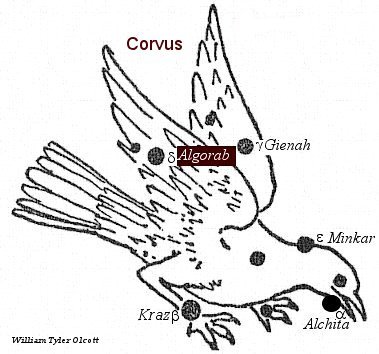
Delta (δ) Corvus, Algorab, is a double star, 3.1 and 8.5 magnitude, pale yellow and purple, on the right wing of the Raven.
Algorab, the generally received modern title, is from the Palermo Catalogue; the English astronomer Proctor (1834-1888) has Algores. It is on the right wing, and at the upper left corner of the square.
Star Names, Their Lore and Meaning, Richard Hinckley Allen, 1889].
The Lunar Mansions
This star was included in the Hindu 11th nakshatra, Hasta, the Hand, with Savitar, the Sun, as its presiding divinity. Hasta consists of five stars of the constellation Corvus: alpha (α Alchita), beta (β Kraz), delta (δ Algorab), gamma (γ Gienah), and epsilon (ε Minkar). Hasta’s main translation "the Hand". Its alternative translation is "laughter"; the root "Has" in Sanskrit means "to laugh". Its alternative names "Bhanu" and "Ark" translate into "Sun" and "Sun’s Rays" respectively. [The 27 Celestial Portals, Prash Trivedi, 2005, p.201
Influences of the 11th Hindu Moon Mansion Hasta: A light asterism belonging to the Vaisya caste (merchant/business) and favorable for sales, art, sculpture, learning, marital love, wearing of ornaments, medicine, and purchase of carriages when containing the Moon. Those born on the lunar day will be thieves, dealers in large animals, painters, merchants, handsome and religious. With Moon here at birth native will be active, resourceful, shameless, merciless, and a thief and drunkard. Rules tanks and the fingers. [Robson, p.80.]
The astrological influences of the constellation Corvus
Legend: Apollo gave a feast to Jupiter and requiring water sent the raven with a cup (Crater) to fetch some. On his way the raven noticed a fig tree, and, resting there until the figs became ripe, feasted himself upon them until, remembering his errand and fearing the anger of Apollo, he picked up a snake (Hydra) and on his return gave as an excuse that it had prevented him from filling the cup. Apollo ordained in punishment that the raven should never drink so long as figs were not ripe, and placed the raven (Corvus), cup (Crater) and snake (Hydra) in the heavens as a memorial. [Robson, p.40.]
Influences: According to Ptolemy, Corvus is like Mars and Saturn. It is said to give craftiness, greediness, ingenuity, patience, revengefulness, passion, selfishness, lying, aggressiveness, and material instincts, and sometimes causes its natives to become agitators. [Robson, p.41.]
When Typhon came rushing toward Olympus, the gods fled in terror to Egypt where they disguised themselves as animals; Apollo (Phoebus) became a raven:
Corvinus, winner of spoils and a name, aided in combat by a bird which hides beneath a bird’s exterior the godhead of Phoebus" [Astronomica, Manilius, 1st century AD, p.67.]
The astrological influences of the star Algorab
Of the nature of Mars and Saturn. It gives destructiveness, malevolence, fiendishness, repulsiveness and lying, and is connected with scavenging. [Robson].
A Mars-Saturn star that can show up the more troublesome side of Libra, a variation on the truth when an excuse looks to be safer. [The Living Stars, Dr. Eric Morse, p.175.]
Delays and restraint are indicated to come about by fiascoes, losses, wrong handling of matters and enmity in general. Accidents or injuries difficult to avoid. [Fixed Stars and Their Interpretation, Elsbeth Ebertin, 1928, p.60.]
References:
Fixed Stars and Constellations in Astrology, Vivian E. Robson, 1923].