Toucan from Portuguese tucano, Spanish tucán, both from Tupi tucano, ‘type of bird’. Allen [Star Names] notes that it was reported that the word toucan or tucana, may be from the Guaranis ti, ‘nose’, and cang, ‘bone’, and that it first was mentioned in print by Trevet in 1558 as from that Brazilian Indian tribe, the Tupis. The toucan has a huge beak, and the word beak is also an informal word for a human nose. Or the name might come from the sound it makes; an explorer in his voyage up the Amazon, observed, that when a party of toucans alight on a tree, one usually acts the part of sentinel, uttering the loud cry of "Tucano!" whence they derive their name [Eccentricities of the Animal Creation].
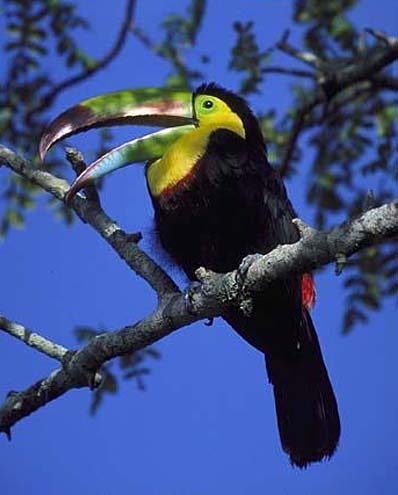
Photo byCagan Sekercioglu
Toucans are of the family Rhamphastos, from the Greek word for beak, ramphos. The most recognizable feature of the toucan is its enormous serrated beak or bill, sometimes as long as its body, variously described as ‘canoe-shaped’, and ‘banana beak’; and for this reason I will assume the word ‘beak‘ belongs here. Beak, from Vulgar Latin beccus and Italian becco. "Compare Old English becca, ‘pickax’, compare also becasse, the woodcock", bicker (from Old English becca, pickax, Gaulish beccus, beak) [Klein Comprehensive Etymological Dictionary p.74]. Spanish pico ‘beak, small amount’ from Latin beccus. A pike, is literally ‘the fish with a pointed beak‘. Old English becca, ‘pickax’, is "probably related" to Latin beccus, beak
PicaIndica was a title for this constellation. In early days a toucan was called a Brazilianpye. The toucans (Rhamphastidae) are a family of picarian birds. The word pica derives from the Indo-European root *speik– ‘Bird’s name, woodpecker, magpie’. Suffixed form *peik-; picaro (a rogue or adventurer, also called picaroon, picar), picket, pike (a spear), pique, (these words from Latin picus, woodpecker). Suffixed form *peik-; pica (from Latin, ‘magpie’, as a literal translation of Greek kissa, kitta ‘magpie, false appetite’; from the magpie’s indiscriminate feeding habits), pie from Latin pica, magpie. [Pokorny (piko– 999. Watkins] Klein supplies more cognates to pike ‘a sharp point’, and says: "Compare also picayune, pickax, picnic, picot, picotee, pinch, pink (‘to pierce’), piquet, pitch (‘to throw’). Compare also pick". Klein also sees the words pick and peck as related.
A feature peculiar to the toucans is that they throw, or pitch (pician), objects. "Called the jokers of tropical American forest" [], they play throw and catch games with each other which consists of tossing (?) berries, between them with their beaks. They habitually toss their food into the air and then catch it in their wide-open beaks as it falls. To pitch is to throw with careful aim, as toucans do, and it is said that they never miss their intended target. Pitch, from Middle English pichen, picchen, "probably related to pick, ‘to pierce’, pike, ‘a sharp point’" [Klein]. Pitchfork, from pick, ‘a pointed instrument’, is influenced in form by an association with pitch, ‘to throw’. Beaks are used for picking things out, as in picking out grains from dirt, and for pecking
The dictionaries say that the word beak is used for the spout of a pitcher, beaker is related to pitcher, from Greek bikos ‘earthenware jug’. A pitcher, is also an iron bar for making holes in the ground. "Eric Partridge says the word ‘pitcher‘ derives from the same root as ‘peck‘, there is a historical tradition of making leather drinking/pouring vessels which were coated with tree pitch on the inside" (see a discussion on these words on this webpage).
The word pitch, the highness or lowness of a tone; the frequency of vibration of the vocal folds, might also relate to toucans. Toucans are one of the noisiest jungle birds, with a croak like a frog that can be heard for half a mile. Their repertoire of sounds include loud barks, bugling calls and harsh croaks [].
Latin picus, is the woodpecker. Toucans and woodpeckers are from the family of picarian birds, and the woodpecker might be like an the Old World counterpart of the toucan in that they live in holes or pockets in tree trunks in the same way. Latin picus, wood-pecker, might have given its name to the words; pike, pickaxe, pick and pitch []. Woodpeckers excavate holes in trees with pickaxe-like strokes of the bill. King Picus, son of Saturn (Kronos), ruled the land of Ausonia (Latium). Circe changed him into a woodpecker. Ovid of Picus; "and what had been a golden brooch, pinning his clothes, became plumage". The French word for pike is brocket, ‘pike,’ a derivative of broche ‘spit’; woodpeckers broach into trees, or poke holes into trees with their beaks. Toucans are also said to hew out holes in trees in which to nest, and it is from this habit of chipping trees that the bird is called by the Spaniards Carpentero (carpenter), and by the Brazilians Tacataca, in imitation, apparently, of the sound it thus makes [Eccentricities of the Animal Creation].
Bird’s beaks are likened to weapons, they have a sharp point like a pike. The sculptural shape of the serrated ‘toucan beak’ suggests some form of blade or sword. [Perhaps a ‘tuck’, an archaic word for a slender sword or rapier]. In early days of discovery, toucan beaks were brought to Europe as curiosities, and the shape was thought to resemble a Turkish sword or scimitar [Eccentricities of the Animal Creation]. Toucans fight with their beaks, "and they will tease one another and use their beaks like dueling swords" []. The word bicker (related to beak), had this meaning originally; from Middle Dutch bicken, to slash, stab, attack frequently, again and again, from Old English becca, pickax, Gaulish beccus, beak. The Greek word for woodpecker is druokolaptes from drus, tree and kolapto, to peck at. The Old English term for ‘beak’ was bile, ‘bill’. The word ‘bill’, bird’s beak, is the name used for an ancient weapon; a halberd. The Germanic languages had a related word bil, for a hatchet. The woodpecker’s bill is described as hatchet-like in its habit of chopping into trees.
“The woodpecker (picus) took its name from Picus, the son of Saturn, because he would use this bird in augury. People say this bird has a certain supernatural quality because of this sign: a nail, or anything else, pounded into whatever tree the woodpecker has nested in, cannot stay there long, but immediately falls out, where the bird has settled. This is the Martius woodpecker (picus), for the magpie (pica) is another bird.” [The Etymologies of Isidore of Seville, 7th century AD, p.267.]
The woodpeckers are birds of augury. An auger is a tool for boring hole, woodpeckers bore holes into trees. The words augur and augury come from the Indo-European root *aug- ‘To increase’.
There must be some symbolic significance of a bird living in a hole in a tree. Maybe the word ‘animism’ would fit here: the belief in the existence of individual spirits that inhabit natural objects. Adonis was born from a tree after his mother Myrrha (or Smyrna) was changed into a myrrh tree. Both Picus and Adonis were boar-hunters. Adonis died in the arms of a grief-stricken Aphrodite. The goddess ordained that from his blood a flower, the anemone, should arise []. ‘Anemone’ and ‘animism’ are from Indo-European ane-
A bird’s nose is on its beak with which it breathes through.
Toucans sleep in tight-fitting holes or pockets in hollow tree-trunks by folding themselves into round balls. In George of the Jungle, the Tookie-Tookie Bird is a wise toucan who gets George out of some tight spots. Toucans tucks (?) themselves in for the night by placing their long beaks on their backs, and folding their long tails forward over their heads, becoming like a ball of feathers. Five or six adults may sleep in a single hole of rotted hollow tree trunks.
"Sacred to the Incas and revered by the Maya, the Toucan was a mystic symbol and a tribal totem; the medicine men considered it an incarnation to fly to the spirit world" []. "The bird is re-created on tribal totems to signify the tribe’s common ancestry" []. In its native region, toucans are associated with evil spirits and are thought to be the incarnation of a demon. In certain religions of South and Central America, the father of a new child must not eat toucan flesh as it might bewitch the newborn and cause it to fade away []. The toucan is the symbol of Belize.
© Anne Wright 2008.
| Fixed stars in Tucana | |||||||
| Star | 1900 | 2000 | R A | Decl 1950 | Lat | Mag | Sp |
| alpha | 08AQU17 | 09AQU40 | 333 46 24 | -60 30 35 | -45 23 57 | 2.91 | K5 |
| gamma | 19AQU03 | 20AQU26 | 348 37 51 | -58 30 37 | -47 50 51 | 4.10 | F0 |
| zeta | 20AQU56 | 22AQU19 | 004 22 11 | -65 10 07 | -57 42 33 | 4.34 | F8 |
| beta | 25AQU12 | 26AQU35 | 007 18 55 | -63 14 00 | -57 20 47 | 4.52 | B9 |