Constellations of Words
Explore the etymology and symbolism of the constellations
Scorpius
the Scorpion
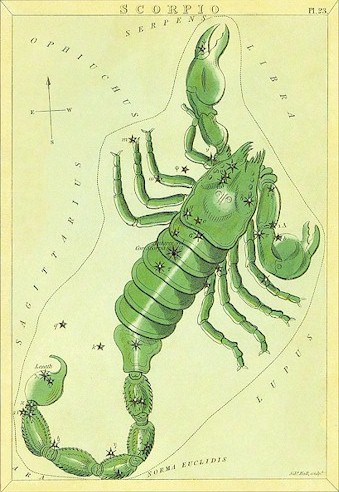
Urania’s Mirror1825
Contents:
1. Clues to the meaning of this celestial feature
2. The fixed stars in this constellation
3. History_of_the_constellation
Clues to the meaning of this celestial feature
The word Scorpio comes from Latin scorpio, from Greek skorpios, “which is probably ultimately connected with Hebrew ‘aqribh (or akrabh), ‘scorpion'” [Klein].
Akrabh or acrab (a-crab), is the Hebrew word for scorpion. That scorpions were engendered from crabs was a belief in classical times: Ovid (Metamorphoses, 1st century CE, 15, 369-371) wrote:
“If you remove the hollow claws of land-crabs, and put the rest under the soil, a scorpion, with its curved and threatening tail, will emerge from the parts interred” [].
The first Scorpions are believed to have evolved from the Eurypteridae or water scorpions 425 to 450 million years ago in the Silurian Period. Sea scorpions might have been the first animals to move onto land [], making scorpions one of the pioneers of terrestrial life. They would have needed to be able to withstand the strong ultraviolet rays before the ozone layer buildup, scorpions fluoresce under ultraviolet light.
Skorpios (Scorpius) was a giant scorpion sent by the earth-goddess Gaia to slay the giant Orion when he threatened to kill all the beasts of the earth. The Scorpion stung Orion on the heel (marked by the star Rigel, beta Orion) and killed him. These two opponents Orion and the Scorpion were placed amongst the stars as their namesake constellations, but are positioned on opposite sides of the sky, one sets as the other rises. The Scorpion rises as Orion starts to sink into the other side of the sky, and this was seen as Orion running away from the attacker, and still in fear of him.
Scorpius, because of its position, is one of the two ‘gateways’ to the Milky Way, the other being the opposite constellation of Orion. The Scorpion men attacked Osiris in Egyptian legend, and the Scorpions sting killed Orion in Greek myth.” [].
“Scorpion men feature in several Babylonian and Sumerian myths, including the Enûma Elish and Gilgamesh. They are also known as aqrabuamelu or girtablilu. In the Epic of Gilgamesh, they stand guard outside the gates of the sun god Shamash at the mountains of Mashu. These give entrance to Kurnugi, the land of darkness. The scorpion men open the doors for Shamash (Sun) as he travels out each day, and close the doors after him when he returns to the underworld at night. They also warn travellers of the danger that lies beyond their post. Their heads touch the sky, their ‘terror is awesome’ and their ‘glance is death'” [].
[The Scorpion stung Orion on the heel.] “Mythologically, a sacred heel is that part of the sun or moon that at setting touches earth or sea [on the horizon]. The bruise it receives is poisonous in that it causes the whole body to collapse or sink.” [Outer Space: Myths, Name Meanings, 1964. p.239.] “The Semang believe that at death the soul leaves the body through the heel (ELIC p. 281). Scorpions and snakes most often bite the heel. The heel is, as it were, the foundation-stone of the human being with the characteristically upright stance. Once the heel is affected, the person falls down. In the logic of the imagination, then, there is no contradiction for the entry-point of death to be also the final exit-point of the soul” [The Penguin Dictionary of Symbols].
The Scorpion-men of Babylonian myth guards the horizons where the sun rises and sets. “The scorpion men open the doors for Shamash, the Sun, as he travels out each day, and close the doors after him when he returns to the underworld at night [].” Klein says the word horizon is probably cognate with Latin urvus, ‘furrow, marking a boundary line’, and related to the words urban, and suburb
“When the Scorpion uplifts the stars which shine at the end of its tail, the man then born with the blessing of the planets will enrich the world with cities [urbes] and, with robes hitched up and driving a team of oxen, will trace the circuit of the walls with curved plough; else he will level the cities which have been erected and turn towns back into fields, and produce ripe corn [aristas] where houses stood. Such will be his worth and such the power which is joined thereto” [Manilius, Astronomica, 1st century AD, p.267].
The Latins occasionally wrote the word Scorpius, or Scorpio for this constellation; while other Roman writers; Cicero, Ennius, Manilius, and perhaps Columella gave the kindred African title Nepa, or Nepas [Allen, Star Names]:
‘Prodigal’ (nepos), so called from a certain kind of scorpion (i.e. nepa) that consumes its offspring except for the one that has settled on its back [scorpion mothers carry their young on their backs]; for in turn the very one that has been saved consumes the parent; hence people who consume the property of their parents with riotous living are called prodigals. Hence also nepotatio means riotous living, by which any belongings are surely consumed.” [The Etymologies of Isidore of Seville, 7th century AD, p.225.]
Isidore says that nepa, scorpion, is related to the Latin nepos, translated ‘grandson or nephew’, he also says “the word nepos refers to either sex” (p.207). Latin nepos is translated ‘prodigal’, and Greek has the word skorpizo (related to skorpios, scorpion) which they translate ‘scatter’ or ‘squander’, the word was used to translate the Prodigal son’s ‘squandering’ of his wealth. Nepos is from the Indo-European root *nepot ‘Grandson, nephew’. Derivatives: nephew, nepotism, niece, from Latin nepos, grandson, nephew, and neptis, granddaughter, niece. [Pokorny nepot– 764. Watkins] The illegitimate child of an ecclesiastic was referred to as nephew or niece.
Klein supplies another cognate to the word nephew; “compare Greek nepodes (Odyssey 4, 404; said of seals) which probably means ‘children, descendants’, and is the plural of nepos, (equivalent to Latin nepos).”
Odyssey 4, 404:
“When the sun is at the zenith, the wise Old Man of the Sea (Proteus) emerges from the brine, masked by the dark wave, while the west wind blows. Once risen, he lies down and sleeps in an echoing cave, and the seals (Greek nepodes), the daughter of the sea’s children, slithering from the grey water, lie down around him in a slumbering herd, breathing out the pungent odour of the deep”. http://www.tonykline.co.uk/PITBR/Greek/Odyssey4.htm
In Egyptian mythology, Serket (also spelt Serket-hetyt, Selket, Selkis, Serkhet, Selchis, and Selkhit) was originally the deification of the scorpion []. A number of those Egyptian words resemble the Indo-European words for seals (the animals): Selkies (also known as silkies or selchies) are mythological creatures in Irish, Icelandic, and Scottish legend that can transform themselves from seals to humans []. The legend apparently originated on the Orkney Islands where selch or selkie) is the Scots word for seal (Old English seolh).
Scorpaeniformes (scorpionfishes) are united as an order because of a distinctive caudal skeleton [].
Scorpios armata violenta cuspide cauda: “By virtue of his tail armed with its powerful sting” [Manilius, Astronomica, 1st century AD, p.239-240]
caudaqueminabiturunca glosses and translates scorpio, describing the animal’s main attribute which is responsible for its name (cauda, tail)” [Ancient Etymologies in Ovid’s Metamorphoses, Andreas Michalopoulos].
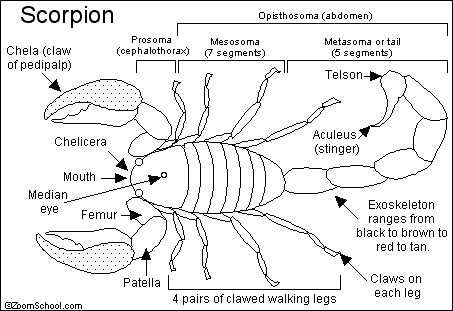

The Greek word for ‘scatter’ is skorpizo (Strong’s 4650), and it is related to the word ‘scorpion‘, “apparently from the same as skorpios (through the idea of penetrating); to dissipate, i.e. (figuratively) put to flight, waste, be liberal, disperse abroad, scatter (abroad) [10]. Here, (‘skorpios’) is akin to ‘(skorpizo’) which means to scatter, (‘diaspeiro’) further means to scatter abroad, as in (‘dia’) and ‘(spiro’) to sow seed [11]. Luke uses the same Greek word (skorpizo) for both ‘scatters’ and ‘squanders’ and has been used in the context of the Prodigal Son’s dissipation [12], diaskorpizo ‘to scatter abroad,’ (‘diaspeiro’) is also used metaphorically of ‘squandering property’.
Strong’s Bible Dictionary has for skorpios (scorpion) number 4651; “Probably from an obsolete skerpo (perhaps strengthened from the base of skopos and meaning to pierce); a ‘scorpion’ (from its sting)”. The word skerpo is explained; “from skeptomai (to peer about ‘skeptic‘; perhaps akin skapto4626 through the idea of concealment; compare 4629); a watch (sentry or scout), i.e. (by implication) a goal:–mark” [13]. Greek skeptomai comes from the Indo-European root *spek– ‘To observe’. Derivatives: spy, espionage, specimen, spectacle, spectrum, speculate, speculum (from Latin, ‘mirror’, from specere, specula, a mirror), spice, aspect, circumspect, conspicuous, despise,expect, inspect, introspect, perspective, prospect, respect, respite (from respicere ‘to look back’), retrospect, suspect, (from Latin specere, to look at), spectre (or specter), special, spectator, spectacular (from spectare), specific, specify, species, specious, especial, despicable, skeptic (from Greek skeptesthai, to examine, consider), sceptical, scope (from Latin scopus, from Greek skopos, ‘aim, target, watcher’), –scope, –scopy, bishop (epi– + skopos). [Pokorny spek– 984. Watkins
The astrological influences of the constellation given by Manilius:
“The Scorpion presides over arms” [Manilius, Astronomica, 1st century AD, book 4, p.253]
“By virtue of his tail armed with its powerful sting, wherewith, when conducting the Sun’s chariot through his sign, he cleaves the soil and sows seed in the furrow, the Scorpion creates natures ardent for war and active service, and a spirit which rejoices in plenteous bloodshed and in carnage more than in plunder. Why, these men spend even peace under arms: they fill the glades and scour the woods; they wage fierce warfare now against man, now against beast, and now they sell their persons to provide the spectacle of death and to perish in the arena, when, warfare in abeyance, they each find themselves foes to attack. There are those, too, who enjoy mock-fights and jousts in arms (such is their love of fighting) and devote their leisure to the study of war and every pursuit which arises from the art of war.” [Manilius, Astronomica, 1st century AD, p.239-240].
Sowing seed is a metaphor for sexual intercourse. Scorpio is the sign of sex and death, the beginning and ending of things [14].
© Anne Wright 2008.
| Fixed stars in Scorpio | |||||||
| Star | 1900 | 2000 | R A | Decl 1950 | Lat | Mag | Sp |
| Dschubba delta | 01SAG10 | 02SAG34 | 239 20 34 | -22 28 52 | -01 58 48 | 2.54 | B0 |
| pi | 01SAG34 | 02SAG57 | 238 57 20 | -25 58 18 | -05 28 08 | 3.00 | B1 |
| rho | 01SAG46 | 03SAG09 | 238 26 53 | -29 04 11 | -08 35 34 | 4.02 | B4 |
| Acrab beta | 01SAG48 | 03SAG11 | 240 37 53 | -19 40 13 | +01 00 50 | 2.90 | B1 |
| Jabbah nu | 03SAG15 | 04SAG39 | 242 16 17 | -19 19 57 | +01 38 23 | 4.29 | B2 |
| sigma | 06SAG25 | 07SAG48 | 244 32 11 | -25 28 29 | -04 01 52 | 3.08 | B1 |
| Antares alpha | 08SAG22 | 09SAG46 | 246 35 03 | -26 19 22 | -04 33 48 | 0.98 var | M1 |
| tau | 10SAG05 | 11SAG28 | 248 11 29 | -28 06 51 | -06 06 56 | 2.91 | B0 |
| epsilon | 13SAG58 | 15SAG21 | 251 43 48 | -34 12 16 | -11 43 40 | 2.36 | G9 |
| My1 | 14SAG46 | 16SAG09 | 252 07 10 | -37 57 49 | -15 24 59 | 3.09 | B2 |
| Grafias zeta 2 | 15SAG51 | 17SAG14 | 252 45 54 | -42 16 40 | -19 38 03 | 3.75 | K5 |
| eta | 19SAG22 | 20SAG45 | 257 08 30 | -43 10 31 | -20 10 23 | 3.44 | A7 |
| Lesath upsilon | 22SAG37 | 24SAG01 | 261 50 26 | -37 15 29 | -14 00 05 | 2.80 | B3 |
| Shaula lambda | 23SAG11 | 24SAG35 | 262 33 09 | -37 04 10 | -13 46 54 | 1.63 | B2 |
| Sargas theta | 24SAG12 | 25SAG36 | 263 25 51 | -42 58 05 | -19 38 19 | 2.04 | F0 |
| Aculeus NGC6405 M6 | 24SAG20 | 25SAG44 | 264 10 30 | -32 11 00 | -08 50 18 | 5.30 | |
| kappa | 25SAG06 | 26SAG27 | 264 45 23 | -39 00 23 | -15 38 15 | 2.51 | B3 |
| iota | 26SAG08 | 27SAG31 | 266 01 17 | -40 06 35 | -16 42 28 | 3.14 | F6 |
| 26SAG32 | 27SAG55 | 266 36 48 | -37 01 46 | -13 36 59 | 3.25 | K2 | |
| Acumen NGC6475 M7 | 27SAG21 | 28SAG45 | 267 39 00 | -34 48 00 | -11 22 13 | 3.20 |
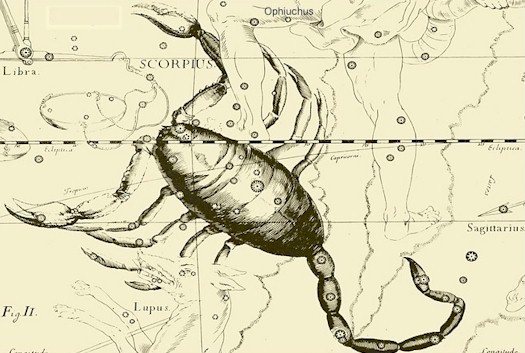
Hevelius,Firmamentum, 1690
History of the constellation
from Star Names, 1889, Richard H. Allen
. . . that cold animal
Which with its tail doth smite among the nations.
— Longfellow’s translation of Dante’s Purgatorio
Scorpio, orScorpius, the Scorpionwas the reputed slayer of the Giant (Orion), exalted to the skies and now rising from the horizon as Orion, still in fear of the Scorpion, sinks below it; {Page 361} although the latter itself was in danger, — Sackville writing in his Induction to theMirrorofMagistrates, about 1565:
Whiles Scorpio, dreading Sagittarius‘ dart
Whose bow prest bent in flight the string had slipped,
Down slid into the ocean flood apart.
Classical authors saw in it the monster that caused the disastrous runaway of the steeds of Phoebus Apollo when in the inexperienced hands of Phaethon.
For some centuries before the Christian era it was the largest of the zodiac figures, forming with the Khelai, its Claws, — the prosectaechelae of Cicero, now our Libra, — a double constellation, as Ovid wrote:
Porrigit in spatium signorum membra duorum
and this figuring has been adduced as the strongest proof of Scorpio’s great antiquity, from the belief that only six constellations made up the earliest zodiac, of which this extended sign was one.
With the Greeks it universally was Skorpios; Aratos, singularly making but slight allusion to it, added Megatherion, the Great Beast, changed in the 1720 edition of Bayer to Melatherion; while another very appropriate term with Aratos was Teras mega, the Great Sign. This reputed magnitude perhaps was due to the mythological necessity of greater size for the slayer of great Orion, in reference to which that author characterized it as pleioterosprophaneis, “appearing hugher still.”
The Latins occasionally wrote the word Scorpios, but usually Scorpius, or Scorpio; while Cicero, Ennius, Manilius, and perhaps Columella gave the kindred African title Nepa, or Nepas, the first of which the AlfonsineTables copy, as did Manilius the Greek adjective Opistho Bamon, Walking Backward. Astronomical writers and commentators, down to comparatively modem times, occasionally mentioned its two divisions under the combined title ScorpiuscumChelis (Scorpio and Libra); while some representations even showed the Scales in the creature’s Claws.
Grotius said that the Arabians called the Claws Graffias, and the Latins, according to Pliny, Forficulae
In early China it was an important part of the figure of the mighty but genial AzureDragon of the East and of spring, in later days the residence of the heavenly BlueEmperor; but in the time of Confucius it was TaWho, the Great Fire, a primeval name for its star Antares; and ShingKung, a Divine Temple, was applied to the stars of the tail. As a member {Page 362} of the early zodiac it was the Hare, for which, in the 16th century, was substituted, from Jesuit teaching, TienHe, the Celestial Scorpion.
Sir William Drummond asserted that in the zodiac which the patriarch Abraham knew it was an Eagle; and some commentators have located here the biblical ChambersoftheSouth, Scorpio being directly opposite the Pleiades (in Taurus) on the sphere, both thought to be mentioned in the same passage of the BookofJob with two other opposed constellations, the Bear (Ursa Major) and Orion; but the original usually is considered a reference to the southern heavens in general. Aben Ezra identified Scorpio, or Antares, with the ’sil of the Hebrews; although that people generally considered these stars as a Scorpion, their Akrabh, and, it is claimed, inscribed it on the banners of Dan as the emblem of the tribe whose founder was “a serpent by the way.” When thus shown it was as a crownedSnake or Basilisk. A similar figure appeared for it at one period of Egyptian astronomy; indeed it is thus met with in modern times, for Chatterton, that precocious poet of the last century, plainly wrote of the Scorpion in his line,
The slimy Serpent swelters in his course;
and long before him Spenser had, in the FaerieQueen
and now in Ocean deepe
Orion flying fast from hissing snake,
His flaming head did hasten for to steepe.
But the Denderah zodiac shows the typical form.
Kircher called the whole constellation Isias, Static Isidis, the bright Antares having been at one time a symbol of Isis.
The Arabians knew it as Al ‘Akrab, the Scorpion, from which have degenerated Alacrab, Alatrab, Alatrap, Hacrab, — Riccioli’s Aakrab and Hacerab; and similarly it was the Syrians’ Akreva. Riccioli gave us AcroboChaldaeis, which may be true, but in this Latin word he probably had reference to the astrologers.
The Persians had a Scorpion in their Ghezhdum or Kazhdum, and the Turks, in their Koirughi, Tailed, and UzunKoirughi, Long-tailed.
The Akkadians called it Girtab, the Seizer, or Stinger, and the PlacewhereOneBowsDown, titles indicative of the creature’s dangerous character; although some early translators of the cuneiform text rendered it the DoubleSword. With later dwellers on the Euphrates it was the symbol of darkness, showing the decline of the sun’s power after the autumnal equinox, then located in it. Always prominent in that astronomy, Jensen thinks that it was formed there 5000 B.C., and pictured much as it now is; {Page 363} perhaps also in the semi-human form of two Scorpion-men, the early circular Altar, or Lamp, sometimes being shown grasped in the Claws, as the Scales were in illustrations of the 15th century. In Babylonia this calendar sign was identified with the eighth month, Arakh Savna, our October-November.
Early India knew it as Ali, Vicrika, or Vrouchicam, — in Tamil, Vrishaman; but later on Varaha Mihira said Kaurpya, and Al Biruni, Kaurba, both from the Greek Scorpios. On the Cingalese zodiac it was Ussika
Dante designated it as UnSecchione
Formed like a bucket that is all ablaze;
and in the Purgatorio as IlFriddoAnimal of our motto, not a mistaken reference to the creature’s nature, but to its rising in the cold hours of the dawn when he was gazing upon it. Dante’s translator Longfellow has something similar in his own Poets‘ Calendar for October:
On the frigid Scorpion I ride.
Chaucer wrote of it, in the HousofFame, as the Scorpioun; his Anglo-Norman predecessors, Escorpiun; and the Anglo-Saxons, Throwend
Caesius mistakenly considered it one of the ScorpionsofRehoboam; but Novidius said that it was
the scorpion or serpent whereby Pharaoh, King of Egypt, was enforced to let the children of Israel depart out of his country;
of which Hood said “there is no such thing in history.” Other Christians of their day changed its figure to that of the ApostleBartholomew; and Weigel, to a Cardinal’Hat
In some popular books of the present day it is the Kite, which it as much resembles as it does a Scorpion. Its symbol is now given as 
Ampelius assigned to it the care of Africus, the Southwest Wind, a duty which, he said, Aries and Sagittarius shared; and the weather-wise of antiquity thought that its setting exerted a malignant influence, and was accompanied by storms; but the alchemists held it in high regard, for only when the sun was in this sign could the transmutation of iron into gold be performed. Astrologers, on the other hand, although they considered it a fruitful sign, “active and eminent,” knew it as the accursed constellation, {Page 364} the baleful source of war and discord, the birthplace of the planet Mars, and so the HouseofMars, the MartisSidus of Manilius. But this was located in the sting and tail; the claws, as Zugos, Jugum, or the Yoke of the Balance (Libra), being devoted to Venus, because this goddess united persons under the yoke of matrimony. It was supposed to govern the region of the groin in the human body, and to reign over Judaea, Mauritania, Catalonia, Norway, West Silesia, Upper Batavia, Barbary, Morocco, Valencia, and Messina; the earlier Manilius claiming it as the tutelary sign of Carthage, Libya, Egypt, Sardinia, and other islands of the Italian coast. Brown was its assigned color, and Pliny asserted that the appearance of a comet here portended a plague of reptiles and insects, especially of locusts.
Although nominally in the zodiac, the sun actually occupies but nine days in passing through the two portions that project upwards into Ophiuchus, so far south of the ecliptic is it; indeed, except for these projections, it could not be claimed as a member of the zodiac.
Scorpio is famous as the region of the sky where have appeared many of the brilliant temporary stars, chief among them, perhaps, that of 134 B.C., the first in astronomical annals, and the occasion, Pliny said, of the catalogue of Hipparchos, about 125 B.C. The Chinese SheKe confirmed this appearance by its record of “the strange star” in June of that year, in the sieu (Chinese Moon Mansion) Fang, marked by beta, delta, pi, rho, and others in Scorpio. Serviss thinks it conceivable that the strange outbursts of these novae in and near Scorpio may have had some effect in causing this constellation to be regarded by the ancients as malign in its influence. But this character may, with at least equal probability, have come from the fiery color of its lucida, as well as from the history of the constellation in connection with Orion, and the poisonous attributes of its earthly namesake.
Along its northern border, perhaps in Ophiuchus, there was, in very early days, a constellation, the Fox, taken from the Egyptian sphere of Petosiris, but we know nothing as to its details.
Star Names: Their Lore and Meaning, Richard H. Allen, 1889.]