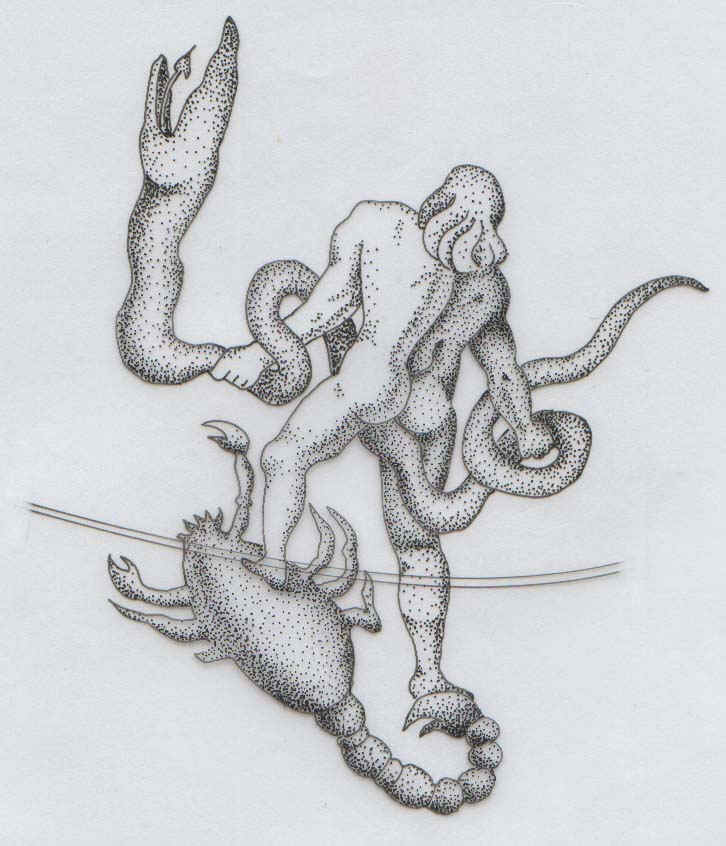
Ophiuchus, or Serpentarius, the Serpent-holder, the Serpent Bearer, the Serpent Wrestler, or the Snake Charmer, is depicted holding a snake, the snake is represented by the constellation Serpens. The constellation is located around the celestial equator with the two legs of Ophiuchus protruding right into the zodiac and south of the ecliptic. Ophiuchus is identified with Aesculapius (Asklepios, Asclepius), an ancient physician who grew so skilled in the craft of healing that he was able to restore the dead to life. However, because this was a crime against the natural order, Zeus destroyed him with a thunderbolt. According to one version (Pindar’s) he offended Zeus by accepting a fee in exchange for raising the dead. Ophiuchus is identified with the Euphratean Sagimu (Sa-gi-mu), the God of Invocation.
Read what writers of myth have written on Asclepius on this Theoi Projectwebpage
The association of the serpent (Serpens) with this constellation, Ophiuchus, may indicate the miraculous powers which are ascribed to snake-charmers. Before medicine became a science the role of the physician and priest were combined in many cultures, and existed in what we know today as the witch doctor, shaman, or medicine man, and the earliest snake charmers were traditional healers. Their aim was holistic healing, the healing of both mind and body. They used herbs, potions, charms, incantations, exorcism, magic, divination, and prayers, in their means to establish the cure. Aesculapius, we are told, was the first doctor of medicine with the ability to restore people to life. The name and the profession were continued in the Asclepiadae, an order of priest-physicians in Greece. Those seeking aid in healing stayed for periods of time in what was called an Asclepieion (or Asklepieion), a sanctuary or shrine dedicated to Asclepius. They slept overnight in these places where the god was said to reveal the remedies for the disease in dreams, they reported their dreams to a priest the following day who prescribed a cure. The Asklepieion at Epidaurus is traditionally regarded as the birthplace of Asclepius. Other Asklepieions were located in Athens, Cos, Pergamum, and later Rome, where his worship spread after a plague in 293 B.C.
Phorbas, or Phorbaceus, who freed Rhodes from snakes, is identified with this constellation. Phorbas cleansed the island of the snakes and in gratitude the Rhodians venerated him as a hero. For his achievement he won a place among the stars as the constellation Serpentarius or Ophiuchus. Virgil tells how Somnus appeared to Palinurus; “Winged Somnus flies down from the sky and sits on the stern of Aeneas’ ship, where he assumes the guise of Phorbas”. Assuming the guise of Somnus should make Phorbas the same as Somnus. Latin somnus is from the Indo-European root *swep ‘To sleep’. Derivatives: sopor, soporific, somni-, somnolent, insomnia, (these words from Latin somnus, sleep), hypno-, hypnosis, hypnogogic, hypnotize, (these words from Greek hupnos, sleep). [Pokorny 1. swep- 1048. Watkins
A core part of the shaman’s or witch-doctor’s role is the use of altered state of consciousness and hypnotism. Snake charming is the practice of hypnotizing a snake by playing a musical instrument [].
“Ophiuchus means ‘he who holds the serpent’ and that is how he is depicted. The struggle will last forever, since they wage it on equal terms with equal powers”. [Manilius, Astronomica, 1st century AD, book 1, p.31]
The snake, Serpens, that Ophiuchus, the snake-handler, holds, is found on the symbol of medicine worldwide, the caduceus. The staff of Aesculapius was a single snake wrapped around a staff (often confused with the staff of Mercury or Hermes which has two snakes and is said to represent commerce). See picture of the Rod of Asclepius.
The snake, Serpens, that Ophiuchus, the snake-handler holds, and the symbol of the Rod of Asclepius, may have something to do with the kundalini; the kundalini is said to represent the life-force; the balanced flow of this energy is critical to health and harmony. The kundalini energy or ‘serpent power’ resides at the base of the spine, and is represented symbolically as a snake coiled up upon itself in three and a half circles like a true snake or serpent (Draco is a four-footed snake not depicted curled up in that manner, but Draco might also have something to do with this power). Kundalini is a Sanskrit word meaning either ‘coiled up’ or ‘coiling like a snake’. The cultivation and management of this life-force has been the aim of the physician-priests, witch-doctors, and shamans, in many cultures who used drumming, trance, chanting, hallucinogenics etc. to facilitate intuitive diagnostics and the cure.
Ophiuchus had an Arabic title lePsylle, and the constellation is also said to be identified with the Psylli of Libya, Herodotus mentions the Psylli, a tribe of snake-charmers in North Africa. The word resembles the Latin word psylla, psyllius, Greek psullion, meaning a flea. Fleas are bloodsucking insects and doctors were called leeches. Latin word psylla is related to Latin pulex, the genus of fleas, genitive pulicis, ‘flea’, cognate with the color puce or peuce, perhaps because of the purplish color of the flea’s engorged blood, and puceron, plant lice.
The name Asklepios is suggested to have been derived from spalax, ‘blind rat mole‘, a truly blind mole, also spelled skalopsaspalas, which this Wikipedia page says “refers to the resemblance of the Tholos in Epidauros and the building of a mole”. The Greek word for mole was aspalae, the word is translated talpa, the Latin for the genus of moles. A mole was also called mus caecus, ‘blind mouse’ []. The constellation figure, Ophiuchus, also was associated with Caecius (from Latin caecus, blind) [Allen, below]. Moles are blind or nearly blind. Latin talpa, a mole, is believed to be related to Greek tuphle, tuphla, blind [Valpy, p.463].
According to Allen [Star Names] “the figure also was associated with Caecius, the Blinding One, slain by Hercules and celebrated by Dante in the Inferno“:
Asklepiades: Also ‘AsklepieianAsklepeian drug’, but ‘Asklepepian temple’. Also Asklepiadai, the doctors, from Asklepios. He [derived his name] from keeping bodies tough (askele) [probably a misprint and should be askete] and gentle (epia). Asklepios, the patron of medicine, could heal Pauson and Iros and any other hopeless case” [Suidas s.v. Asklepiades
JAMA says Scholia in Homer’s Iliad suggests that the name Asklepios was derived from words meaning applying (askein) and making the limbs gentle (epia). Greek askein gives us the word ascetic, a hermit or monk, from Greek asketikos, asketes, ‘one that exercises or practices’, from askein ‘to exercise, train’. The –epia, –epios, in the name Asklepios is variously translated ‘gentle’, ‘kind’, ‘calm’, ‘soothing’. Epione, ‘the Mild One’, was the wife of Asklepios.
Medicine comes from the same root as the name Medusa, whose severed head Perseus carries, the star Algol represents her. The name of the sorceress and drug-brewer Medea also comes from this root. The blood that flowed on Medusa’s left side was said to be fatal poison. The blood from her right side was beneficial. Asclepius used her blood to heal which might mean he used medicine to heal.
The Roman equivalent of the Greek name Asclepius is Aesculapius. Jacqueline Brook in Our Rock Who Art In Heaven gives an interesting opinion on the name:
“In examining the name Aesculapius, I discovered that the adjective relating to this god, Aesculapian, has an alternate spelling: Esculapian. The word “esculent” is from the Latin esculentus, meaning “edible”‘ and esca, meaning “food” [esca ‘food’, from edere ‘to eat’]. Lapis, in Latin, means ‘stone'”
The constellation may have further associations with stones: As mentioned above Ophiuchus also was associated with Caecius (Greek Kaikias), the Blinding One. Kaikias is the North East wind, and depicted carrying a large shield which scatters hailstones upon the ground below.
Caesius, a Christian astronomer, gave the title Aaron to Ophiuchus. Aaron, whose staff became a serpent:
“Aaron threw down his staff in front of Pharaoh and his court, and it turned into a serpent”. Exodus 7:12
Charmers often supplement their performances with juggling, sleight of hand, and other tricks. One occasional feat is “turning a rod into a serpent”, a trick that has been known since Biblical times (see Exodus 7:12). This is reportedly accomplished by putting pressure on a particular nerve behind the snake’s head, which causes it to stiffen up [].
It is said that so expert in restoring life had Asclepius become that Hades, God of the Underworld, complained to his brother Zeus that fewer and fewer souls were being sent down to him in Hades. Zeus killed Asclepius with a thunderbolt.
The cock was sacred to Asclepius and the bird was sacrificed as his altar. “I owe a cock to Asclepius” were Socrates last words on the point of death. The cock crows and wakes people up from sleep. The cock’s crow heralds daybreak, the awakening to a new day, or symbolically resurrection into a new life. Aesculapius became so skilled a physician that he was able to restore the dead to life; raise people from the dead. Perhaps this means the new life after death as the sacrifice of a cock by Socrates to Aesculapius seems to suggest. Socrates was executed with a dose of hemlock poison:
“When the poison reaches the heart, that will be the end. He was beginning to grow cold about the groin, when he uncovered his face, for he had covered himself up, and said (they were his last words)–`Krito, we owe a cock to Asklepios. Pay it and do not neglect it.'” [Plato, Phaedo 118a (trans. Lamb) (Greek philosopher C4th B.C.): http://www.theoi.com/Cult/AsklepiosCult.html
Alektryona athleten Tanagraion (A prize-fighting cock of Tanagra): These aristocrats sing [this]. `He sends it to be a votive offering and a delight to Asklepios, as if the bird were an attendant or servant in the temple, that man of Aspendos.’ [Suidas s.v. Alektryona athleten Tanagraion (Byzantine Greek lexicon C10th A.D.)
“Certain people have said that he holds the snake for the following reason. [N.B. The following myth is usually told of the seer Polyidos rather than Asklepios.] When he was commanded to restore Glaucus, and was confined in a secret prison, while meditating what he should do, staff in hand, a snake is said to have crept on to his staff. Distracted in mind, Aesculapius killed it, striking it again and again with his staff as it tried to flee. Later, it is said, another snake came there, bringing an herb in its mouth, and placed it on its head. When it had done this, both fled from the place. Whereupon Aesculapius, using the same herb, brought Glaucus, too, back to life.
And so the snake is put in the guardianship of Aesculapius and among the stars as well. Following his example, his descendants passed the knowledge on to others, so that doctors make use of snakes.” [Pseudo-Hyginus, Astronomica 2. 14 from Theoi websiteOf the sun’s healing power Asclepius is the symbol, and to him they have given the staff as a sign of the support and rest of the sick, and the serpent is wound round it, as significant of his preservation of body and soul: for the animal is most full of spirit, and shuffles off the weakness of the body. It seems also to have a great faculty for healing: for it found the remedy for giving clear sight, and is said in a legend to know a certain plant which restores life. [Porphyry, On Images, (c. 232 AD – c. 304), Fragment 8.]
Lana Rings’website
Ophiuchus might be the fetus (foetus) attached to the umbilicus cord (Serpens). phiuchus is depicted holding a snake, the snake is represented by the constellation Serpens. Ophiuchus, from Greek Ophiukhos, literally ‘holding a serpent’, from Greek opis (or ophis), the Greek word for ‘serpent’, + Greek ekhein, ‘to hold, keep, have’. In a discussion on this linguist webpage there is a suggestion that there is a likely relationship between the Greek words ophis and *omphi-. [Omphi from the Indo-European root *nobh-. Related words ‘umbilicus‘, ‘omphallus‘, ‘navel‘, ‘nave‘, the hub of a wheel]. The constellation Ophiuchus is identified with Asclepius who was cut from his mother’s womb as a foetus. The long tube-like shape of a snake bears a resemblance to an umbilical cord. When the snake is curled up it might appear to be like the nave or hub of a wheel. [The womb is represented by Delphinus.]
Another clue could be the association with incubation which was practiced in all the Asclepius’ sanctuaries in the ancient world.
Also the connection of Asclepius’ name to the ‘mole’. The life of a foetus is similar to that of a mole, in that it can sense light, but cannot see or focus clearly. Both feel around in a confined space.
Ophiuchus was called Ciconia, the Stork, by the Arabian astronomers. They had depicted a stork in the place of Ophiuchus [Urania: 1754, John Hill]. The stork is often depicted on greetings cards and advertisements carrying a bundle with the newborn baby in its beak. Or maybe it was the soul or spirit of the baby that the stork delivers; according to this website there was a belief in folklore that “the spirit of unborn children dwelled in bodies of water where the stork was known to stalk. Waiting to be plucked by a stork passing by, these babies were then delivered to new mothers.” In Ancient Egypt, the stork was the hieroglyph for, the Ba, or ‘soul’ [Wikipedia] (Ancient Egyptians had eight substances that are translated soul or spirit), it might just be a coincidence that this word Ba is the first element in baby; ba-by.
The words (see above) soporific, somnolent, hypnogogic, are not unlikely words to describe the drowsy state of consciousness of a foetus in it’s womb. Greek Hypnos (Roman equivalent Somnus) is described as a sleeping baby living in a palace that is a dark cave where the sun never penetrates.
The astrological influences of the constellation given by Manilius:
“When Ophiuchus, encircled by the serpent’s great coils, rises he renders the forms of snakes innocuous to those born under him. They will receive snakes into the folds of their flowing robes, and will exchange kisses with these poisonous monsters and suffer no harm.” [Manilius, Astronomica, 1st century AD, book 5, p.333].
“One called Ophiuchus holds apart the serpent which with its mighty spirals [gyris] and twisted body encircles his own, that so he may untie its knots and back that winds in loops. But, bending its supple neck, the serpent looks back and returns; and the other’s hands slide over the loosened coils. The struggle will last for ever, since they wage it on level terms with equal powers.” [Manilius, Astronomica, 1st century AD, book 1, p.31].
© Anne Wright 2008.
| Fixed stars in Ophiuchus | |||||||
| Star | 1900 | 2000 | R A | Decl 1950 | Lat | Mag | Sp |
| Yed Prior delta (δ) | 00SAG54 | 02SAG18 | 242 55 45 | -03 34 02 | +17 14 56 | 3.03 | M1 |
| Yed Posterior epsilon (ε) | 02SAG07 | 03SAG31 | 243 55 06 | -04 34 20 | +16 26 42 | 3.34 | G8 |
| Marfik lambda (λ) | 04SAG12 | 05SAG36 | 247 05 51 | +02 05 31 | +23 33 48 | 3.85 | A1 |
| Han zeta (ζ) | 07SAG50 | 09SAG14 | 248 36 02 | -10 28 03 | +11 23 50 | 2.70 | O9 |
| kappa (κ) | 10SAG27 | 11SAG50 | 253 49 30 | +09 27 04 | +31 50 35 | 3.42 | K2 |
| Sabik eta (η) | 16SAG34 | 17SAG58 | 256 52 38 | -15 39 53 | +07 12 10 | 2.63 | A2 |
| theta (θ) | 19SAG41 | 21SAG04 | 259 44 03 | -24 57 05 | -01 50 12 | 3.37 | B2 |
| Ras Alhague alpha (α) | 21SAG03 | 22SAG27 | 263 09 11 | +12 35 42 | +35 50 41 | 2.14 | A5 |
| Kelb Alrai beta (β) | 23SAG56 | 25SAG20 | 265 15 00 | +04 35 11 | +27 56 38 | 2.94 | K1 |
| gamma (γ) | 25SAG15 | 26SAG38 | 266 20 45 | +02 43 28 | +26 07 07 | 3.74 | A0 |
| Sinistra nu (ν) | 28SAG21 | 29SAG45 | 269 04 05 | -09 46 09 | +13 40 25 | 3.50 | K0 |
from Star Names 1889, Richard H. Allen
. . . the length of Ophiuchus huge
In the arctic sky.
— Milton’s ParadiseLost
Ophiuchusvel Serpentarius, the Serpent-Holder, not OphiuchusSerpentarius, is Ofiuco with the Italians, Schlangentrager (Snake Bearer) with the Germans, and Serpentaire with the French. It stretches from just east of the head of Hercules to Scorpius; partly in the Milky Way, divided nearly equally by the celestial equator; but, although always shown with the Serpent (Serpens), the catalogues have its stars entirely distinct from the latter. The classical Hyginus, however, united the two figures into a single constellation, and some early nations, especially the Sogdians and Khorasmians, did the same, the stars being intermingled in their nomenclature.
{Page 298} The original title, Ophioukhos, appeared in the earliest Greek astronomy; mogeros, “toiling,” being an adjectival appellation in the Phainomena
Transliterated as in our title it was best known to the Latins, but also as Ophiulchus, Ophiulcus, Ophiultus, and, in the diminutive, Ophiuculus and Ophiulculus; while the classical word plainly shows itself in the Afeichus, Afeichius, and Alpheichius of the 16th and 17th centuries.
Serpentarius first appeared with the scholiast on Germanicus, while Serpentiger, SerpentisLator, SerpentisPraeses, and Serpentinarius are seen for it; as also the Anguifer of Columella, which was Anguiger elsewhere. Cicero and Manilius had the peculiar Anguitenens. Golius insisted that this sky figure represents a Serpentcharmer, one of the Psylli of Libya, noted for their skill in curing the bites of poisonous serpents; and this would seem to be confirmed by the constellation’s title lePsylle in Schjellerup’s edition of Al Sufi’s work.
But the Serpent-holder generally was identified with Asklepios, Asclepios, or Aesculapius, whom King James I described as “a mediciner after made a god,” with whose worship serpents were always associated as symbols of prudence, renovation, wisdom, and the power of discovering healing herbs. Educated by his father Apollo, or by the Centaur Chiron, Aesculapius was the earliest of his profession and the ship’s surgeon of the Argo. When the famous voyage was over he became so skilled in practice that he even restored the dead to life, among these being Hippolytus, of whom King James wrote:
Hippolyte. After his members were drawn in sunder by foure horses, Esculapius at Neptune’s request glued them together and revived him.
But several such successful operations and numerous remarkable cures, and especially the attempt to revive the dead Orion, led Pluto, who feared for the continuance of his kingdom, to induce Jove to strike Aesculapius with a thunderbolt and put him among the constellations.
The figure also was associated with Caecius, the Blinding One, slain by Hercules and celebrated by Dante in the Inferno; indeed, it is said that the {Page 299} Hero himself was assigned to these stars by Hyginus, and gave them his name: a confusion that may have arisen because the boundaries between the two stellar groups were at first ill defined, or from the similarity of their original myths to that of Izhdubar (maybe Hercules) and the dragon Tiamat (maybe Draco). It also represented Triopas, king of the Perrhaebians; Carnabou, Carnabas, and Carnabus, the slayer of Triopas; Phorbas, his Thessalian son, who freed Rhodes from snakes; Cadmus changed to a serpent; Jason pursuing the golden-fleeced Aries; Aesacus, from the story of Hesperia; Aristaeus, from the story of Eurydice; Laocoon struggling with the serpent; (and Caesius, or Glaucus, the sea-god, although this latter title, identified by some with that of Androgeus, may have come from that namesake who was restored to life by Aesculapius.)
The Arabians translated the Greek name into AlHawwa’, which Assemani repeated as Alhava, Collectorserpentum; but it appeared on the globes as AlHaur, turned by the Moors into AlHague, and by early astronomical writers into Alangue, Hasalangue, and Alange; the Turks having the similar Yilange. It has been suggested, however, that these may have come from the Latin Anguis, a word that the astronomical Arabians and Moors well knew.
Euphratean astronomers knew it, or a part of it with Serpens, as Nutsirda; and Brown associates it with Sagimu, the God of Invocation.
Pliny said that these stars were dangerous to mankind, occasioning much mortality by poisoning; while Milton compared Satan to the burning comet that “fires” this constellation, — a comparison perhaps suggested by the fact that noticeable comets appeared here in the years 1495, 1523, 1537, and 1569, which might well have been known to Milton, for Lord Bacon wrote in his Astronomy
Comets have more than once appeared in our time; first in Cassiopeia, and again in Ophiuchus.
Novidius changed the figure to that of SaintPaulwiththeMalteseViper; Caesius gave it as Aaron, whose staff became a serpent, or as Moses, who lifted up the Brazen Serpent in the Wilderness; but Julius Schiller, far more appropriately, made of it SaintBenedict in the midst of the thorns, for it was this founder of the order of the Benedictine monks who, with his followers in the 6th century, inspired and carried on all the learning of the times, as Aesculapius-Ophiuchus had done in his day.
The constellation generally has been shown as an elderly man, probably copied from the celebrated statue at Epidaurus; but the LeydenManuscript and the planisphere of the monk Geruvigus represent it as an unclad boy {Page 300} standing on the Scorpion and holding the Serpent in his hands; and the Hyginus of 1488 has a somewhat similar representation.
Bayer added to his titles for Ophiuchus GrusautCiconiaSerpenticuminscriptione, Elhague, insistens, which he said was from the Moors, but Ideler asserted was from a drawing of a Crane, or Stork, on a Turkish planisphere instead of the customary figure; and the Almagest of 1551 alludes to Ciconia as if it were a well-known title. All this, perhaps, may be traced to ancient India, whose mythology was largely astronomical, and the Adjutant-bird, Ciconiaargala, prominent in worship as typifying the moon-god Soma, so that its devotees would only be following custom in locating it among the stars.
Although this is not one of the zodiac twelve, Mr. Royal Hill writes:
Out of the twenty-five days, from the 21st of November to the 16th of December, which the sun spends in passing from Libra to Sagittarius, only nine are spent in the Scorpion, the other sixteen being occupied in passing through Ophiuchus
Thus, according to his idea of the boundaries, this actually is more of a zodiacal constellation than is the Scorpion. But the boundaries are very variously given by uranographers.
[Note at end of page: According to Greek tradition, Asclepius was a lineal ancestor of the great physician Hippocrates; and Doctor Francis Adams, in his GenuineWorksof Hippocrates‘, writes: “A genealogical table, professing to give a list of names of his forefathers, up to Aesculapius, has been transmitted to us from remote antiquity.” This list, from the Chiliads of Tzetzes of our 12th century, makes Hippocrates the 15th in descent from Aesculapius through his son Podalirius, who, with his brother Machaon, was an army surgeon, as well as a valiant fighter before the walls of Troy. The name and the profession were continued in the Asclepiadae, an order of priest-physicians long noted in Greece.]
Star Names: Their Lore and Meaning, Richard H. Allen, 1889.]