Constellations of Words
Explore the etymology and symbolism of the constellations
the Ethiopian Queen, the Seated Woman
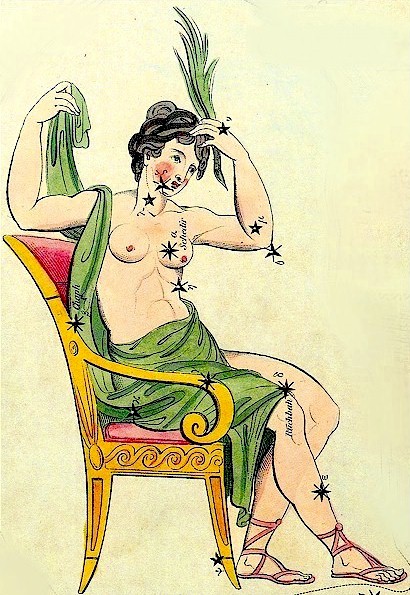
Urania’s Mirror1825
Contents:
1. Clues to the meaning of this celestial feature
2. The fixed stars in this constellation
3. History_of_the_constellation
Clues to the meaning of this celestial feature
Cassiopeia (Greek Kassiope, Kassiepeia) is queen of the celestial royal family, her husband Cepheus is king of Ethiopeia, they are parents of Andromeda. Cassiopeia was proud of her daughter’s beauty and boasted that her daughter was more beautiful than the Sea Nymphs, the Nereids, who were daughters of Poseidon (Neptune). The Nereids complained to Poseidon who sent a sea monster, Cetus, to ravage the coast. With his kingdom in grave danger, Cepheus consulted the oracle of Ammon in Libya for advice. He learned that the only way to save his kingdom was to sacrifice his daughter Andromeda to the sea monster. Andromeda was chained to a rock and left to the mercy of the sea monster. The hero, Perseus, arrives at the scene and falls in love with her, he has a quick consultation with Cepheus and Cassiopeia, it is agreed that if he rescues their daughter, he could marry her. The sea monster arrives and Perseus kills it. Perseus breaks the chains that binds Andromeda to the rock. The wedding follows.
The constellation is in a circumpolar position, i.e. it revolves around the pole star, Polaris, and being so close to the pole, its position appears to change dramatically throughout the night. The five brightest stars trace the shape of a slightly distorted M, known as the Celestial, when above the pole, and a W, known as Celestial, when below the pole, when Cassiopeia is in an upside-down position.
Cassiopea, is the name of the genus of the “upside-down” jellyfish.
Cassiopeia, the Enthroned Queen, is a sitting figure, at times suspended upside-down in the sky in a very undignified position, she is depicted firmly bound to her throne and refrained from falling out of it, in going around the pole head downward (rather like being on a Ferris wheel I imagine). Greeks knowing it as KassiepeiaE tou thronou, ‘Cassiopeia, She of the Throne‘; and Hyde gave it the title Inthronata. The constellation is often referred to as Cassiopeia’s throne because the stars clearly outline the chair, or throne, upon which the queen sits. The word ‘throne‘ comes from the Indo-European root *dher ‘To hold firmly, support’. Derivatives: farm, fermata (in music the prolongation of a tone, chord), firm¹, firm², firmament, affirm, confirm, furl, infirm, infirmary, (these words from Latin firmus, firm, strong), throne (from Greek thronos, seat, throne < ‘support’), dharma (from Sanskrit dharma, statute, law < ‘that which is established firmly’), dharna (the practice of protesting against an injustice by sitting and fasting outside the door of the offender, from Prakrit dharana, a holding firm), Darius (from old Persian darayava(h)us, ‘holding firm the good’, from daraya– to hold firm, uphold). [Pokorny 2. dher– 252. Watkins
The Egyptian word for ‘throne‘ or ‘seat’ is ‘KXA’ (‘kazhaa‘) [] which looks like it could be pronounced ‘cassa’, resembling Cassiopeia’s name.
According to Wikipedia Cassiopeia’s name in Greek is Κassiope, which means “she whose words excel”.
The word ‘dharma‘ (from *dher) is related to the word throne. According to the American Heritage Dictionary; “dharma in Hinduism and Buddhism is the principle or law that orders the universe, also the body of teachings expounded by the Buddha”. Hindus called this constellation Casyapi (Kasyapi, similar to Cassiopeia or Kassiopeia). In Buddhist tradition there is a monk Kasyapa (Kashyapa, Kasiapa) whom Zen Buddhists consider their First Patriarch and the founder of their lineage [], of whom the Buddha remarked that he alone of all his students had received his teaching (dharma), and should thereafter be known as Mahakasyapa, the Buddha said “I have true dharma, and I transmit my dharma to Mahakasyapa” [].
An extinct constellation occupied a position in what is now northern Cassiopeia, Custos Messium, the Harvest Keeper. The Phoenicians are said to have imagined a large Wheat Field in this part of the sky. This might explain ‘farm‘ cognate of *dher
__________
The name Ethiopeia, from Greek aitho, ‘I burn’ from the verb aithein, ‘to burn’, and ops, ‘face’, is believed to derive from the Indo-European root *ai- ‘To burn’. Related words: ember, estival, estivate, from Latin aestas, heat, summer; aestus, ‘heat’, estuary, aedile, edifice, edify, ether, etheric, ethyl, ethane, MtEtna. [Pokorny, ai-dh– 11, Watkins]. “Akasha (or Akash) is the Sanskrit word meaning aether” in both its elemental and mythological senses” [].
Cepheus and Cassiopeia are king and queen of Ethiopeia. The name Ethiopeia is a cognate of Greek aither, Latin aether, shortened to ether. There are masculine and feminine derivatives from the word ‘aether’; the Greek word Aither, Latin spelling Aether, is masculine, and may relate to Cepheus; and the feminine Cassiopeia to Aithre, Latin spelling Aithra. Aither was the ancient Greek Protogenos (first-born elemental god) of the bright, glowing upper air of heaven. His female counterpart was Aithre, “Titanis of the Clear Blue Sky, mother of the Sun and Moon.”
Aether or ether was understood to be the element itself; and aethra is the glow of the aether; according to Isidore (The Etymologies, p.272.):
“The ether (aether) is the place where the stars are, and signifies that fire which is separated high above from the entire world. Of course, ether is itself an element, but aethra (i.e. another word for ether) is the radiance of ether; it is a Greek word.”
The aether (ether) was a general word for the sky, kindle, burn, shine, the regions of space beyond the earth’s atmosphere; the heavens (not the same as Ouranos, Uranus, Caelum). Aether was also the element believed in ancient and medieval civilizations to fill all space above the sphere of the moon and to compose the stars and planets [AHD]. The precise nature of the aether is an open question. Scientists in the late 19th century failed to detect the aether because it could not be measured, and concluded that the space was filled with void, or was a vacuum. Some think that what is now called ‘quintessence’ or ‘dark-matter’ is what the ancients meant by aether [].
Cassiopeia may be Aithre, Latin spelling Aithra. Aithre was also apparently a female aspect of the protogenos Aither, the bright upper air, or shining blue sky. Aithra was the Greek word for the sky, usually translated “the bright sky.” Firmamentum is the classical Latin term for the sky, the firmament, this word is related to throne. See the etymology of the word ‘throne’ above.
Aithra was also known as Theia
Theia was the Titan goddess of sight (thea) and shining light of the clear blue sky (aithre). She was also, by extension, the goddess who endowed gold, silver and gems with their brilliance and intrinsic value. Theia married Hyperion, the Titan-god of light, and bore him three bright children–Helios the Sun, Eos the Dawn, and Selene the Moon. [http://www.theoi.com/Titan/TitanisTheia.html ]
“Theia was the Titan goddess of sight (thea)…” Greek thea is the root of our word theatre, literally ‘a place for seeing’, or viewing.
Theia was “the goddess who endowed gold, silver and gems with their brilliance and intrinsic value”. See the astrological influences given by Manilius below: “Cassiope will produce goldsmiths who can turn their work into a thousand different shapes, endow the precious substance with yet greater value, and add thereto the vivid hue of Jewels…”
__________
The astrological influences of the constellation given by Manilius:
“and Cassiepia, her face upturned to witness the sacrifice she caused” (to her daughter Andromeda) [Manilius, Astronomica, book 1, 1st century AD, p.33.]
“Cassiope will produce goldsmiths who can turn their work into a thousand different shapes, endow the precious substance with yet greater value, and add thereto the vivid hue of Jewels. From Cassiope come the gifts of Augustus which gleam in the temples he consecrated, where the blaze of gold rivals the sun’s brightness and the fires of gems flash forth light out of shadow. From Cassiope come the memorials of Pompey’s triumph of old and the trophies which bear the features of Mithridates: they remain to this very day, spoils undimmed by the passage of time, their sparkle as fresh as ever.
“From Cassiope come the enhancement of beauty and devices for adorning the body: from gold has been sought the means to give grace to the appearance; precious stones have been spread over head, neck, and hands and golden chains have shone on snow-white feet. What products would a grand lady like Cassiope prefer her sons to handle rather than those she could turn to her own employments? And that material for such employment should not be lacking, she bids men look for gold beneath the ground, uproot all which nature stealthily conceals, and turn earth upside down in search of gain; she bids them detect the treasure in lumps of ore and finally, for all its reluctance, expose it to a sky it has never seen. The son of Cassiope will also count greedily the yellow sands, and drench a dripping beach with a new flood; he will make small weights to measure the tiny grains, or else will collect the wealth of gold-foaming Pactolus [Pactolus]; or he will smelt lumps of silver, separating the hidden metal and causing the mineral to flow forth in a running stream; otherwise he will become a trader of the metals produced by these two craftsmen, ever ready to change coinage of the one metal into wares of the other. Such are the inclinations which Cassiope will fashion in those born under her” [Manilius, Astronomica, book 5, 1st century AD, p.343.]
© Anne Wright 2008.
| Fixed stars in Cassiopeia | |||||||
| Fixed Star | Long 1900 | Long 2000 | Decl 2000 | Lat 2000 | R A | Sp.Cl | Mag |
| zeta (ζ) | 03TAU41 | 05TAU04 | +53° 53′ 49″ | +44.43 | 0h 36m 58.3s | B2 | 3.7 |
| Caph Beta (β) | 03TAU43 | 05TAU07 | +59° 8′ 59″ | +51.13 | 0h 9m 10.7s | F2 | 2.4 |
| Schedir Alpha (α) | 06TAU24 | 07TAU47 | +56° 32′ 14″ | +46.37 | 0h 40m 30.5s | K0 | 2.5 |
| Achird Eta (η) | 08TAU50 | 10TAU15 | +57° 48′ 57″ | +47.00 | 0h 49m 6s | F9 | 3.6 |
| Cih Gamma (γ) | 12TAU33 | 13TAU56 | +60° 43′ 0″ | +48.48 | 0h 56m 42.5s | B0 | VAR |
| Rucha Delta (δ) | 16TAU32 | 17TAU56 | +60° 14′ 7″ | +46.24 | 1h 25m 49s | A5 | 2.8 |
| Segin Epsilon (ε) | 23TAU22 | 24TAU46 | +63° 40′ 12″ | +47.32 | 1h 54m 23.7s | B3 | 3.4 |
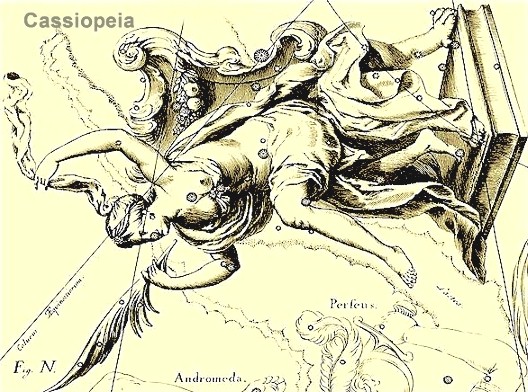
Hevelius,Firmamentum, 1690
History of the constellation
from Star Names 1889, Richard H. Allen
A place where Cassiopea sits within
Inferior light, for all her daughter’s sake.
— Mrs, Browning’s ParaphrasesonNonnus
Cassiopeia, or Cassiope more correctly Cassiepeia, although variously written, is one of the oldest and popularly best known of our constellations, and her throne, “the shinie Casseiopeia’s chair” of Spenser’s FaerieQueen, is a familiar object to the most youthful observer. It also is known as the Celestial when below the pole, and the Celestial when above it.
Hyginus, writing the word Cassiepia, described the figure as bound to her seat, and thus secured from falling out of it in going around the pole head downward, — this particular spot in the sky having been selected by the Cassiopeia (Page 143) queen’s enemies, the sea-nymphs, to give her an effectual lesson in humility, for a location nearer the equator would have kept her nearly upright. Aratos said of this:
She head foremost like a tumbler sits.
Her outstretched legs also, for a woman accustomed to the fashions of the East, must have added to her discomfort.
Euripides and Sophocles, of the fifth century before our era, wrote of her, while all the Greeks made much of the constellation, knowing it as Kassiepeia. and E tou thronou, “She of the Throne”. But at one time in Greece it was the LaconianKey, from its resemblance to that instrument, the invention of which was attributed in classical times to that people; although Pliny claimed this for Theodorus of Samos in Caria, 730 B.C., whence came another title for our stars, Carion. The learned Huetius (Huet, bishop of Avranches and tutor of the dauphin Louis XV) more definitely said that this stellar key represented that described by Homer as sickle-shaped in the wardrobe door of Penelope:
A brazen key she held, the handle turn’d,
With steel and polish’d elephant adorned;
and Aratos wrote of the constellation:
E’en as a folding door, fitted within
With key, is thrown back when the bolts are drawn.
But even Ideler did not understand this simile, although the outline of the chief stars well shows the form of this early key.
The Romans transliterated the Greek proper name as we still have it, but also knew Cassiopeia as MulierSedis, the Woman of the Chair; or simply as Sedes, qualified by regalis or regia; and as Sella and Solium. Bayer’s statement that Juvenal called it Cathedramollis was an error from a misreading of the original text. Hyde’s title Inthronata has been repeated by subsequent authors; and Cassiopeia’s Chair is the children’s name for it now.
The Arabians called it AlDhatalKursiyy, the Lady in the Chair, — Chilmead’s DhathAlcursi, — the Greek proper name having no signification to them; but the early Arabs had a very different figure here, in no way connected with the Lady as generally is supposed, — their KaffalHadib, {Page 144} the large Hand Stained with Henna, the bright stars marking the fingertips; although in this they included the nebulous group in the left hand of Perseus. Chrysococca gave it thus in the Low Greek Kheir bebamene; and it sometimes was the Handof, . . next to, thePleiades, while Smyth said that in Arabia it even bore the title of that group, AlThurayya, from its comparatively condensed figure.
The early Arabs additionally made TwoDogs out of Cassiopeia and Cepheus, from which may have come Bayer’s Canis; but his Cerva, a Roe, is not explained, although La Lande asserted that the Egyptian sphere of Petosiris had shown a Deer to the north of the Fishes. Al Tizini imagined a KneelingCamel from some of its larger stars, whence the constellation’s name Shuter found with Al Nasr al Din, and common for that animal in Persia.
The Alfonsinetables and AraboLatinAlmagest described the figure as habenspalmamdelibutam, “Holding the Consecrated Palm”, from some early drawing that is still continued; but how the palm, the classic symbol of victory and Christian sign of martyrdom, became associated with this heathen queen does not appear. Similarly La Lande cited Siliquastrum (Cercis siliquastrum, commonly known as Judas Tree), the name for a tree of Judaea, referring to the branch in the queen’s hand.
Bayer’s Hebrew title for it, AbenEzra, was by a misreading of Scaliger’s notes.
La Lande quoted Harnacaff from the MetamorphosesofVishnu, but the later Hindus said Casyapi, evidently from the classical word.
Grimm gives the Lithuanian Jostandis, from Josta, a Girdle, although without explanation.
As the figure almost wholly lies in the Milky Way, the Celts fixed upon it as their Llys Don, the Home of Don, their king of the fairies and father of the mythical character Gwydyon, who gave name to that great circle.Schiller’s Wallenstein, as versified by Coleridge, has
That one White stain of light, that single glimmering yonder,
Is from Cassiopeia, and therein
Is Jupiter —
a blunder on the part of the translator that has puzzled many, as “therein “should be “beyond” or “in that direction,” but even then what did the poet have in mind ?
In early Chinese astronomy our constellation was KoTaou according to Williams, although Reeves limited that title to the smaller nu, xi, omicron, and pi with {Page 145} the definition of a Porch-way; but later on its prominent stars were WangLiang, a celebrated charioteer of the Tsin Kingdom about 470 B.C.
As a stellar figure in Egypt Renouf identified it with the Leg, thus mentioned in the BookoftheDead, the Bible of Egypt, that most ancient ritual, 4000 years old or more:
Hail, leg of the northern sky in the large visible basin.
And in some constellated form its stars unquestionably were well known on the Euphrates with the rest of the Royal Family, and shown there on seals. The earthly Cassiopeia ought to have been black, and is so described by Milton in his verses of // Penseroso on
That starr’d Ethiop Queen that strove
To set her beauty’s praise above
The Sea-nymphs;
while Landseer with the same idea called her Cushiopeia, the Queen of Cush, or Kush, but the LeydenManuscript makes her of fair complexion, lightly clad, upright and unbound in a very uncomfortable chair; and such is the general representation. But in the 17th-century reconstruction of sky figures in the interests of religion, our Cassiopeia became MaryMagdalene; or Deborah sitting in judgment under her palm tree in Mount Ephraim; – or Bathsheba, the mother of Solomon, worthy to sit on the royal throne. The astrologers said that it partook of the nature of Saturn and Venus. Professor Young gives the word Bagdei as a help to memorizing the order of the chief components from their letters beta (Caph), alpha (Schedir), gamma (Cih), delta (Rucha), epsilon (Segin), iota; the last being the uppermost when the figure is on the horizon, hanging head downwards.
Cassiopeia lies between Cepheus, Andromeda, and Perseus, Argelander cataloguing 68 stars here, but Heis. 126; and the constellation is rich in clusters.
Star Names: Their Lore and Meaning, Richard H. Allen, 1889.]