The English word eagle comes from Latin aquila. The word aquila, eagle, is believed to mean ‘water-colored bird’ and is related to Latin aqua-, water, as is Aquarius [Klein]. In Britain before 1678, the word eagle referred specifically to the Golden Eagle (Aquila chrysaetos). The other native species, the white-tailed Eagle, being known as the erne [] which is a sea eagle (Haliaeetus albicilla) and a very close cousin of the American Bald Eagle. Aquila was a Roman military standard. Aquiline means having the characteristics of an eagle, or curved or hooked like an eagle’s beak: as in ‘an aquiline nose’.
From the Aquila name comes Eaglewood, Aquilariaagallocha, ‘aloewood‘, from Spanish aguila, ‘eagle’. The heartwood of Aquilaria species infected by certain fungi, is known as ‘agarwood’, agar, or Malay gaharu, and has a high commercial value for incense, perfume and traditional medicine. In Europe it was referred to as Lignum aquila (eagle-wood) or Agilawood, because of the similarity in sound of agila to gaharu
Erne, a sea eagle (Haliaeetus albicilla), is cognate with Greek ornis, ‘bird’, and German aar, eagle. And from a separate root the Greek word for eagle, aetos, is cognate with Latin avis, ‘bird’ [Klein under ‘aviary’]. The name of the alpha star of Aquila, Altair, is Arabic for ‘the bird”. The eagle is often regarded as the prototype of the bird as a species. The eagle is thought of as ‘king of birds’ and this might explain the reason why the word for eagle has cognates with the word for bird in some languages? Euripides (ca. 480 BC–406 BC) tells us that “the birds in general are the messengers of the gods, but the eagle is king, and interpreter of the great deity Jupiter” [].
Greek ornis, meaning bird, is an extension of an ancient stem *orn-, cognate with Old High German aro, arn (modern German aar eagle), Old English earn eagle, Old Slavic orilu, Welsh eryr, and Hittite haras (genitive haranas), from the Indo-European root *or- ‘Large bird’. Derivatives: erne (sea eagle, from Old English earn, eagle), ornitho– (bird, from Greek ornis, stem ornith-, bird), ornithology, Adler (eagle), Arnold. [Pokorny 1. er– 325. Watkins] In heraldry the allerion, meaning ‘noble eagle’ (German adal, ‘noble’, the –erion, related to erne) is an eagle with expanded wings.
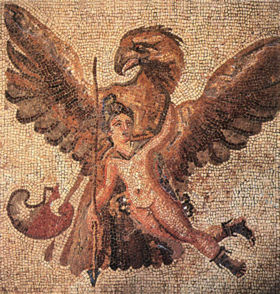
Ganymede and theEaglein a 3rd-century Roman mosaic, Nea Paphos, Cyprus. [
“I will raise you up on eagles wings” [Psalm 91:1-16].
The expression ‘eagle-eyed’ describes the eagle who sees all from a distance. Eagles fly higher so they get a look at the bigger picture. In mythology the Eagle acted like a talent scout for Zeus, instructed to find the most beautiful boy to be cup-bearer on Mount Olympus. With his ‘eagle eyes’, and far-seeing vision that can spot a rabbit three miles away (but has poor close-up vision), metaphorically possessing foresight, and hence the ability to see the potential. He captured Ganymedes (Aquarius) ‘the most beautiful boy’, in his talons.
Livy tells how an eagle seized the cap of Lucius Tarquinius, flew up with it into the sky, then descended and replaced it on his head. His wife Tanaquil, who knew how to interpret omens, told him to look for a high and majestic destiny, for such was the import of the eagle’s action. He went on to become the seventh king of Rome. Lucius Tarquinius was, in effect, inaugurated by the eagle. Inaugurate from Latin auger, seems to have meant literally “one who performs with birds,” from avis ‘bird’ [].
“Aquila the Eagle is called so from the acuteness (acumine) of his eyes, for he is said to have such wonderful eyesight that, when he is poised above the seas on motionless plume – not even visible to the human gaze – yet from such a height he can see the little fishes swimming, and, coming down like a thunderbolt, he can carry off his captured prey to the shore, on the wing.” [The Book of Beasts: Being a Translation from a Latin Bestiary of the Twelfth Century, p.105]
Eagles are also said to represent the rise towards Heaven:
“It was a widely used custom in many ancient cultures to release eagles at the funeral of a ruler: the flight of an eagle, as the body was cremated, symbolized the departure of the soul to live among the gods. In Christian iconography the eagle is often seen to symbolize John the Evangelist, the ascension of the prophet Elijah, and the ascension of Jesus Christ” [].
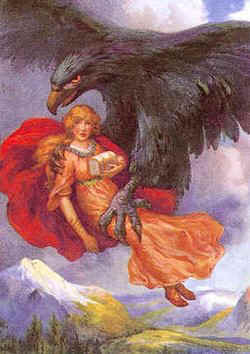
Iðunn is carried off byÞjaziin this artwork by H. Theaker, 1920.Wikipedia
Aquila is said to be the Eagle that preyed on the liver of Prometheus in the Caucasian Mountains; and had the titles Aquila Promethei and Tortor Promethei: and The Eagle Kaukasios [Allen, Star Names].
Zeus baiting Typhon said: “let crafty Prometheus leave his chains, and come with you; the bold bird who makes hearty meals off that rejuvenescent liver shall show him the way to heaven” [].
In Norse mythology the giant Thiassi had the ability to turn himself into an eagle. Thiassi arrived in eagle shape and snatched Idunn and flew away with her to his home in Thrymheim [].
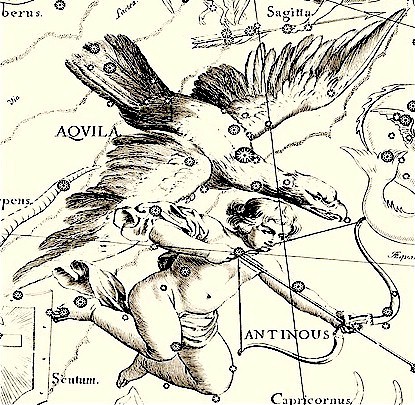
Hevelius,Firmamentum, 1690
The relationship between the Emperor Hadrian and Antinous was compared with that between Zeus and Ganymedes (Aquarius) (the emperor was, after all, considered to be a god) [] Ganymedes is identified with Aquarius
Antinous was a former constellation south of Aquila. In modern times, Antinous was variously considered an asterism within Aquila, or a separate constellation, until IAU formalized the constellations in 1930, when Antinous was discarded.” [] “The origins of this obsolete constellation date back to the year 132 and the Emperor Hadrian. He had this constellation placed in the sky to honor a favorite youth of his court, who according to myth sacrificed himself in order to prolong the life of the emperor. Later astronomers recognized this constellation as the youth Ganymede, who the Greek god Zeus had brought to Olympus by his eagle Aquila, in order to serve as cup-bearer to the gods. The stars of this constellation have since been given to the constellation of Aquila.” [Obsolete Constellations]
Aetites (Greek aetos, an eagle), also called Aquilaeus or eagle-stone, is a stone said to have magical properties, particularly connected to childbirth, and in the Mesopotamian legend of Etana travels on the back of an eagle to find a herb to ease his wife’s pain in childbirth:
“the hero, Etana, wanting to ease the pain his wife was feeling during childbirth, rode on the back of the god Shamash’s eagle to the heavens to retrieve a medicinal plant that would relieve her pain. The magical plant was only found in the upper reaches of heaven where Anu lived. While Etana rode on the back of the eagle he noticed that the earth was becoming smaller and smaller, lost his nerve, and according to some versions of the story, his grip. One description of the legend has him living for 1,560 years and leaving only two children. A second version has him crashing to earth for daring to attempt to enter the realm of Anu. The mythical plant may actually be the poisonous mountain arnica which, when taken in controlled doses, does ease the pain of childbirth” [The Glorious Constellations, Giuseppe Maria Sesti].
Giuseppe Maria Sesti postulates that the mythical plant may be arnica; the prefix arn– resembles Old English earn, eagle, as in the name Arnold
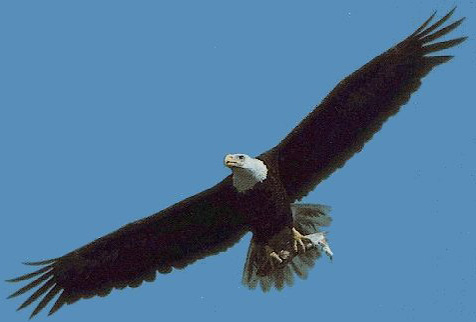 The word prayer is a possibility? Eagles, the chief birds of prey, were believed to be carriers of prayers to the sky []. “Medieval mystics often invoked the eagle to evoke the vision of God and compared prayer with the eagle’s soaring flight into the sunlight” []. The story of Ajax below is said to be based on the appearance of an eagle sent by Zeus in response to Heracles prayer to Zeus to send a brave son to his friend Telamon. Prayer is from the Indo-European root *prek, ‘To ask, entreat’. Derivatives: pray, prayer¹, precarious, deprecate, imprecate, priedieu, (these words from *prex, prayer), postulate, expostulate, (these words from Latin postulare, to ask, request), postulant (a candidate for admission into a religious order.) [Pokorny 4. perk– 821. Watkins
It seems that being carried by an eagle is a precarious position to be in. While Mesopotamian Etana was being carried heavenwards by an eagle, he became afraid, the eagle faltered, and they fell to earth, the second ascent was successful. And Zeus in the form of an eagle was not too sure of himself either while carrying Ganymedes; “Zeus appeared to be anxious as he flew through the air, holding the terrified boy with claws that tore not, gently moving the wings and sparing his strength, for he feared Ganymede might slip and fall headlong from the sky” (Nonnus, Dionysiaca 25.430 ) [].
Aetites (Greek aetos, an eagle), also called Aquilaeus or eagle stone, is a stone said to have magical properties, particularly connected to childbirth. Supposed at one time to form part of an eagle’s nest. Pliny mentions them. It is said that without these stones eagles cannot hatch their eggs. The stones are a hollow oval nodule of yellow clay ironstone, the nucleus of which, being of a different texture, had by drying become detached from the surrounding crust so as to rattle loosely. There was an ancient belief that the eagle found it necessary to have one in her nest before she could lay her eggs.
Maybe the aetites stone are similar to Russian nesting doll (matryoshka), where the top and bottom come apart to reveal a smaller, similar doll inside that similarly comes apart, and so on. Philosophers and theologians have conjectured that every individual existed as a homunculus in Adam’s testicles (spermism) or Eve’s ovaries (ovism), the hypothesis that each embryo could contain even smaller embryos ad infinitum, like a Matryoshka doll; spermists claimed the homonculus must come from the man, and ovists, who located the homonculus in the ova [].
The eagle is Jove’s guardian, called his armsbearer (armiger) because so full of heat that the coldest giant stone rattles, when warmed under a breeding eagle, as if an egg, according to Lucan [Medieval Mythography Jane Chance. P. 313].
Isidore says:
“The eagle (aquila) is named from the acuity of its vision (acumenoculorum), for it is said that they have such sight that when they soar above the sea on unmoving wings, and invisible to human sight, from such a height they can see small fish swimming, and descending like a bolt seize their prey and carry it to shore with their wings. It is said that the eagle does not even avert its gaze from the sun; it offers its hatchlings, suspended from its talons, to the rays of the sun, and the ones it sees holding their gaze unmoving it saves as worthy of the eagle family, but those who turn their gaze away, it throws out as inferior.” [The Etymologies of Isidore of Seville, 7th century AD, p.264.]
Porphyry on why Zeus is pictured holding an eagle in his right hand:
“because he is master of the gods who traverse the air, as the eagle is master of the birds that fly aloft – or a victory, because he is himself victorious over all things.” [On Images, Porphyry, trans. E.H. Gifford]
Aquilo is the word the Romans used for the north wind, which the Greeks called Boreas, it brought the cold winter air. Aquilo is believed to be from aquilus, ‘dark-colored’, as aquila, ‘eagle’, properly means ‘the dark-colored (bird)’:
In many countries the wind has been conceived as a mighty bird of prey which seizes and carries things away. In Greek aetos, the eagle, must have originally been the keen-winged bird, being akin to aetes, wind (from aemi, to blow), just as among the Romans Aquilo, the sharp northeaster was closely related to aquila, the eagle, the idea of forcible keenness being common to both (root ac, sharp, in ac-er, ac-uo, etc.). Quite similarly in Etruscan andas, the north-wind, antae, winds, seem to claim kinship with antar, the eagle; and in Finnish Pulmri, a personification of the north wind, wears the form of an eagle. [Some curios from a word-collector’s cabinet, Abram Smythe Palmer, p.149-150]
Other mythological characters: The name according to Pindar, Ajax (Greek Aias), is said to be based on the appearance of an eagle (Gk. aietos) sent by Zeus in response to Heracles prayer to Zeus to send a brave son to his friend Telamon. He was described as vicious, fearless, strong and powerful but also with a very high level of combat intelligence. Ajax kills himself after failing to obtain Achilles’ armour.
Another possible cognate of both Greek aietos, eagle, and Ajax (Greek Aias), is the Greek exclamation aiai. In Sophocles’ drama, the hero Ajax connects his name to a Greek lament, aiai. The name Ajax was Aias (Αιας) in the original Greek aiai (αιαι) is an exclamation of grief which we might translate by the old-fashioned phrase “woe is me” or “woe!”. In the text Ajax also used the word aiazein (αιαζειν) “to wail” or “to cry aiai” [Yahoo Answers]
In Greek myth, the hyacinth was said to have markings on it similar to the Greekai ai which means “Alas!” referring to Hyacinthus, was struck by the discus as it fell to the ground, and died
The astrological influences of the constellation given by Manilius:
“Then soars to the heights the bird of mighty Jupiter as though, winging its way with wonted effort, it were carrying thunderbolts; it is a bird worthy of Jupiter and the sky, which it furnishes with awful armaments.” [Manilius,Astronomica, 1st century A.D, p.31]
Now I shall tell of the constellation of the Eagle : it rises on the left [translator’s note: an error: Aquila, a northern constellation, rises on Aquarius’s right] of the youth who pours, whom once it carried off from earth [the poet here identifies Aquarius as Ganymede], and with wings outspread it hovers above its prey [translator’s note: another error (shared with Hyginus, Poet. Astr. 2. 16): Aquila hovers above Capricorn and Sagittarius rather than Aquarius]. This bird brings back the thunderbolts which Jupiter has flung and fights in the service of heaven. He that is born on earth in the hour of its rising, will grow up bent on spoil and plunder, won even with bloodshed; he will draw no line between peace and war, between citizen and foe, and when he is short of men to kill he will engage in butchery of beast. He is a law unto himself, and rushes violently wherever his fancy takes him; in his eyes to show contempt for everything merits praise. Yet, should perchance his aggressiveness be enlisted in a righteous cause, depravity will turn into virtue, and he will succeed in bringing wars to a conclusion and enriching his country with glorious triumphs. And, since the Eagle does not wield, but supplies weapons, seeing that it brings back and restores to Jupiter the fires and bolts he has hurled, in time of war such a man will be the aide of a king or of some mighty general, and his strength will render them important service”. [Astronomica, Manilius, 1st century AD, book 5, p.341.].
© Anne Wright 2008.
| Fixed stars in Aquila | |||||||
| Star | 1900 | 2000 | R A | Decl 2000 | Lat | Mag | Sp |
| 12 | 14CAP40 | 16CAP03 | 19h 1m 40.8s | -5° 44′ 20″ | +16 51 07 | 4.15 | K1 |
| lambda (λ) | 15CAP57 | 17CAP20 | 19h 6m 14.9s | -4° 52′ 57″ | +17 34 23 | 3.55 | B9 |
| epsilon (ε) | 16CAP53 | 18CAP16 | 18h 59m 37.4s | +15° 4′ 6″ | +37 34 27 | 4.21 | K0 |
| Dheneb zeta (ζ) | 18CAP24 | 19CAP48 | 19h 5m 24.6s | +13° 51′ 48″ | +36 11 34 | 3.02 | B9 |
| Deneb Okab delta (δ) | 22CAP14 | 23CAP38 | 19h 25m 29.9s | +3° 6′ 53″ | +24 49 20 | 3.44 | A5 |
| iota (ι) | 24CAP27 | 25CAP50 | 19h 36m 43.3s | -1° 17′ 11″ | +20 00 57 | 4.28 | B8 |
| eta (η) | 29CAP03 | 0AQU26 | 19h 52m 28.4s | +1° 0′ 20″ | +21 31 43 | var | G0 |
| Tarazed gamma (γ) | 29CAP33 | 00AQU56 | 19h 46m 15.6s | +10° 36′ 48″ | +31 14 56 | 2.80 | K3 |
| Altair alpha (α) | 00AQU22 | 01AQU47 | 19h 50m 47s | +8° 52′ 6″ | +29 18 18 | 0.77 | A7 |
| Alshain beta (β) | 01AQU02 | 02AQU25 | 19h 55m 18.8s | +6° 24′ 24″ | +26 40 16 | 3.90 | G8 |
| theta (θ) | 03AQU32 | 04AQU55 | 20h 11m 18.3s | -0° 49′ 17″ | +18 43 58 | 3.37 | B9 |
from Star Names: Their Lore and Meaning 1889, Richard H. Allen
Aquila the Eagle, is the French Aigle, the German Adler, and the Italian Aquila, next to and westward from the Dolphin, is shown flying toward the east and across {Page 56} the Milky Way; its southern stars constituting the now discarded Antinous. Early representations added an arrow held in the Eagle’s talons; and Hevelius included a bow and arrow in his description; but on the Heis map the Youth is held by Aquila, for the Germans still continue this association in their combined title derAdiermitdemAntinous
Our constellation is supposed to be represented by the bird figured on a Euphratean uranographic stone of about 1200 B.C., and known on the tablets as IdkhuZamama, the Eagle, the Living Eye.
It always was known as Aquila by the Latins, and by their poets as JovisAles and JovisNutrix, the Bird, and the Nurse, of Jove; JovisArmiger and ArmigerAles, the Armor-bearing Bird of Jove in this god’s conflict with the giants; while GanymedesRaptrix and ServansAntinoum are from the old stories that the Eagle carried Ganymede to the heavens and stood in attendance on Jove. Ovid made it Merops, King of Cos, turned into the Eagle of the sky (he was inconsolable over the death of his wife, and Hera placed him among the stars); but others thought it some Aethiopian king like Cepheus, and with the same heavenly reward.
As the eagles often were confounded with the vultures in Greek and Roman ornithology, at least in nomenclature, Aquila also was Vulturvolans, the stars beta and gamma, on either side of alpha, marking the outstretched wings; this title appearing even as late as Flamsteed’s day, and its translation, the Flying Grype, becoming the Old English name, especially with the astrologers, who ascribed to it mighty virtue.
Aetos, the Eagle, in a much varied orthography, was used for our constellation by all the Greeks; while poetically it was Dios Ornis, the Bird of Zeus; and Pindar had Oinon Basileus, the King of Birds, which, ornithologically, has come to our day. Later on it was Basanos and Basanismos (from basanizo; torture. Basanos is Greek for touchstone. Such a touchstone may be a piece of slate used to test gold, or it may be a metaphor for torture or torment to test truthfulness [1]), all kindred titles signifying Torture, referred by Hyde to the story of the eagle which preyed on the liver of Prometheus. Similarly we find AquilaPromethei and TortorPromethei; but Ideler said that this idea came from a confounding by Scaliger of the Arabic Ikab, Torture, and Okab, Eagle.
Dupuis fancifully thought that its name was given when it was near the summer solstice, and that the bird of highest flight was chosen to express the greatest elevation of the sun; and he asserted that the famous three Stymphalian Birds of mythology were represented by Aquila, Cygnus, and Vultur cadens, our Lyra, still located together in the sky; the argument being that these are all paranatellons of Sagittarius, which is the fifth in the line of zodiacal constellations beginning with Leo, the Nemean lion, the object of Hercules’ first labor, while the slaying of the birds was the fifth. Appropriately enough, like so much other stellar material, these creatures {Page 57} came from Arabia, migrating thence either to the Insula Martis, or to Lake Stymphalis, where Hercules encountered them.
Thompson thinks that the fable, in Greek ornithology, of the eagle attacking the swan, but defeated by it, is symbolical of “Aquila, which rises in the East, immediately after Cygnus, but, setting in the West, goes down a little while before that more northern constellation.”
A similar thought was in the ancient mind as to the eagle in opposition to the dolphin and the serpent; their stellar counterparts, Aquila, Delphinus, and Serpens, also being thus relatively situated.
In connection with the story of Ganymede, the eagle appeared on coins of Chalcis, Dardanos, and Ilia; and generally on those of Mallos in Cilicia and of Camarina; while it is shown perched on the Dolphin on coins of Sinope and other towns, chiefly along the Black Sea and Hellespont. One, bearing the prominent stars, was struck in Rome, 94 B.C., by Manius Aquilius Nepos, the design being evidently inspired by his name; and a coin of Agrigentum bears Aquila, with Cancer on the reverse, — the one setting as the other rises.
To the Arabians the classical figure became Al ‘Okab, probably their Black Eagle, Chilmead citing this as Alhhakhab; while their AlNasralTair, the Flying Eagle, was confined to alpha, beta, and gamma; although this was contrary to their custom of using only one star for a sky figure. Grotius called the whole Altair and Alcair; Bayer said Alcar and Atair. Al Achsasi, however, mentioned it as AlGhurab, the Crow, or Raven, probably a late Arabian name, and the only instance that I have seen of its application to the stars of our Aquila.
Persian titles were Alub, Gherges, and Shahintarazed, the Star-striking Falcon of Al Nasr al Din, but now divided for beta (Alshain) and gamma (Tarazed). In the IlkhanianTables, as perhaps elsewhere, it was Gups Petomenos, the Flying Vulture; the Turks call it Taushaugjil, their Hunting Eagle; — all these for the three bright stars.
The Hebrews knew it as Neshr, an Eagle, Falcon, or Vulture; and the ChaldeeParaphrase asserted that it was figured on the banners of Dan; but as these tribal symbols properly were for the zodiac, Scorpio usually was ascribed to Dan. This confusion may have originated from the fact, asserted by Sir William Drummond, that in Abraham’s day Scorpio was figured as an Eagle. Caesius said that Aquila represented the EagleofmilitaryRome, or the EagleofSaintJohn; but Julius Schiller had already made it SaintCatherinetheMartyr; and Erhard Weigel, a {Page 58} professor at Jena in the 17th century, started a new set of constellations, based on the heraldry then so much in vogue, among which was the Brandenburg Eagle, made up from Aquila, Antinous, and the Dolphin (Delphinus). Hevelius said that the stellar Eagle was a fitting representation of that bird on the Polish and Teutonic coats of arms.
The Chinese have here the DraughtOxen, mentioned in the book of odes entitled SheKing, compiled 500 years before Christ by K’ung fu tsu, Kung the Philosopher (Confucius), — the passage being rendered by the Reveiend Doctor James Legge:
Brilliant show the Draught Oxen,
But they do not serve to draw our carts;
and the three bright stars are their Cowherd, for whom the Magpies’ Bridge gives access to the SpinningDamsel, our Lyra, across the River of the Sky, the Milky Way. This story appears in various forms; stars in the Swan (Cygnus) sometimes being substituted for those in the Eagle, Lyra becoming the WeavingSisters
The Korean version, with more detail, turns the Cowherd into a Prince, and the Spinster into his Bride, both banished to different parts of the sky by the irate father-in-law, but with the privilege of an annual meeting if they can cross the River. This they accomplish through the friendly aid of the good-natured magpies, who congregate from all parts of the kingdom during the 7th moon, and on its 7th night form the fluttering bridge across which the couple meet, lovers still, although married. When the day is over they return for another year to their respective places of exile, and the bridge breaks up; the birds scattering to their various homes with bare heads, the feathers having been worn off by the trampling feet of the Prince and his retinue. But as all this happens during the birds’ molting-time, the bare heads are not to be wondered at; nor, as it is the rainy season, the attendant showers which, if occurring in the morning, the story-tellers attribute to the tears of the couple in the joy of meeting; or if in the evening, to those of sorrow at parting. Should a magpie anywhere be found loitering around home at this time, it is pursued by the children with well-merited ill-treatment for its selfish indifference to its duty. Nor must I forget to mention that the trouble in the royal household originated from the Prince’s unfortunate investment of the paternal sapekes in a very promising scheme to tap the Milky Way and divert the fluid to nourish distant stars.
Another version is given by the Reverend Doctor William Elliot Griffis in his Japanese Fairy World, where the Spinning Damsel is the industrious princess Shokujo, separated by the Heavenly River from her herd-boy lover, {Page 59} Kinjin. But here the narrator makes Capricorn and the star Wega represents the lovers.
The native Australians knew the whole of Aquila as Totyarguil, one of their mythical personages, who, while bathing, was killed by a kelpie; their stellar Eagle being Sirius.
It was in the stars of our constellation, to the northwest of Altair, that Professor Edward E. Bamard discovered a comet from its trail on a photograph taken at the Lick Observatory on the 12th of October, 1892 — the first ever found by the camera.
Star Names: Their Lore and Meaning, Richard H. Allen, 1889.]