| Fixed star: ZUBEN ELAKRAB | |
| Constellation: Gamma (γ) Libra | |
| Longitude 1900: 23SCO44 | Longitude 2000: 25SCO08 |
| Declination 1900: -14.27′ | Declination 2000: -14.46′ |
| Right ascension: 15h 35m | Latitude: +04.23′ |
| Spectral class: G6 | Magnitude: 4.0 |
The history of the star: Zuben Elakrab
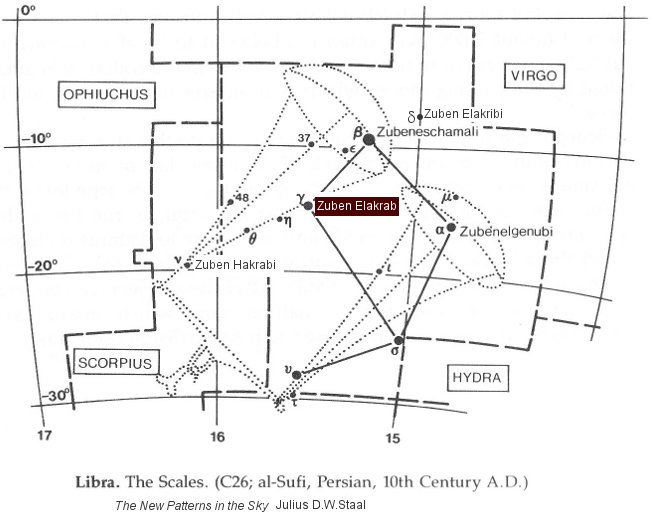
Gamma (γ Libra), Zuben Elakrab, is a fourth-magnitude star in the middle of the northern Claw (Zubenelschemali) or scale of Libra.
Wikipedia says gamma Libra “also has the traditional name Zuben-el-Akrab, meaning “Shears of the Scorpion”. The name is a modification of the Arabic al-Zuban al-Aqrab. Alternate modifications of the phrase include Zuben el Hakrabi and Zuben Hakraki.”
The two scales of Libra are marked by two stars which Bullinger (in The Witness of the Stars) called the Price of the Deficient (α Zuben Algenubi) balanced by the Price which Covers (β Zubenelschemali) and added “but there is a third star, gamma, below, towards Centaurus and the Victim slain (Lupus), telling, by that and by its name, of the conflict by which that redemption would be accomplished. It is called Zuben Akrabi or Zuben al Akrab, which means ‘the price of the conflict!'” [The Witness of the Stars, Ethelbert W. Bullinger, 1893]
The Lunar Mansions
Alpha (α Zuben Elgenubi) marked the nakshatra (Hindu Moon Mansion) Vicakha, Branched, under the rule of Indragni, the dual tutelar divinity Indra and Agni. This lunar station was figured as a decorated Gateway, and in later Hindu astronomy its borders were extended to include this star gamma (γ Zuben Elakrab) and iota (ι), thus completing the resemblance to the object for which the asterism was named; iota (ι) was the junction star with Anuradha. [Star Names, p.275]
Influences of 14th Hindu Moon Mansion Vicakha or Vishaka: Ruled by Jupiter. A soft and sharp asterism belonging to the lowest caste and producing mixed effects. Those born on the lunar day will be religious, dealers in produce, and fond of red flowers. With Moon here at birth native will be jealous, mean, miserly, good-looking, clever in speech, and quarrelsome. Rules cotton fields and the nipples. [Robson, p.81.]
The astrological influences of the constellation Libra
History and Legend: Libra was not considered a separate constellation by the ancients and was called Chelae, or the Claws of Scorpio, which sign was made to consist of 60°. The present constellation figure is said to represent the balance wherein Astraea weighed the deeds of men and presented them to Jupiter. [Robson, p.49.]
Influences: Ptolemy makes the following observations: “Those stars at the points of the claws of Scorpio operate like Jupiter and Mercury: those in the middle of the claws, like Saturn, and in some degree like Mars.” By the Kabalists, Libra is associated with the Hebrew letter Heth and the 8th Tarot Trump “Justice”. [Robson, p.49-50.]
The astrological influences of the constellation Libra given by Manilius:
“Balancing night with the length of day when after a year’s space we enjoy the new vintage of the ripened grape, the Scales will bestow the employment of weights and measures and a son to emulate the talents of Palamedes, who first assigned numbers to things, and to these numbers names, fixed magnitudes, and individual symbols. He will also be acquainted with the tables of law, abstruse legal points, and words denoted by compendious signs; he will know what is permissible and the penalties incurred by doing what is forbidden; in his own house he is a people’s magistrate holding lifelong office. Under no other sign would Servius [Servius Sulpicius Rufus, ca. 106-43 BC, extolled as the greatest of jurists by Cicero] more fittingly have been born, who in interpreting the law framed legislation of his own. Indeed, whatever stands in dispute and needs a ruling the pointer of the Balance will determine” [Manilius, Astronomica, 1st century AD, book 4, p.239]
References:
Fixed Stars and Constellations in Astrology, Vivian E. Robson, 1923].